




The global smartphone landscape in 2026 continues to evolve at a breathtaking pace, pushing technologies that were once exclusive to ultra-expensive ultra-flagships down into the mid-range and "flagship killer" segments. Among the most anticipated clashes of the year is the fierce rivalry between Poco and OnePlus. With the introduction of the Poco F9 Pro and the OnePlus 15R, consumers are presented with two distinct philosophies of mobile engineering. On one hand, you have Poco, a brand synonymous with uncompromising raw performance, aggressive pricing, and gamer-centric features. On the other hand, OnePlus represents polished refinement, clean software ecosystems, premium tactile designs, and balanced everyday reliability.
Choosing between these two heavyweights is no simple task. Both devices target power users, mobile gamers, and photography enthusiasts who refuse to spend upwards of a thousand dollars on a phone. In this exhaustive, in-depth comparison, we will dissect every single aspect of the Poco F9 Pro and the OnePlus 15R—from design ergonomics and display technology to thermal efficiency, gaming benchmarks, camera versatility, and battery endurance—to determine which smartphone truly deserves a spot in your pocket.
1. Design Aesthetics and Build Quality
First impressions matter, and both manufacturers have invested heavily in ensuring their devices look and feel distinct. However, their approaches diverge significantly when it comes to material choices and form factor ergonomics.
The Poco F9 Pro leans into an assertive, dynamic aesthetic. It features a rugged yet stylish chassis designed to appeal to younger demographics and mobile gamers. The back panel incorporates advanced texture treatments that resist fingerprint smudges while providing a secure grip during intense gaming sessions. The camera module is housed in a prominent geometric island that projects confidence and modern industrial styling. Despite packing massive cooling hardware underneath, Poco has managed to keep the device remarkably slim, though it retains a solid, reassuring heft that signals durability.
Conversely, the OnePlus 15R adheres to a philosophy of minimalist elegance. OnePlus has refined its signature curves and matte glass finishes to deliver an exceptionally premium tactile experience. The device feels like a true flagship when held, with seamless transitions between the aluminum frame and the curved glass back. The alert slider, a fan-favorite hardware staple, continues to offer tactile convenience. If your preference leans toward understated sophistication that looks at home in a corporate boardroom as well as a casual setting, the OnePlus 15R takes an early lead in pure aesthetic polish.
2. Display Technology and Visual Immersion
A smartphone's display is your primary window into the digital world, and neither Poco nor OnePlus has cut corners here. Both devices feature high-end AMOLED panels equipped with adaptive refresh rates, vibrant color reproduction, and high peak brightness levels for outdoor legibility under direct sunlight.
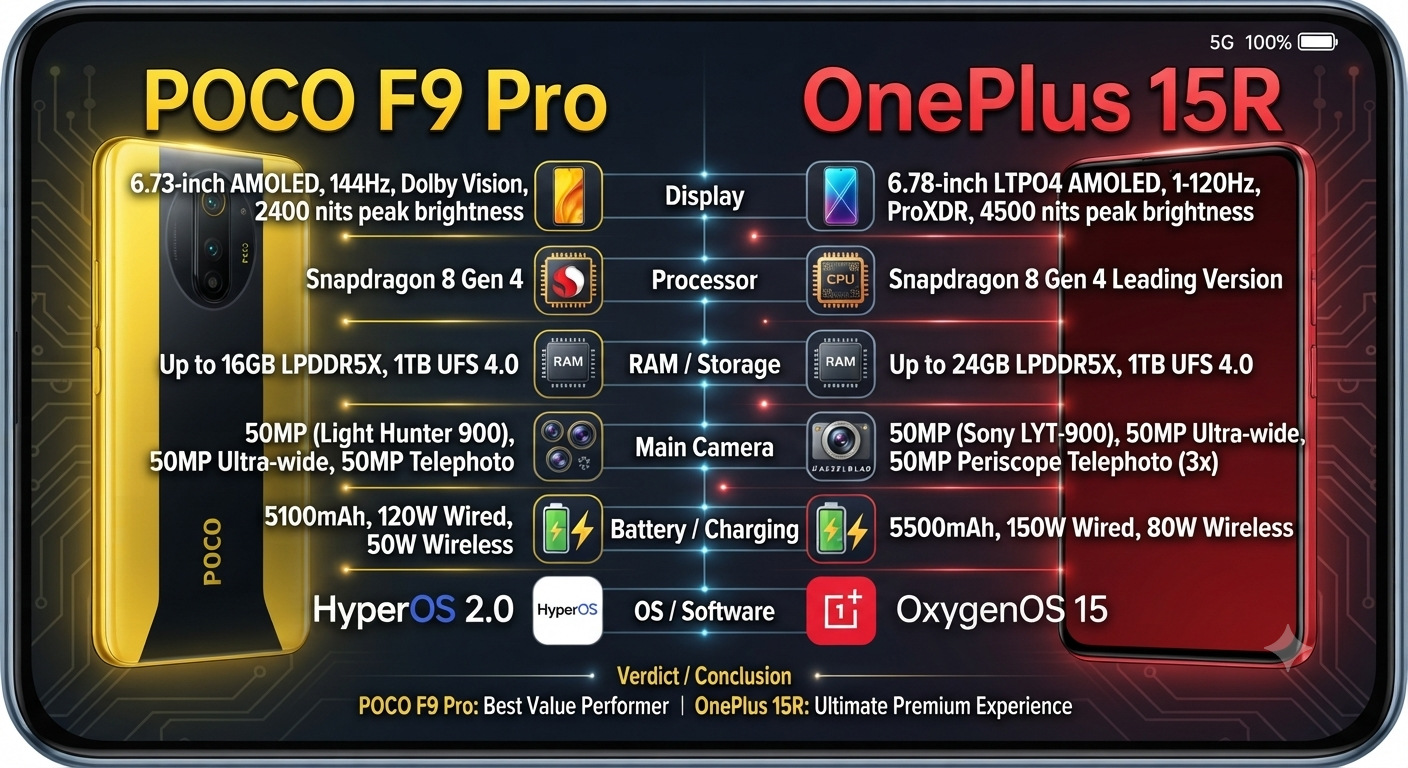
The Poco F9 Pro sports a expansive 6.7-inch 144Hz AMOLED display. This ultra-high refresh rate gives it a unique edge in competitive mobile gaming and fast-paced UI navigation, making every swipe and animation feel instantaneous. Touch sampling rates are exceptionally high, ensuring zero perceptible input lag. Color accuracy is vibrant, with HDR10+ certification and Dolby Vision support ensuring that streaming movies or playing visually rich open-world games is an absolute treat for the eyes.
The OnePlus 15R counters with a gorgeous 6.7-inch 120Hz LTPO 3.0 AMOLED panel. While its maximum refresh rate is slightly lower on paper than the Poco's 144Hz, the LTPO technology allows the display to dynamically scale its refresh rate all the way down to 1Hz depending on the content on screen, optimizing battery life significantly during static reading or browsing. OnePlus’s color calibration is renowned for its natural tone accuracy, making it an ideal choice for photo editors and media purists who prefer true-to-life color reproduction over hyper-saturated punchiness.
3. Performance and Processing Hardware
Underneath the hood, this is where the gloves come off. Both the Poco F9 Pro and the OnePlus 15R are built to shred through demanding tasks, heavy multitasking, and graphic-intensive 3D gaming without breaking a sweat.
The Poco F9 Pro packs top-tier Qualcomm Snapdragon silicon paired with blazing-fast LPDDR5X RAM and UFS 4.0 storage. Poco has integrated a massive vapor chamber cooling system equipped with graphite layers and optimized thermal algorithms. This hardware configuration ensures that thermal throttling is kept to an absolute bare minimum during extended gaming marathons. Benchmarks reveal blistering multi-core CPU scores and graphical performance that easily trades blows with devices costing twice as much. If your primary requirement is maximum raw computational muscle and sustained peak frame rates, the Poco F9 Pro is an absolute powerhouse.
The OnePlus 15R utilizes a finely tuned variant of flagship silicon optimized for efficiency and sustained daily responsiveness. OnePlus excels in software-hardware integration. Through memory expansion technology and deep system-level optimizations, the phone maintains hundreds of apps in the background without stuttering or reloading. While synthetic benchmark scores might lean marginally in favor of the Poco during sustained maximum loads, the real-world fluidity of the OnePlus 15R is legendary. Apps open instantly, animations never drop frames, and multitasking feels entirely effortless.
4. Software Ecosystems and User Experience
Hardware is only half the battle; the software experience dictates how you interact with your device every single day. Here, the contrast between the two brands is stark and will heavily influence your purchasing decision.
The Poco F9 Pro runs on HyperOS (based on Android). HyperOS offers an immense degree of customization, allowing users to tweak everything from lock screen widgets and icon packs to advanced gaming dashboard settings. It features dedicated floating windows, extensive game turbo toolbars that let you alter voice changers and performance modes on the fly, and robust theme stores. However, it can occasionally come with pre-installed promotional apps (bloatware) that require a few minutes of cleanup upon initial setup.
The OnePlus 15R runs OxygenOS (based on Android), celebrated for its clean, near-stock Android aesthetic coupled with thoughtful productivity enhancements. OxygenOS eschews clutter, providing a streamlined, ad-free environment that prioritizes speed and simplicity. Features like Zen Mode, Shelf, and highly responsive gesture controls make it a joy to use for users who prefer a distraction-free, highly organized digital workspace. OnePlus also promises a robust software support lifecycle, ensuring your device remains secure and up-to-date with the latest Android features for years to come.
5. Camera System and Photographic Versatility
Mid-range phones used to compromise heavily on camera performance, but 2026 models bridge that gap dramatically. Both phones offer versatile multi-lens arrays, but their imaging science and output characteristics differ notably.
The Poco F9 Pro focuses on high-resolution sensors and advanced AI computational photography. Its primary high-megapixel main camera captures an incredible amount of fine detail, making it fantastic for cropping into landscapes or shooting urban architecture. Night mode algorithms leverage multi-frame noise reduction to pull clean, bright images out of dark environments. Additionally, AI-driven portrait enhancements and creative filters make social-media sharing seamless straight out of the camera roll.
The OnePlus 15R takes a more balanced approach, incorporating optimized sensor hardware. Known for its tuning partnership heritage, OnePlus delivers stunningly accurate skin tones, excellent dynamic range, and consistent white balance across all lenses. The ultrawide camera minimizes edge distortion effectively, while the telephoto capabilities allow for crisp medium-range zoom shots. Video recording on the OnePlus 15R is particularly stellar, offering rock-solid electronic and optical image stabilization, cinematic color profiles, and crystal-clear audio capture.
6. Battery Endurance and Charging Speeds
Power anxiety is a thing of the past with both of these devices, though their charging philosophies cater to slightly different user habits.
The Poco F9 Pro houses a massive high-density battery paired with hyper-fast charging technology. It can rocket from zero to a full charge in under twenty minutes using its bundled high-wattage charger. For users who forget to plug in overnight and need a lightning-fast top-up while getting ready in the morning, Poco’s charging speed is nothing short of miraculous.
The OnePlus 15R features an equally impressive battery paired with super-fast charging. Thanks to the power-efficient LTPO display and intelligent background power management, the OnePlus 15R often stretches battery life even further during mixed daily usage, easily surviving a full day and a half of heavy texting, navigation, and media streaming before needing a refill.
Final Verdict: Which Smartphone Should You Buy?
Concluding our extensive analysis, the Poco F9 Pro and the OnePlus 15R are both magnificent triumphs of engineering that redefine what we expect from mid-range flagships in 2026.
- Choose the Poco F9 Pro if you are a hardcore mobile gamer, media consumer, or power user who demands the absolute highest refresh rate display, raw processing muscle, and lightning-fast charging speeds for the best possible value.
- Choose the OnePlus 15R if you value refined tactile design, a clean and clutter-free software experience, superior video recording, natural camera color science, and incredible daily battery efficiency.
Which of these two powerhouse contenders fits your daily workflow better? Share your thoughts and let us know your pick in the comments section below!