




Quick Summary
Tesla expanded its Robotaxi service to Orlando and Tampa in July 2026, bringing its total footprint to seven US metropolitan areas just over a year after the program's June 2025 launch in Austin. The expansion arrived a day before Tesla's second-quarter earnings call, where executives highlighted growing autonomous mileage — though a closer look at Tesla's own reported numbers shows the pace of growth may be flattening rather than accelerating.
Key Takeaways
- Tesla now operates Robotaxi service in seven US cities: Austin, Dallas, Houston, Phoenix, Miami, Orlando, and Tampa
- The company reported more than 380,000 driverless miles without a safety monitor as of its Q2 2026 earnings call
- Quarter-over-quarter paid mileage reportedly stayed roughly flat between Q1 and Q2 2026, despite new city launches
- CEO Elon Musk has repeatedly said safety testing, not technology, is the limiting factor on expansion speed
From Austin to Seven Cities in Just Over a Year
Tesla's Robotaxi program began quietly in June 2025, with a small fleet of Model Ys operating in Austin, Texas under human safety supervision. Since then, the service has expanded steadily: Dallas and Houston earlier in 2026, Miami earlier this month, and now Orlando and Tampa, added within days of each other in late July. The timing of the Florida expansion — announced the day before Tesla's Q2 earnings call — was widely read as an attempt to give investors fresh momentum to point to heading into the results.
Unlike Waymo, which relies on lidar sensors for its autonomous system, Tesla's approach uses cameras paired with AI-based software, a distinction the company has defended as more scalable but which has also drawn scrutiny from analysts comparing safety records between the two systems.
What Tesla Reported on the Earnings Call
During the Q2 2026 call, Tesla's VP of AI said the company has now logged more than 380,000 miles driven without a safety monitor present in the vehicle — a milestone the company presented as evidence of growing confidence in the system's reliability. Executives, including Musk, framed the Florida expansion and the mileage figures together as proof that the program continues to scale.
The More Complicated Story Behind the Chart
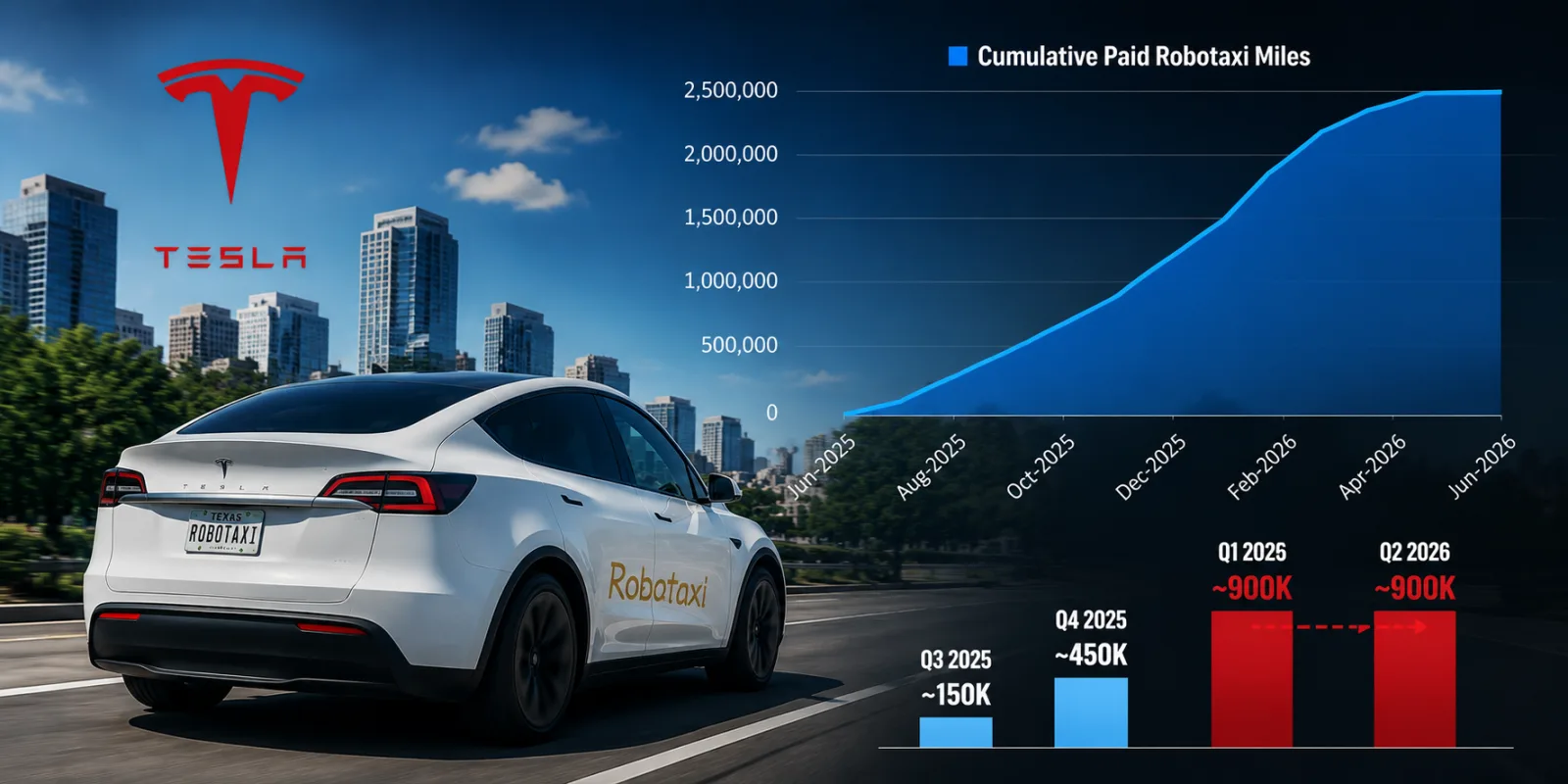
Reporting from Electrek that examined Tesla's own disclosed figures paints a more nuanced picture. Tesla's headline chart tracks cumulative paid Robotaxi miles, which by nature only ever slopes upward regardless of the underlying rate of growth. Breaking that same data into quarterly additions instead tells a different story: Tesla reportedly added roughly 900,000 paid miles in both the first and second quarters of 2026 — meaning the pace of growth was flat quarter over quarter, not accelerating, despite new cities coming online.
Looking at the data by month makes the pattern even more visible. Roughly 500,000 of the second quarter's added miles reportedly came in April alone, with May and June each contributing only about 200,000 miles — suggesting the growth rate actually slowed as the quarter progressed, even as Tesla added new markets.
This distinction matters for anyone trying to judge whether Robotaxi is a business scaling toward the kind of volume that would meaningfully move Tesla's overall revenue, or a set of pilot programs that have leveled off in intensity per city while simply adding more cities to the map.
Musk's Track Record on Timelines
It's worth being direct about context here: Musk has a well-documented history of setting autonomy targets the company has not met on schedule. In 2019, he expressed confidence about a 2020 robotaxi rollout. In mid-2025, he predicted the service would reach half the US population by the end of that year — a target that did not materialize. Most recently, Musk has said Robotaxi coverage would be "widespread" across the US by the end of 2026, a claim analysts are treating cautiously given this pattern.
Musk's own explanation for the slower-than-promised pace has been consistent: he attributes the constraint to deliberate, rigorous safety testing rather than any shortfall in the underlying technology or demand for the service.
Why This Matters Beyond Tesla
The Robotaxi program has become central to how markets value Tesla as a company, with Musk increasingly directing investor attention toward AI, autonomy, and humanoid robotics rather than core vehicle sales growth. That makes the distinction between "more cities" and "more rides per city" more than a technical footnote — it's a meaningful signal for anyone trying to assess whether the autonomous ride-hailing business is actually scaling the way Tesla's valuation currently assumes.
What to Watch Next
Tesla has not disclosed its total Robotaxi fleet size, total paid ride count, safety intervention rates, or per-trip economics — data points analysts have specifically asked for and that would clarify whether the seven-city footprint reflects genuine commercial scaling or a broader but still shallow pilot. Tesla is also expected to begin deploying its purpose-built Cybercab vehicle, which has no steering wheel or pedals, as a next step in the program's evolution.
FAQ
Q: How many cities does Tesla's Robotaxi service currently operate in?
As of July 2026, Tesla operates Robotaxi service in seven US metropolitan areas: Austin, Dallas, Houston, Phoenix, Miami, Orlando, and Tampa.
Q: Is Tesla's Robotaxi service actually growing faster in 2026?
According to Tesla's own disclosed figures, quarterly paid mileage stayed roughly flat between Q1 and Q2 2026, even as the company added new cities to its coverage map.
Q: Does Tesla's Robotaxi system use lidar like Waymo?
No. Tesla's system relies on cameras and AI-based software rather than the lidar sensors used by Waymo's autonomous vehicles.
Q: What is the Cybercab?
The Cybercab is Tesla's purpose-built autonomous vehicle, designed without a steering wheel or pedals, intended for dedicated Robotaxi use.