



Introduction
The competition between Apple and Samsung has defined the premium smartphone industry for more than a decade, and in 2026 the rivalry is stronger than ever. With the release of the iPhone 17 and the Samsung Galaxy S26 Ultra, both companies have once again pushed the boundaries of innovation, performance, and user experience. These flagship devices represent years of research and development, offering cutting-edge processors, professional-grade camera systems, advanced artificial intelligence features, and premium build quality.
Although both smartphones target the same premium market, they follow very different philosophies. Apple continues to focus on simplicity, seamless software integration, privacy, and a tightly connected ecosystem that works effortlessly across multiple devices. Samsung, meanwhile, embraces innovation by offering larger displays, powerful multitasking capabilities, AI-driven productivity tools, and industry-leading hardware specifications.
Choosing between these two flagship smartphones is no longer simply about selecting Android or iOS. Instead, it comes down to understanding your lifestyle, priorities, and daily smartphone usage. Whether you’re a professional content creator, a mobile gamer, a photographer, or someone who simply wants the best smartphone experience available, both devices have something unique to offer.
Design and Build Quality
Apple and Samsung continue to refine their premium smartphone designs while maintaining their distinct identities.
The iPhone 17 carries forward Apple’s recognizable flat-edge design language with precision-crafted aluminum and glass construction. It feels comfortable in the hand, looks elegant, and maintains a premium appearance that has become synonymous with the iPhone brand. Apple focuses on simplicity, using clean lines and subtle design refinements rather than dramatic changes.
Samsung takes a different approach with the Galaxy S26 Ultra. The larger display, thinner bezels, and curved design create a more immersive appearance that immediately stands out. Despite its larger size, the phone remains surprisingly comfortable to hold thanks to improved weight distribution and ergonomic engineering.
Both smartphones feature durable materials designed to withstand daily use. High-quality glass, reinforced frames, and improved scratch resistance ensure both devices remain attractive even after months of use.
Ultimately, the choice comes down to personal preference. Users who appreciate compact elegance may prefer Apple’s approach, while those seeking maximum screen size and a more futuristic appearance may find Samsung more appealing.
Display Comparison
The display is one of the most important aspects of any flagship smartphone, and both companies continue to lead the industry.
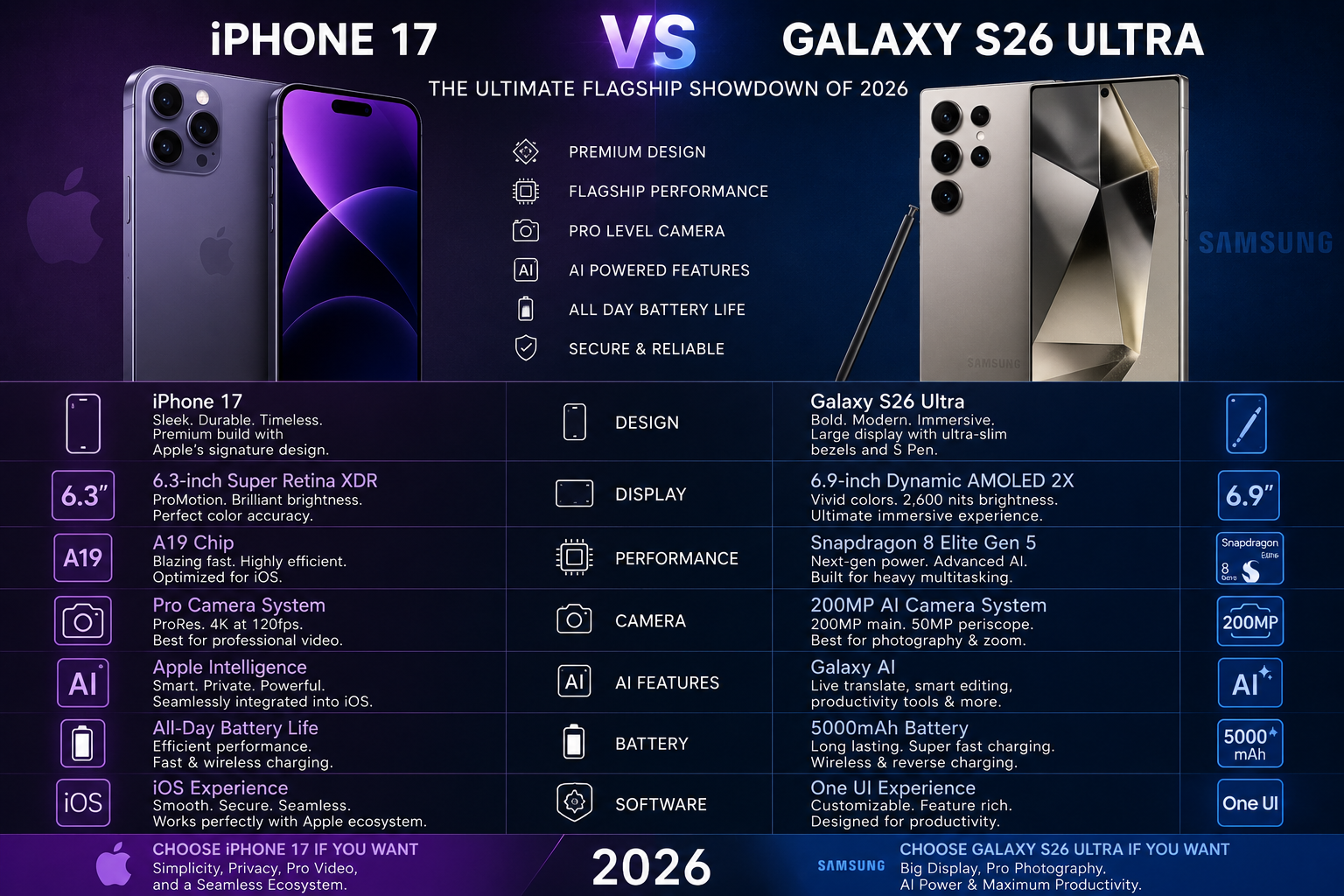
Samsung’s Galaxy S26 Ultra features an expansive 6.9-inch Dynamic AMOLED 2X display that delivers exceptional contrast, vibrant colors, and remarkable brightness. Watching movies, gaming, editing photos, and reading documents all feel incredibly immersive thanks to the larger screen.
The high refresh rate ensures fluid scrolling, smoother animations, and a highly responsive user experience. Outdoor visibility remains excellent even under direct sunlight, making the display suitable for virtually every environment.
Apple’s iPhone 17 features a 6.3-inch Super Retina XDR display with ProMotion technology. Although smaller than Samsung’s display, Apple’s screen excels in color accuracy, HDR performance, and brightness. Professionals working with photography or video often appreciate Apple’s meticulous color calibration because it produces natural, true-to-life colors.
The display also delivers incredibly smooth animations while maintaining excellent power efficiency. Combined with iOS optimization, the overall viewing experience feels polished and refined.
Samsung wins in terms of size and immersion, while Apple continues to lead in color precision and consistency.
Performance and Processing Power
Performance has become one of the defining characteristics of flagship smartphones.
Samsung equips the Galaxy S26 Ultra with the Snapdragon 8 Elite Gen 5 processor, delivering exceptional speed, advanced AI processing capabilities, and outstanding gaming performance.
Heavy multitasking, demanding games, professional photo editing, and 4K video rendering are handled effortlessly. Samsung’s improved cooling system helps maintain peak performance during extended workloads.
Apple counters with its A19 chip, continuing the company’s tradition of combining raw performance with remarkable efficiency. Applications launch instantly, multitasking feels seamless, and overall responsiveness remains among the best in the smartphone industry.
One of Apple’s biggest strengths is optimization. Because Apple designs both the hardware and software, every component works together efficiently, producing consistently smooth performance regardless of workload.
Whether editing videos, creating digital art, gaming, or managing business tasks, both smartphones rank among the fastest devices available in 2026.
Camera Comparison
Photography remains one of the biggest reasons consumers choose premium smartphones.
Today’s flagship cameras rival professional equipment in many situations, and both Apple and Samsung continue pushing mobile photography forward.
Samsung’s Photography Advantage
Samsung’s Galaxy S26 Ultra is designed for users who prioritize versatility.
Its impressive 200MP primary sensor captures extraordinary detail while maintaining excellent dynamic range and vibrant colors. Images remain sharp even after significant cropping, making the camera ideal for landscape photography and high-resolution printing.
Samsung’s advanced Nightography technology dramatically improves low-light performance. Even challenging nighttime scenes retain detail, natural colors, and minimal image noise.
The multiple telephoto lenses provide unmatched flexibility. Whether photographing wildlife, sports events, concerts, or distant architecture, Samsung’s zoom capabilities remain among the best available.
For photographers who enjoy experimenting with different focal lengths, the Galaxy S26 Ultra offers incredible creative freedom.
Apple’s Professional Video Excellence
While Samsung dominates versatility, Apple continues to set the standard for professional smartphone videography.
The iPhone 17 supports ProRes recording, Apple Log 2, advanced cinematic stabilization, and professional 4K recording at high frame rates.
Video footage looks remarkably smooth and natural, making the iPhone the preferred choice for filmmakers, journalists, YouTubers, documentary creators, and social media professionals.
Apple’s color science produces consistent results across different lighting conditions, reducing editing time during post-production.
The seamless integration between iPhone, Final Cut Pro, and Mac devices further strengthens Apple’s position among professional creators.
If your primary focus is video production, the iPhone remains exceptionally difficult to beat.
Artificial Intelligence Features
Artificial intelligence has become one of the defining innovations in modern smartphones.
Samsung has invested heavily in Galaxy AI, integrating intelligent features throughout the operating system.
Live translation allows users to communicate across languages in real time.
Writing assistance helps generate, summarize, and improve text.
AI-powered photo editing removes unwanted objects, improves portraits, and enhances image quality with minimal effort.
Smart multitasking features understand user behavior and simplify everyday workflows.
Apple approaches AI differently.
Rather than overwhelming users with visible AI tools, Apple integrates intelligence subtly into daily experiences.
Camera improvements, predictive suggestions, voice recognition, photo organization, and intelligent automation operate naturally behind the scenes.
Apple’s philosophy emphasizes privacy, ensuring much of the AI processing occurs directly on the device rather than relying heavily on cloud services.
Both companies demonstrate different visions for the future of artificial intelligence.
Productivity and Software Experience
Software remains one of the largest differences between these flagship devices.
Samsung’s One UI offers exceptional flexibility.
Users can customize nearly every aspect of the interface, run multiple applications simultaneously, use floating windows, split-screen multitasking, and enjoy desktop-style functionality.
Professionals who frequently multitask often appreciate Samsung’s productivity-focused design.
Apple’s iOS takes a cleaner approach.
Rather than offering endless customization, Apple focuses on consistency, simplicity, and reliability.
The ecosystem remains one of Apple’s greatest advantages.
AirDrop enables instant file sharing.
Handoff allows users to continue tasks across multiple Apple devices.
FaceTime provides seamless communication.
Continuity Camera transforms the iPhone into a professional webcam.
Universal Clipboard lets users copy text between devices effortlessly.
These features create an experience that feels unified across Apple’s ecosystem.
Battery Life
Battery performance remains outstanding on both devices.
Samsung’s larger battery provides excellent endurance during gaming, streaming, productivity, and photography.
Intelligent power management helps maximize battery efficiency throughout the day.
Apple’s A19 processor delivers remarkable energy efficiency despite using a smaller battery.
The optimization between hardware and software allows the iPhone 17 to comfortably last through a full day of demanding use.
Both smartphones support fast wired charging, wireless charging, and convenient battery management features.
Security and Privacy
Privacy and security continue to influence purchasing decisions.
Apple remains an industry leader in protecting user privacy.
Face ID offers secure facial authentication, while on-device processing minimizes unnecessary data sharing.
Apple’s commitment to encryption and software security continues to build consumer trust.
Samsung combines biometric authentication with Samsung Knox, providing enterprise-grade security trusted by businesses worldwide.
Additional AI-powered privacy features help protect sensitive information during everyday use.
Both companies invest heavily in keeping user data secure.
Which Smartphone Should You Choose?
Choose the iPhone 17 If:
- You already use Apple products.
- You prioritize professional video recording.
- You value privacy and long-term software support.
- You prefer a simple and polished interface.
- You want seamless integration across all your devices.
Choose the Samsung Galaxy S26 Ultra If:
- You want the largest display possible.
- Photography and zoom capabilities matter most.
- You enjoy advanced AI features.
- You frequently multitask.
- You like extensive customization options.
Conclusion
The iPhone 17 and Samsung Galaxy S26 Ultra represent two different visions of smartphone excellence.
Apple continues refining its ecosystem with unmatched software optimization, industry-leading video capabilities, exceptional efficiency, and an experience that feels effortless from the moment you turn on the device. Every feature is designed to work seamlessly together, making the iPhone an outstanding choice for users who value reliability, creativity, and simplicity.
Samsung, meanwhile, continues pushing technological boundaries through innovative hardware, industry-leading displays, powerful AI tools, outstanding photography capabilities, and productivity features that transform a smartphone into a mobile workstation. Its larger display, impressive camera system, and advanced multitasking options make it an ideal device for professionals, creators, and technology enthusiasts.
Neither smartphone is objectively superior because each excels in different areas. The right choice ultimately depends on how you use your device every day. If you prioritize ecosystem integration, professional video production, long-term software consistency, and ease of use, the iPhone 17 remains one of the best flagship smartphones available. If you value innovation, photography, multitasking, customization, and cutting-edge AI features, the Samsung Galaxy S26 Ultra stands among the most capable smartphones ever created.
As smartphone technology continues to evolve, one thing remains certain: Apple and Samsung will continue driving innovation, ensuring consumers benefit from increasingly powerful, intelligent, and feature-rich devices for years to come.