





The brief period of calm that settled over the Middle East has once again given way to uncertainty, reminding the world how quickly fragile diplomatic understandings can unravel in one of the most strategically sensitive regions on the planet. What appeared to be a temporary pause in hostilities has instead exposed the deep mistrust that continues to shape relations between the United States and Iran. Even during periods of reduced military activity, neither side has fundamentally altered its broader security objectives, and the underlying tensions that have defined the relationship for decades remain firmly in place. The latest escalation therefore represents not a sudden new conflict, but the resurfacing of a confrontation that has never been fully resolved.
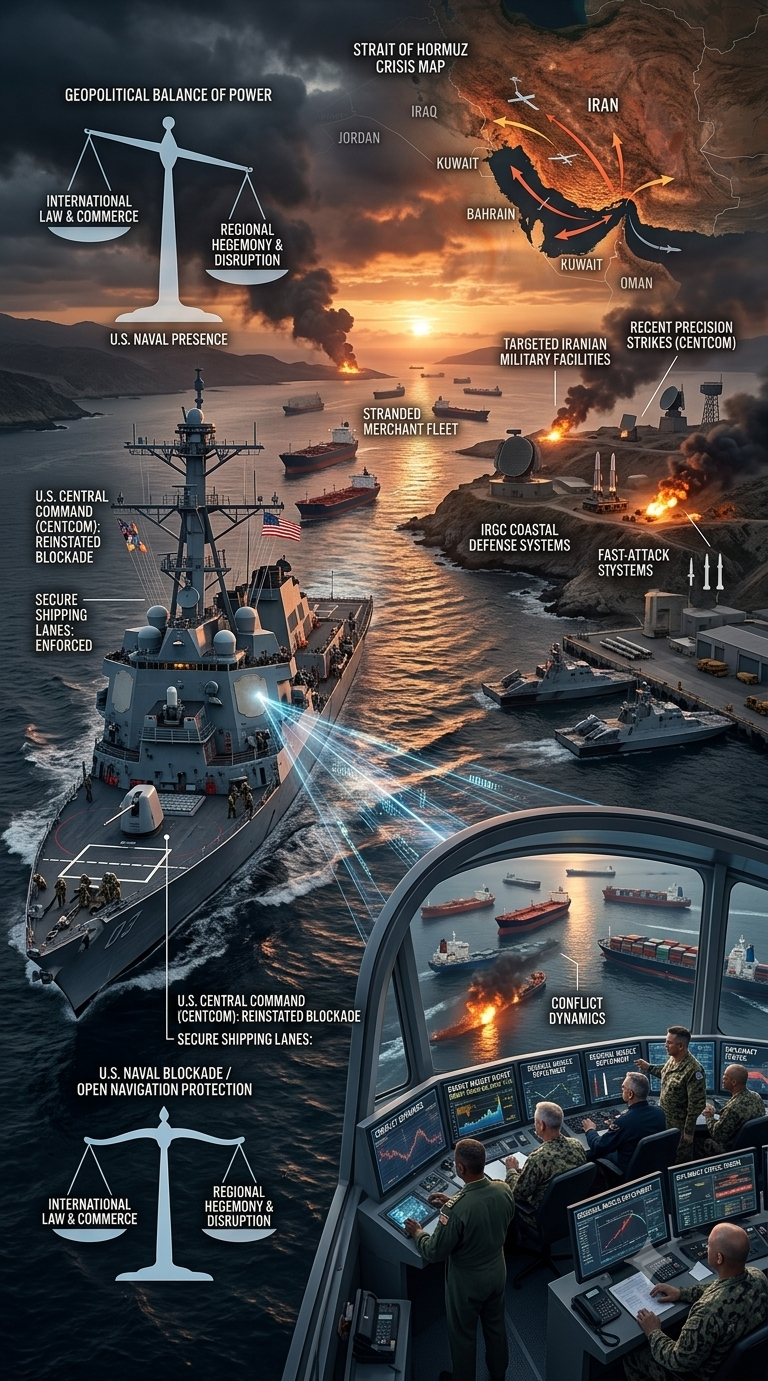
At the center of the renewed crisis is the Strait of Hormuz, a narrow waterway that carries an extraordinary share of the world’s energy supply. Although it stretches only a short distance between the Persian Gulf and the Gulf of Oman, its economic importance is immense because roughly one-fifth of globally traded crude oil and a significant portion of liquefied natural gas exports pass through it every day. Any threat to navigation in this corridor immediately affects shipping companies, energy markets, governments, and financial institutions across multiple continents. For this reason, military activity around the strait is rarely viewed as a purely regional issue; it is treated as a matter of global economic security.
Recent developments have heightened concerns that the waterway could become the primary flashpoint in a wider confrontation. Competing claims over maritime security, freedom of navigation, and regional influence have intensified diplomatic rhetoric and increased military alert levels throughout the Gulf. While officials on all sides continue to publicly defend their actions as necessary for national security, the growing concentration of naval forces, surveillance assets, and military aircraft in the region has created an environment in which even a limited incident could trigger a broader escalation. Analysts note that the danger often lies not only in deliberate military decisions, but also in miscalculations made under pressure.
The collapse of the earlier understanding has also demonstrated how difficult it has become to separate military competition from economic strategy. Control over shipping routes, energy exports, sanctions enforcement, and regional alliances are now deeply interconnected. Decisions made by military commanders can have immediate consequences for oil prices, insurance costs, shipping schedules, and investor confidence. As a result, governments far beyond the Middle East are closely monitoring developments because disruptions in the Gulf can quickly affect inflation, transportation costs, and industrial production in distant economies.
One reason the situation has attracted such intense international attention is the memory of previous crises involving the Strait of Hormuz. Historically, even limited confrontations in the area have produced significant market reactions because traders fear interruptions to energy supplies. During earlier periods of tension, oil prices often rose sharply despite the absence of a full-scale war, illustrating how sensitive global markets remain to events in the Gulf. The current environment carries similar risks because uncertainty alone can be enough to influence commodity prices and corporate planning decisions.
The renewed tensions are also placing neighboring Gulf states in a difficult position. Countries such as Bahrain, Kuwait, Oman, Qatar, and the United Arab Emirates maintain important economic relationships with both regional and international partners while also hosting critical military infrastructure. Their governments therefore face the challenge of protecting national security without becoming direct participants in a larger confrontation. Many regional leaders are attempting to preserve diplomatic channels even as they strengthen defensive measures around ports, energy facilities, and transportation networks.
Another major concern is the impact on commercial shipping. The Persian Gulf is one of the busiest maritime corridors in the world, carrying not only oil and gas but also industrial equipment, consumer goods, food products, and raw materials. Shipping companies and insurers closely watch any increase in military activity because higher security risks can lead to increased insurance premiums, rerouted vessels, and delivery delays. Even if the strait remains technically open, heightened uncertainty can still raise transportation costs throughout the global supply chain.
Financial markets have already shown how sensitive investors are to developments in the region. Energy prices tend to react quickly whenever tensions rise around the Strait of Hormuz because traders fear potential disruptions to supply. Higher oil prices can then influence fuel costs, manufacturing expenses, airline operations, and consumer inflation in countries far removed from the conflict itself. For governments already dealing with economic pressures, another prolonged period of energy market volatility would create additional challenges for fiscal planning and monetary policy.
Diplomatic efforts continue behind the scenes, but progress remains difficult because both sides appear determined to avoid appearing weak while still trying to prevent an uncontrolled escalation. International mediators have repeatedly emphasized the importance of maintaining communication channels, yet the political climate has become increasingly strained. Public statements from officials have grown more confrontational, and each new military incident tends to reduce the political space available for compromise. The result is a dangerous cycle in which security measures taken by one side are interpreted as threats by the other, leading to further military preparations.
The broader geopolitical implications extend beyond the immediate confrontation. The Gulf region sits at the intersection of global energy markets, international shipping routes, and major strategic alliances. Any prolonged instability could affect relationships between the United States, European countries, Asian energy importers, and regional governments. Nations that depend heavily on Gulf energy supplies are particularly concerned because they have limited influence over the military dynamics yet remain highly vulnerable to economic consequences.
Military analysts generally agree that neither side benefits from a full-scale regional war, but they also acknowledge that repeated confrontations increase the risk of unintended escalation. Modern conflicts can evolve rapidly when naval patrols, drones, missile systems, cyber operations, and air defenses operate in close proximity. A single incident involving a commercial vessel, surveillance aircraft, or military patrol could quickly become a larger political crisis if communication channels fail to contain it.
For ordinary citizens across the region, the renewed tensions bring a return of uncertainty after a brief period of relative calm. Businesses must reconsider investment plans, shipping operators must reassess risk exposure, and families living near strategic infrastructure face renewed concerns about regional stability. Although financial markets often focus on oil prices and trade flows, the human impact of prolonged insecurity is felt through disrupted economic activity, higher living costs, and reduced confidence in the future.
The current situation therefore represents more than a temporary diplomatic setback. It highlights the fragility of security arrangements in a region where military competition, energy politics, economic interests, and international alliances are tightly intertwined. The Strait of Hormuz has once again become a symbol of how local confrontations can carry global consequences, affecting everything from fuel prices and shipping routes to investment decisions and geopolitical strategy.
Whether the coming weeks bring renewed negotiations or further escalation remains uncertain. What is clear, however, is that the collapse of the fragile truce has reopened one of the world’s most dangerous fault lines. As governments, businesses, and international organizations watch developments closely, the stability of a narrow stretch of water in the Gulf has once again become a central concern for the broader global economy