





The Problem With “Forever Chemicals”
Per- and polyfluoroalkyl substances, better known as PFAS, have earned their nickname for a simple reason: they are exceptionally persistent.
The strong carbon-fluorine bonds that characterize many PFAS compounds give them remarkable resistance to heat, water, oil, and environmental degradation.
For decades, these synthetic chemicals have been used in a wide range of products and industrial applications, including non-stick cookware, waterproof materials, firefighting foams, and specialized packaging.
But their durability has created a serious environmental challenge.
PFAS have been detected in soil, water systems, wildlife, and human populations around the world. Because many of these compounds break down extremely slowly, contamination can persist long after the original source has disappeared.
From Containment to Destruction
Historically, efforts to manage PFAS contamination have often focused on removing the chemicals from water or transferring contaminated materials to controlled disposal sites.
These approaches can reduce immediate exposure, but they do not necessarily eliminate the underlying chemical problem.
The emerging goal is more ambitious:
Destroy the PFAS molecule itself.
A new generation of treatment technologies is exploring ways to break apart the exceptionally strong chemical structures that make these substances so persistent.
Innovative Approaches to Breaking the Unbreakable Bond
Scientists and environmental engineers are investigating several promising approaches to PFAS destruction.
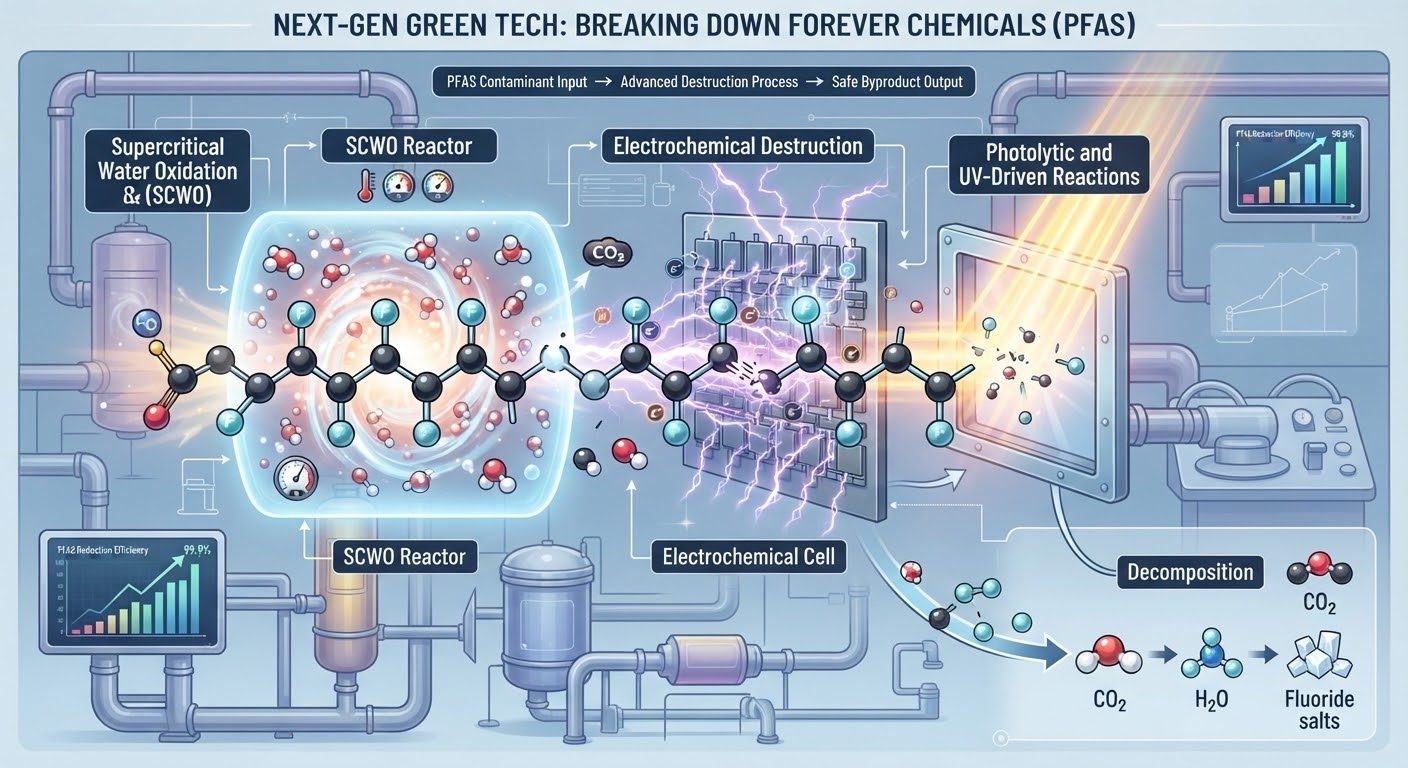
Supercritical Water Oxidation
Supercritical Water Oxidation (SCWO) uses extremely high temperatures and pressures to create conditions in which organic contaminants can be rapidly broken down.
Under carefully controlled conditions, PFAS-containing waste streams can be treated in ways designed to transform contaminants into simpler compounds, including inorganic salts, water, and carbon dioxide.
The technology has attracted interest because it aims to destroy contaminants rather than simply transfer them to another waste stream.
Electrochemical Destruction
Electrochemical treatment uses electricity to drive chemical reactions that can break down PFAS compounds.
One approach involves specialized electrodes, including boron-doped diamond materials, which can generate highly reactive conditions at the electrode surface.
These reactions can progressively degrade PFAS molecules and potentially reduce them to simpler end products.
The technology is particularly interesting for treating concentrated waste streams, although questions around energy consumption, cost, and large-scale deployment remain important considerations.
Photolytic and UV-Driven Treatment
Advanced ultraviolet systems are also being studied as potential tools for PFAS destruction.
In some treatment processes, UV light is combined with chemical reagents or catalysts to generate highly reactive species capable of attacking persistent chemical structures.
These systems may be particularly useful when integrated into broader treatment processes designed to concentrate and then destroy PFAS contamination.
The Challenge of Scaling Up
The science behind PFAS destruction is advancing, but laboratory success is only the beginning.
The real challenge is bringing these technologies to a scale where they can be deployed economically across municipal water systems, industrial facilities, contaminated sites, and other affected environments.
Several factors must be considered, including:
- Energy requirements.
- Treatment costs.
- The concentration and type of PFAS present.
- Potential formation of intermediate compounds.
- Verification that destruction is complete.
- Long-term operational reliability.
These considerations are critical because effective PFAS treatment must demonstrate not only that contaminants disappear from the original waste stream, but also that the process does not simply transform them into other harmful substances.
A New Era of Environmental Cleanup
As governments and regulatory agencies strengthen controls around PFAS exposure and contamination, the pressure to develop effective destruction technologies is increasing.
The environmental challenge is enormous, but the direction of innovation is changing.
Instead of asking how to store, filter, or contain “forever chemicals,” researchers are increasingly asking a more fundamental question:
How can we make them disappear permanently?
Answering that question could transform the future of industrial pollution management.
Conclusion
PFAS represent one of the most difficult environmental legacies of modern industrial chemistry.
Their persistence has made them extraordinarily difficult to manage, but advances in chemical engineering and environmental technology are creating new possibilities for permanent destruction.
The road from promising laboratory research to affordable, large-scale deployment will not be easy. Yet if these technologies can be made reliable and economically viable, they could provide a powerful new tool for addressing one of the world’s most persistent classes of pollutants.
The future of environmental cleanup may ultimately depend on a shift from containment to destruction.
The age of “forever chemicals” may eventually meet its greatest challenge in technologies designed to make them last no longer.