





Samsung Galaxy Z Fold 8 vs Z Fold 8 Ultra vs Z Fold 7: What Actually Changed in 2026

Samsung split its foldable line into two phones for 2026. Here's exactly what's different across display, camera, battery, and price — and which one is worth buying.

Samsung Galaxy Z Fold 8 vs Z Fold 8 Ultra vs Z Fold 7: What Actually Changed in 2026

For the first time, Samsung isn't selling one book-style foldable. It's selling two. At Galaxy Unpacked in London on July 22, 2026, the company split its flagship Fold line into the Galaxy Z Fold 8 and a brand-new Galaxy Z Fold 8 Ultra, while the year-old Galaxy Z Fold 7 sticks around at a lower price. If you're trying to figure out which one actually deserves your money, here's what changed and what didn't.

Quick answer

The Fold 8 is the lighter, cheaper option built around content and everyday use, with a redesigned 4:3 unfolded screen and no telephoto camera. The Fold 8 Ultra is the true flagship — Samsung's first "Ultra" foldable — with a 200MP camera, a dedicated telephoto lens, a brighter screen, and a new Flex Titanium layer that noticeably reduces the crease. The Fold 7 is last year's model, now selling for hundreds less, and still a genuinely capable phone if you don't need the newest camera or AI features.

Price and release date

Pricing is where Samsung made its most surprising move. Instead of raising the price across the board, it pushed the entry point down and put the increase on the new Ultra tier.

  • Galaxy Z Fold 7: now discounted from its original $1,999 / £1,799 launch price
  • Galaxy Z Fold 8: starts at £1,699 in the UK — cheaper than the Fold 7 was at launch
  • Galaxy Z Fold 8 Ultra: starts at £1,899 in the UK, roughly $1,999 in the US

Pre-orders opened the same day as the announcement, July 22, 2026, with general retail availability from August 7, 2026. That means all three phones are shopping options at the same time this year, which hasn't happened with a Fold launch before.

Display: two very different shapes

This is the biggest change, and it's not just a size bump.

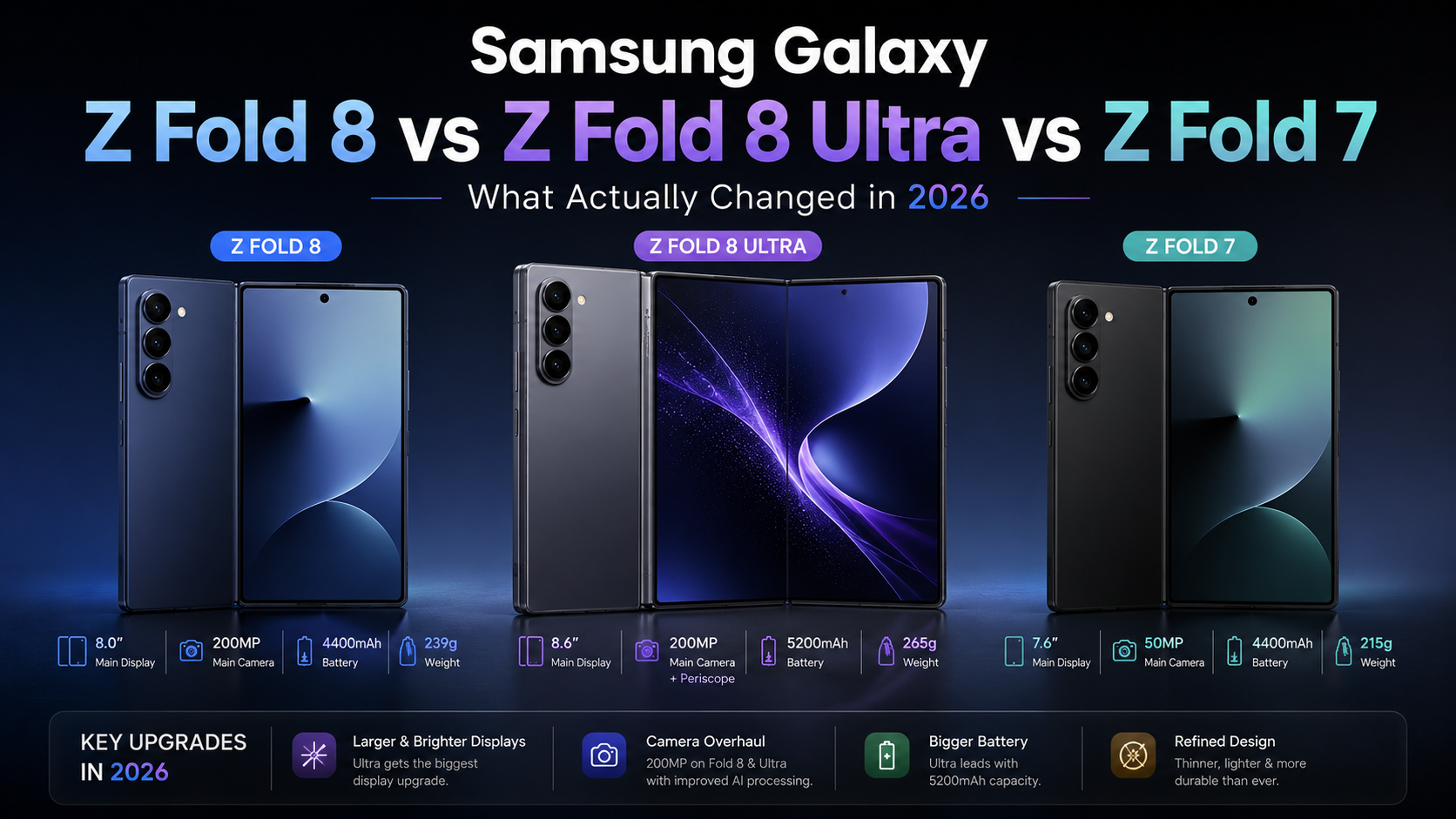
The Fold 7 and the new Fold 8 Ultra keep the familiar tall, near-square 8-inch inner display that Fold owners are used to — good for split-screen multitasking and typing like a mini laptop.

The standard Fold 8, however, has been redesigned around a wider 7.6-inch inner screen at a 4:3 aspect ratio, with a 5.5-inch cover screen. Unfolded, it's built for watching video and gaming in landscape. Rotated, it switches to a 3:4 ratio that Samsung says is more comfortable for reading and browsing. It's a genuinely different phone shape, not just a smaller Ultra.

Also Read: Samsung Galaxy Z Fold 8 vs Galaxy Z Fold 7: Is the Upgrade Really Worth It?

Both new models also get Samsung's Flex Titanium layer, which tightens the hinge mechanism and display tension to cut down on the visible crease — long the biggest complaint about book-style folds. The Fold 7 doesn't have this upgrade.

Brightness also moves up on the Ultra specifically, with Samsung quoting a 15% brighter panel than the Fold 7's, peaking around 3,000 nits — useful if you've ever tried to read a foldable outdoors in daylight.

Camera: the real dividing line

If photography matters to you, the decision is simple.

The Fold 8 Ultra carries a 200MP main sensor, an improved 50MP ultra-wide with wider apertures for low light, and a dedicated telephoto lens — plus 8K video recording. It's built to sit alongside the Galaxy S26 Ultra as a proper camera-first flagship.

The standard Fold 8 drops the telephoto entirely, leaning on a 2x in-sensor crop from its 50MP main camera instead — the same compromise Samsung made on the Fold 7. It's fine for social posts and everyday shots, but it's a clear step down from the Ultra, and arguably from the Fold 7's headline 200MP sensor too.

Also Read: Samsung Galaxy Z Fold 8 vs Z Fold 8 Ultra vs Z Fold 7: What Actually Changed in 2026

The Fold 7 actually still ships with a 200MP main sensor, which on paper edges out the standard Fold 8. If camera resolution alone is your deciding factor, the older phone isn't automatically the weaker choice.

Battery and everyday use

  • Fold 7: 4,400mAh
  • Fold 8: 4,800mAh, rated for 26+ hours of video playback, and Samsung's lightest Fold yet at 201 grams
  • Fold 8 Ultra: 5,000mAh, 215 grams, 4.1mm thick unfolded — the thinnest Fold Samsung has made

Both new phones run on the Snapdragon 8 Elite Gen 5 for Galaxy, a step up from the Fold 7's chip, and all three support 45W wired charging.

AI and software

This is where the Ultra separates itself from being "just" a bigger camera. Samsung is leaning on agentic AI features exclusive to the new phones:

  • Gemini Notebook turns uploaded meeting notes, PDFs, or audio recordings into summaries, slides, or quizzes
  • Now Nudge watches for multitasking moments — like adding a plan from a messaging app straight into your calendar — and opens the right split-screen window automatically
  • On the Fold 8, My FanCam can automatically reframe a video around one person after you tap to select them

The Fold 7 can run some Galaxy AI features through software updates, but the newest agentic tools are tied to the 2026 hardware.

Also Read: Samsung Galaxy Z Fold 8 — Ultimate Foldable Review

Which one should you actually buy?

  • Buy the Fold 8 Ultra if you want the best camera, the most durable hinge, and the newest AI multitasking tools, and the extra £200 over the standard Fold 8 doesn't bother you.
  • Buy the Fold 8 if you mainly use your foldable for video, reading, and everyday tasks, and you'd rather save money and carry the lightest Fold Samsung has ever made.
  • Buy the discounted Fold 7 if you want the familiar tall foldable shape and a 200MP camera without paying 2026 flagship prices — just skip it if the crease reduction or newest AI tools matter to you.

Frequently asked questions

Is the Galaxy Z Fold 8 cheaper than the Fold 7 was at launch? Yes. The standard Fold 8 starts at £1,699 in the UK, £100 less than the Fold 7's £1,799 launch price a year earlier.

Does the Galaxy Z Fold 8 have a telephoto camera? No. Only the Fold 8 Ultra has a dedicated telephoto lens. The standard Fold 8 relies on a 2x crop from its main sensor.

When can I actually buy the Galaxy Z Fold 8 and Fold 8 Ultra? Pre-orders opened July 22, 2026, with general availability from August 7, 2026.

Is the crease actually better on the new Fold models? Samsung's new Flex Titanium display layer is designed specifically to reduce crease visibility and is only on the Fold 8 and Fold 8 Ultra, not the Fold 7.

Reporting based on Samsung's official Galaxy Unpacked July 2026 announcement and independent UK/US pricing coverage as of late July 2026. Specifications may be confirmed or adjusted at general retail availability.
Quick Summary

Samsung split its foldable line into two phones for 2026. Here's exactly what's different across display, camera, battery, and price — and which one is worth buying.

Key Takeaways

  • Galaxy Z Fold 7: now discounted from its original $1,999 / £1,799 launch price
  • Galaxy Z Fold 8: starts at £1,699 in the UK — cheaper than the Fold 7 was at launch
  • Galaxy Z Fold 8 Ultra: starts at £1,899 in the UK, roughly $1,999 in the US
  • Fold 8: 4,800mAh, rated for 26+ hours of video playback, and Samsung's lightest Fold yet at 201 grams

Quick Facts

Category: Technology
Published: July 29, 2026
Updated: October 6, 2026
Reading time: 6 min
67 views
Updated Oct 6, 2026 6 min read

Related Articles

View all
The 2026 Smartphone Divide: iPhone vs. Android Technology

The 2026 Smartphone Divide: iPhone vs. Android

As we move through 2026, the long-standing rivalry between iOS and Android has evolved. While both platforms are more capable and secure than ever, they serve fundamentally different philosophies: Apple’s curated ecosystem versus Android’s open-source flexibility.

Orwell, George 9 min 293

Mixed Content

Technology

The Post-Automation Economy: Architecting Human Skill Premiums in the Age of Autonomy

The rapid proliferation of agentic workflows and large action models is structurally inverting the traditional corporate skill pyramid. While routine analytical processes and information retrieval tasks are being automated into low-cost utility, uncommoditizable human traits—emotional intelligence, strategic ambiguity management, and ethical governance—are commanding an unprecedented value premium. Succeeding in the post-automation enterprise requires re-engineering workforce development to focu

Mutwassim 3 min 72
The Decline of Friction: Inside the FinTech Revolution in Cross-Border Settlement and Digital Identity Technology

The Decline of Friction: Inside the FinTech Revolution in Cross-Border Settlement and Digital Identity

The traditional plumbing of global finance—characterized by multi-day delays, hidden fees, and fragmented identity silo—is undergoing a profound transformation. A new generation of FinTech architectures, combining distributed ledger technology (DLT), synchronized liquidity pools, and decentralized digital passports, is enabling cross-border instant payments with near-zero friction.

Mutwassim 1 min 44
The City as a Switch: Architecting IoT Logistics for the Post-Congestion Urban Era Technology

The City as a Switch: Architecting IoT Logistics for the Post-Congestion Urban Era

The traditional model of urban delivery—reliant on high-emission diesel vans navigating static street grids—is creating unsustainable levels of congestion and pollution in global metros. To reclaim urban space, cities are transitioning to IoT-orchestrated logistics. This data-driven framework utilizes autonomous delivery swarms, automated micro-fulfillment centers, and dynamic digital kerb-side management to route goods with the efficiency of internet packets, transforming static streets into fl

Mutwassim 4 min 71
Beyond the Coffee Shop: How Cross-Border Employment and Sovereign Visas Are Institutionalizing Remote Work Technology

Beyond the Coffee Shop: How Cross-Border Employment and Sovereign Visas Are Institutionalizing Remote Work

Remote work is transitioning from an informal perk into an institutionalized pillar of international commerce. Over 60 nations have launched dedicated digital nomad visa regimes, while multi-jurisdictional compliance platforms and Employer of Record (EOR) frameworks dismantle traditional geographic barriers. As knowledge workers disperse globally, enterprises and municipal governments are formalizing policies around tax residency, permanent establishment risk, and asynchronous operational workfl

Mutwassim 3 min 71
The Death of Syntax: Inside the Shift to Intent-Driven Software Engineering Technology

The Death of Syntax: Inside the Shift to Intent-Driven Software Engineering

The day-to-day discipline of software engineering is undergoing its most radical abstraction leap since the transition from assembly language to high-level compilers. Generative code synthesis and deterministic reasoning engines are automating boilerplate syntax, turning software developers into systems architects. Survival in this new paradigm demands mastering intent formalization, specification design, and continuous verification.

Mutwassim 3 min 71
The Post-Visual Threat: Architecting Zero-Trust Defense Against Weaponized Deepfakes Technology

The Post-Visual Threat: Architecting Zero-Trust Defense Against Weaponized Deepfakes

The rapid weaponization of real-time voice cloning and synthetic video generation has transformed social engineering from opportunistic phishing into targeted executive identity emulation. High-profile incidents involving multi-million-dollar wire transfers authorized via synthetic video calls prove that sight and sound can no longer authenticate authorization. Securing modern enterprises requires an uncompromising zero-trust identity layer capable of neutralizing synthetic deception.

Mutwassim 3 min 137
Beyond the Battery: How Electric Mobility Is Forcing a Overhaul of the Global Power Grid Technology

Beyond the Battery: How Electric Mobility Is Forcing a Overhaul of the Global Power Grid

The global transition toward electric vehicles is no longer constrained primarily by battery chemistry or vehicle range. Instead, the real bottleneck has shifted directly to the electrical grid. As commercial fleets and passenger cars electrify at scale, utilities and city planners are racing to deploy vehicle-to-grid (V2G) bidirectional systems, AI-driven dynamic load balancers, and decentralized microgrid storage to avoid grid failure.

Mutwassim 3 min 58
Cloud 3.0: The Shift Toward Sovereign Data Architectures and Edge Computing Technology

Cloud 3.0: The Shift Toward Sovereign Data Architectures and Edge Computing

The architectural assumption that enterprise compute and storage should reside in a handful of centralized hyperscaler data centers is fracturing. Driven by strict cross-border data sovereignty regulations and the demand for millisecond-latency AI inference, global IT leaders are pivoting to Cloud 3.0—a model centered on distributed, locally governed, and hybrid sovereign architectures.

Mutwassim 3 min 61