



Introduction
As of mid-2026, Apple and Samsung continue to dominate the global smartphone industry, setting the benchmark for innovation, performance, and user experience. While the smartphone market has faced significant challenges—including component shortages, rising production costs, and increasing competition—these two technology giants have maintained their leadership through consistent innovation and premium product strategies.
Rather than competing solely on specifications, Apple and Samsung have shifted their focus toward creating complete digital ecosystems. Smartphones are no longer standalone devices; they serve as the central hub connecting smartwatches, tablets, laptops, smart home devices, and AI-powered services. This transformation has changed how consumers choose their smartphones. Instead of asking which device has the better camera or faster processor, users are increasingly considering which ecosystem best complements their lifestyle.
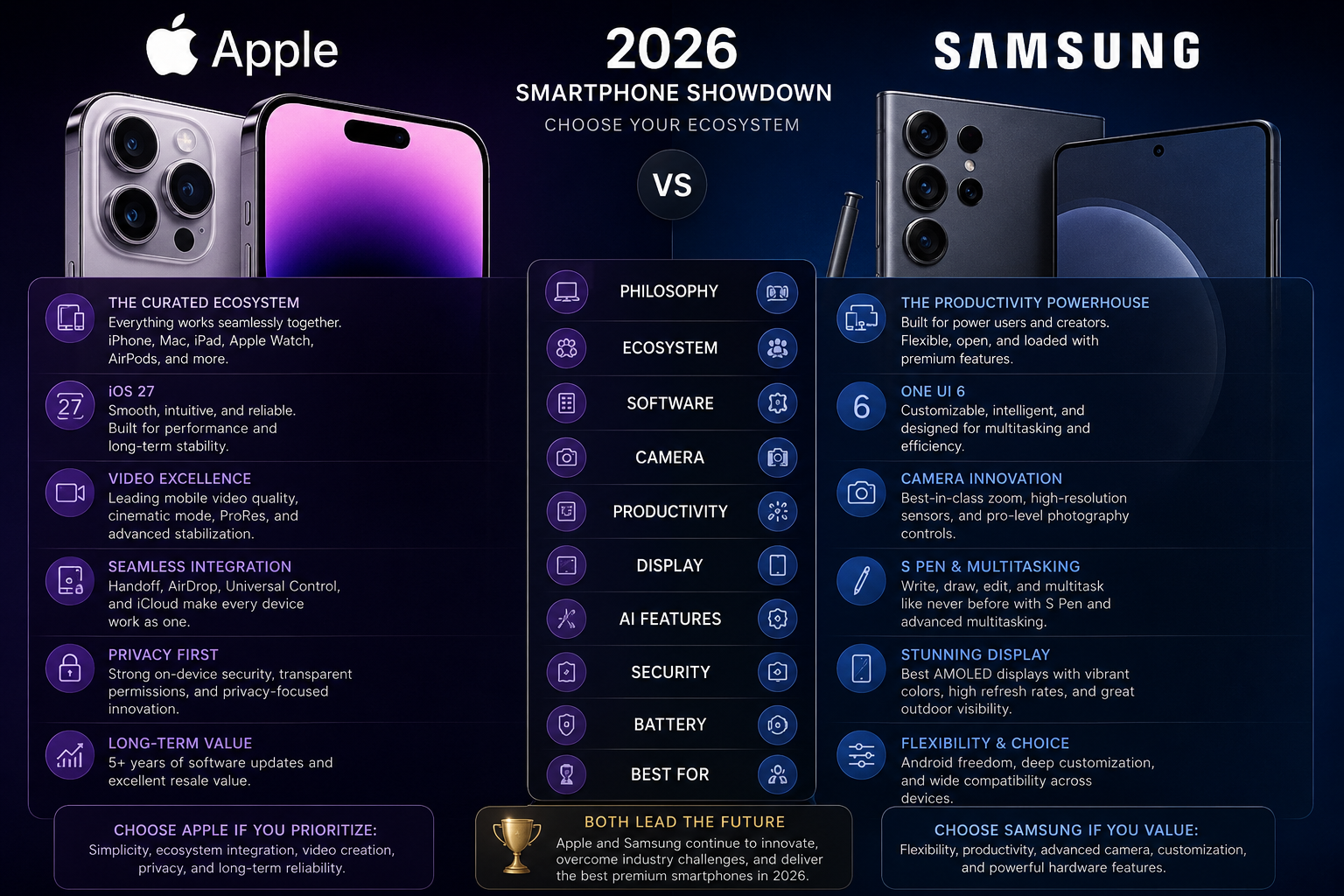
Although both brands offer flagship devices capable of handling demanding tasks, they approach smartphone design with entirely different philosophies. Apple prioritizes simplicity, consistency, and seamless integration, while Samsung focuses on flexibility, customization, and hardware innovation. Understanding these differences is essential for anyone planning to invest in a premium smartphone in 2026.
The State of the Smartphone Market in 2026
The smartphone industry has matured considerably over the past decade. Annual hardware improvements have become more refined, meaning manufacturers now compete primarily through software experiences, artificial intelligence, ecosystem integration, and long-term support.
Economic pressures have also influenced the market. Rising manufacturing expenses, fluctuating memory prices, and supply chain disruptions have forced many smaller smartphone companies to reduce production or delay flagship launches. Despite these challenges, Apple and Samsung have remained resilient by securing critical components well in advance and maintaining strong relationships with suppliers.
This strategic advantage has allowed both companies to continue delivering premium smartphones without major compromises, reinforcing their reputation as reliable choices for consumers seeking devices that will remain capable for several years.
Apple’s Philosophy: The Curated Ecosystem
Apple’s greatest strength in 2026 is not simply the iPhone itself but the ecosystem surrounding it. Every Apple device is designed to work seamlessly with every other Apple product, creating a user experience that feels effortless.
With iOS 27, Apple has refined the philosophy of “it just works.” Instead of overwhelming users with countless customization options, Apple focuses on ensuring every feature is polished, stable, and intuitive.
The iPhone acts as the central hub connecting:
- Mac computers
- iPads
- Apple Watch
- AirPods
- Apple TV
- Vision devices
- Home accessories
Information flows naturally between devices without requiring complicated setup. Users can begin editing a document on a Mac, continue it on an iPad, and finish it on an iPhone within seconds.
This level of integration saves time while making everyday workflows feel almost invisible.
iOS 27: Smarter, Faster, and More Connected
iOS 27 introduces significant improvements centered around intelligence rather than dramatic visual redesigns.
Artificial intelligence now assists users by organizing notifications, improving search capabilities, summarizing conversations, and automating repetitive tasks.
Performance optimization has also become a priority. Applications launch faster, multitasking feels smoother, and battery management intelligently adapts to individual usage habits.
Privacy remains one of Apple’s strongest selling points. Advanced on-device processing ensures sensitive information remains secure while reducing dependence on cloud computing.
For professionals, students, and everyday users alike, iOS 27 delivers a polished experience built around reliability.
Apple’s Strength in Video Creation
One area where Apple continues to excel is video production.
The latest iPhones deliver professional-quality video recording with exceptional stabilization, natural colors, and industry-leading processing.
Content creators appreciate Apple’s consistent image quality across all cameras, allowing seamless transitions between lenses without noticeable differences in color or exposure.
Features such as cinematic recording, advanced HDR processing, spatial video capture, and improved low-light performance have made the iPhone one of the most trusted tools for mobile filmmaking.
Many professional creators now use iPhones alongside dedicated cameras because of their reliability and outstanding video capabilities.
Long-Term Software Support
Apple has built a strong reputation for providing software updates over many years.
Instead of replacing their phones every two or three years, many users comfortably keep their iPhones for five years or longer while continuing to receive security updates and new features.
This long lifespan significantly increases resale value and lowers the overall cost of ownership.
Consumers seeking a smartphone that remains reliable for years often consider Apple’s update policy a major advantage.
Samsung’s Philosophy: The Productivity Powerhouse
Samsung approaches smartphones from a completely different perspective.
Instead of limiting user choices, Samsung provides flexibility and advanced hardware features that appeal to power users.
Its Galaxy S26 lineup combines premium design with cutting-edge technology, giving users access to tools typically unavailable on competing devices.
Samsung believes smartphones should function as portable computers capable of handling productivity, creativity, gaming, and entertainment simultaneously.
This philosophy has helped Samsung build a loyal community of users who value customization and hardware innovation.
One UI in 2026
Samsung’s One UI has matured into one of Android’s most polished interfaces.
The software offers extensive customization while remaining user-friendly.
Users can personalize nearly every aspect of their phone, including themes, icons, multitasking layouts, widgets, gestures, lock screens, and productivity shortcuts.
AI-powered features improve writing, photo editing, translation, scheduling, and task automation without sacrificing the flexibility Android users expect.
One UI successfully combines simplicity with powerful customization options.
Samsung’s Camera Innovation
Samsung continues to push smartphone camera technology forward.
Its flagship devices feature advanced zoom systems capable of capturing distant subjects with remarkable clarity.
Whether photographing wildlife, sports events, concerts, or landscapes, Samsung’s telephoto capabilities remain among the best in the industry.
The company also excels in:
- High-resolution photography
- Night photography
- AI scene optimization
- Professional camera controls
- Expert RAW shooting
- 8K video recording
For photography enthusiasts who prioritize hardware versatility, Samsung remains an outstanding choice.
Display Leadership
Samsung has long been recognized as the industry leader in smartphone displays.
The Galaxy S26 series features incredibly bright AMOLED panels with vibrant colors, deep blacks, and smooth high refresh rates.
These displays provide exceptional viewing experiences whether users are watching movies, gaming, reading documents, or editing photographs.
Outdoor visibility has improved significantly, making Samsung devices comfortable to use even under direct sunlight.
Productivity Features
Samsung offers numerous productivity tools unavailable on many competing smartphones.
These include:
- Advanced multitasking
- Split-screen applications
- Floating windows
- Desktop mode
- Enhanced stylus support
- Powerful file management
- External monitor connectivity
The S Pen continues to distinguish Samsung’s Ultra models by providing precise handwriting, drawing, note-taking, annotation, and remote camera control.
Professionals who rely on multitasking often find Samsung’s feature set unmatched.
Artificial Intelligence Becomes Essential
Artificial intelligence has become one of the defining features of flagship smartphones in 2026.
Both Apple and Samsung now integrate AI into nearly every aspect of the user experience.
These technologies assist with:
- Writing messages
- Editing photos
- Language translation
- Voice commands
- Scheduling
- Searching files
- Organizing notifications
- Battery optimization
Rather than replacing users, AI now serves as an intelligent assistant that improves productivity throughout the day.
Ecosystem Integration
Choosing between Apple and Samsung increasingly means choosing between two digital ecosystems.
Apple provides unmatched integration for users who already own multiple Apple devices.
Samsung, meanwhile, delivers excellent compatibility across Android devices, Windows PCs, smart TVs, tablets, wearables, and smart home products.
Both ecosystems have become more connected than ever, reducing friction between devices and improving everyday workflows.
Gaming Performance
Gaming remains a major priority for flagship smartphones.
Apple continues to impress with powerful chip optimization, efficient thermal management, and consistent frame rates across demanding games.
Samsung complements powerful processors with advanced cooling systems, large AMOLED displays, and customizable gaming tools.
Both brands comfortably handle modern mobile games, making gaming performance less of a deciding factor than ecosystem preference.
Battery Life and Charging
Battery technology has continued to improve in 2026.
Apple focuses on maximizing efficiency through hardware and software optimization.
Samsung offers larger batteries, fast charging technologies, wireless charging, and reverse wireless charging.
Real-world battery performance remains excellent on both platforms, easily supporting a full day of typical use.
Security and Privacy
Security remains an essential consideration.
Apple continues emphasizing privacy-first computing with strong encryption, on-device AI processing, and transparent permission controls.
Samsung combines Android security enhancements with Knox protection, providing enterprise-grade security trusted by businesses worldwide.
Both companies invest heavily in protecting user information.
Which Smartphone Is Right for You?
The best smartphone depends entirely on your priorities.
Choose Apple if you:
- Already own Apple devices.
- Prioritize video creation.
- Prefer a simple interface.
- Want long software support.
- Value reliability and resale value.
Choose Samsung if you:
- Prefer Android flexibility.
- Need advanced multitasking.
- Love photography and zoom.
- Enjoy customization.
- Want desktop-like productivity features.
Neither choice is objectively better; each serves a different type of user exceptionally well.
Market Resilience During Industry Challenges
The smartphone industry continues to face manufacturing pressures, fluctuating memory prices, and supply chain uncertainty.
Apple and Samsung have responded by strengthening supplier relationships and securing long-term component agreements.
This proactive strategy has allowed both companies to continue producing flagship smartphones without significant delays or quality compromises.
Meanwhile, several smaller manufacturers have reduced flagship production or shifted focus toward mid-range devices due to higher costs.
As a result, Apple and Samsung have further strengthened their positions as the industry’s most dependable premium smartphone brands.
Final Verdict
Apple and Samsung remain the undisputed leaders of the smartphone market in 2026 because they offer more than just premium hardware—they provide complete digital experiences.
Apple excels through seamless ecosystem integration, outstanding video performance, long-term reliability, and polished software that prioritizes simplicity.
Samsung stands out through hardware innovation, industry-leading displays, advanced camera technology, extensive customization, and productivity-focused features that transform smartphones into powerful workstations.
Ultimately, your decision should reflect your lifestyle rather than marketing claims. If you value a tightly integrated ecosystem with effortless performance, Apple remains an excellent investment. If you prefer maximum flexibility, professional-grade hardware, and powerful multitasking capabilities, Samsung continues to lead the Android world.
Regardless of which platform you choose, both companies have demonstrated remarkable resilience during industry challenges and continue setting the global standard for premium smartphones. Investing in either ecosystem ensures access to cutting-edge technology, years of software support, and a flagship experience designed to remain relevant well into the future.