




Introduction
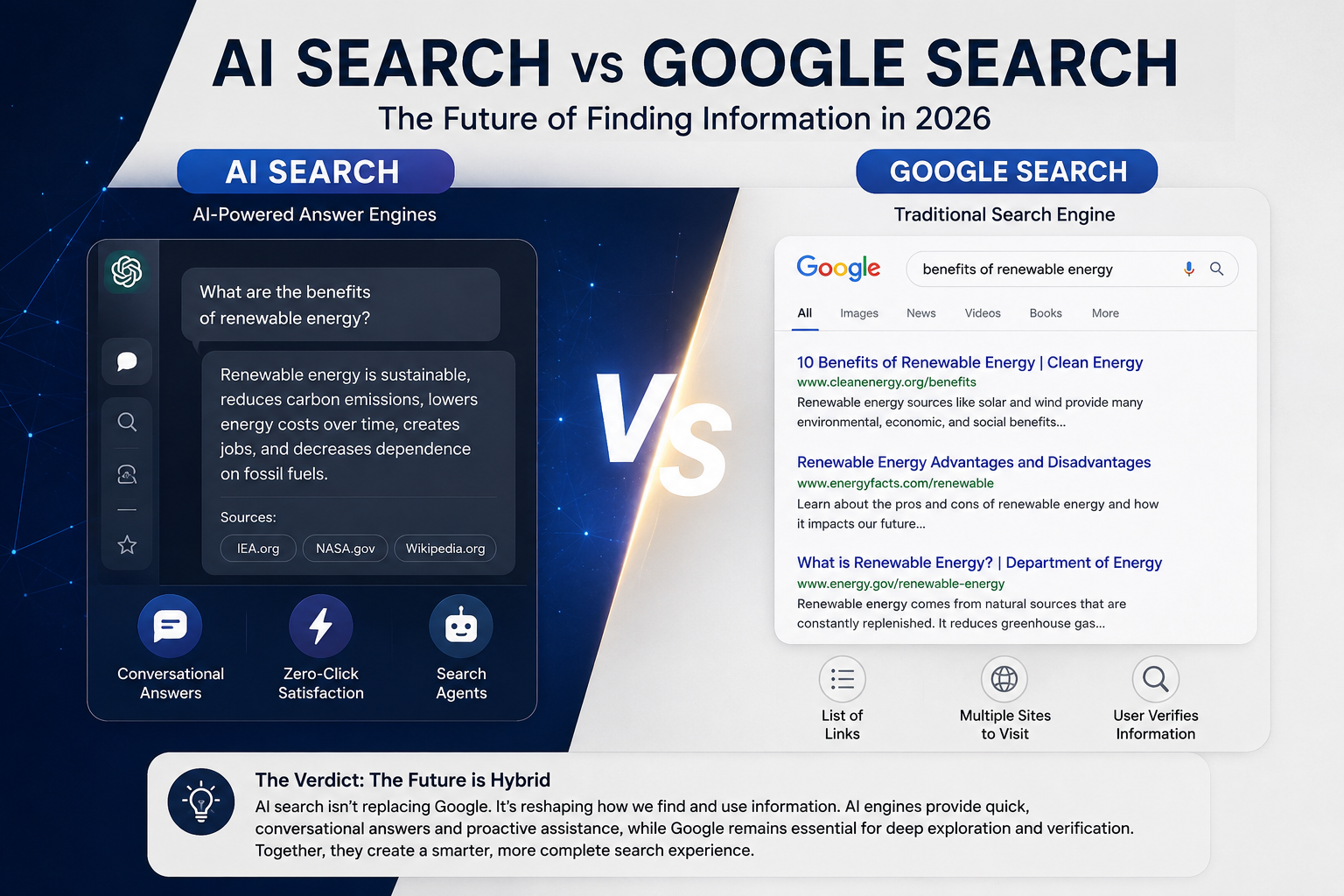
The way people search for information is undergoing its biggest transformation in decades. While Google Search continues to be the world’s leading gateway to the web, AI-powered answer engines like ChatGPT, Gemini, and Perplexity are changing how users discover knowledge. Instead of presenting a list of links, these platforms provide direct, conversational, and context-aware answers, making research faster and more intuitive. In 2026, the future of search is no longer about choosing between AI and Google—it’s about how both technologies work together to deliver smarter, more efficient access to information.
The Digital Front Door Has Changed
For more than twenty years, Google Search dominated how people discovered information online. Its familiar list of blue links became the standard way to navigate the internet. In 2026, however, AI-powered search assistants such as ChatGPT, Gemini, and Perplexity have introduced a new approach by providing complete, conversational answers instead of simply directing users to websites.
Rather than replacing traditional search, these AI platforms are transforming the way people research, compare products, and make decisions.
Why AI Search Is Growing
The shift toward AI search reflects changing user expectations. Many people are frustrated by crowded search results, increasing advertisements, and the need to visit multiple websites before finding a complete answer.
AI search engines solve this by delivering clear, summarized responses that combine information from multiple trusted sources into one easy-to-understand answer.
Conversational Search
Instead of typing short keyword phrases, users now ask natural, detailed questions. AI systems understand context, remember previous questions, and provide responses that feel like conversations rather than traditional search results.
This creates a faster and more intuitive search experience for everyday users.
Zero-Click Answers
One of the biggest trends in 2026 is the rise of zero-click searches. Rather than opening several websites, users often receive complete answers directly within the AI interface.
While this changes how websites receive traffic, it provides users with quicker access to accurate information and reduces the time spent searching.
The Rise of Search Agents
AI has evolved beyond simple question answering. Modern Search Agents can continuously monitor information, compare prices, track products, research apartments, and perform other ongoing tasks automatically.
Instead of waiting for users to search repeatedly, these intelligent assistants work in the background and deliver updates when needed.
SEO vs. GEO: A New Digital Strategy
The growth of AI search has created a new discipline known as Generative Engine Optimization (GEO).
Traditional Search Engine Optimization (SEO) focuses on ranking higher in Google’s search results through keyword optimization, backlinks, technical performance, and page speed.
GEO focuses on making content clear, trustworthy, and well-structured so AI systems are more likely to cite it when generating answers.
How Businesses Can Succeed
Success in 2026 requires a balanced strategy. Businesses still need strong SEO to remain visible in traditional search results, but they also need GEO to increase the likelihood of becoming a trusted source within AI-generated responses.
High-quality content, factual accuracy, direct question-and-answer formatting, and demonstrated expertise are becoming more valuable than ever.
The Verdict: A Hybrid Future
AI search is not replacing Google—it is reshaping how people interact with information.
Google remains essential for discovering websites, verifying information, and exploring topics in depth. Meanwhile, AI answer engines are becoming the preferred starting point for research, recommendations, and decision-making.
The most successful brands and users in 2026 understand that AI search and traditional search work best together. AI creates the first impression by delivering instant insights, while Google provides the deeper exploration and verification that complete the user’s journey.
Conclusion
The future of search is no longer a competition between AI and Google—it’s a collaboration. AI answer engines excel at delivering fast, conversational insights, while Google remains the go-to platform for exploring sources and verifying information. As user behavior continues to evolve, individuals and businesses that embrace both technologies will be better equipped to find, share, and create trustworthy information in the AI-powered digital era.