




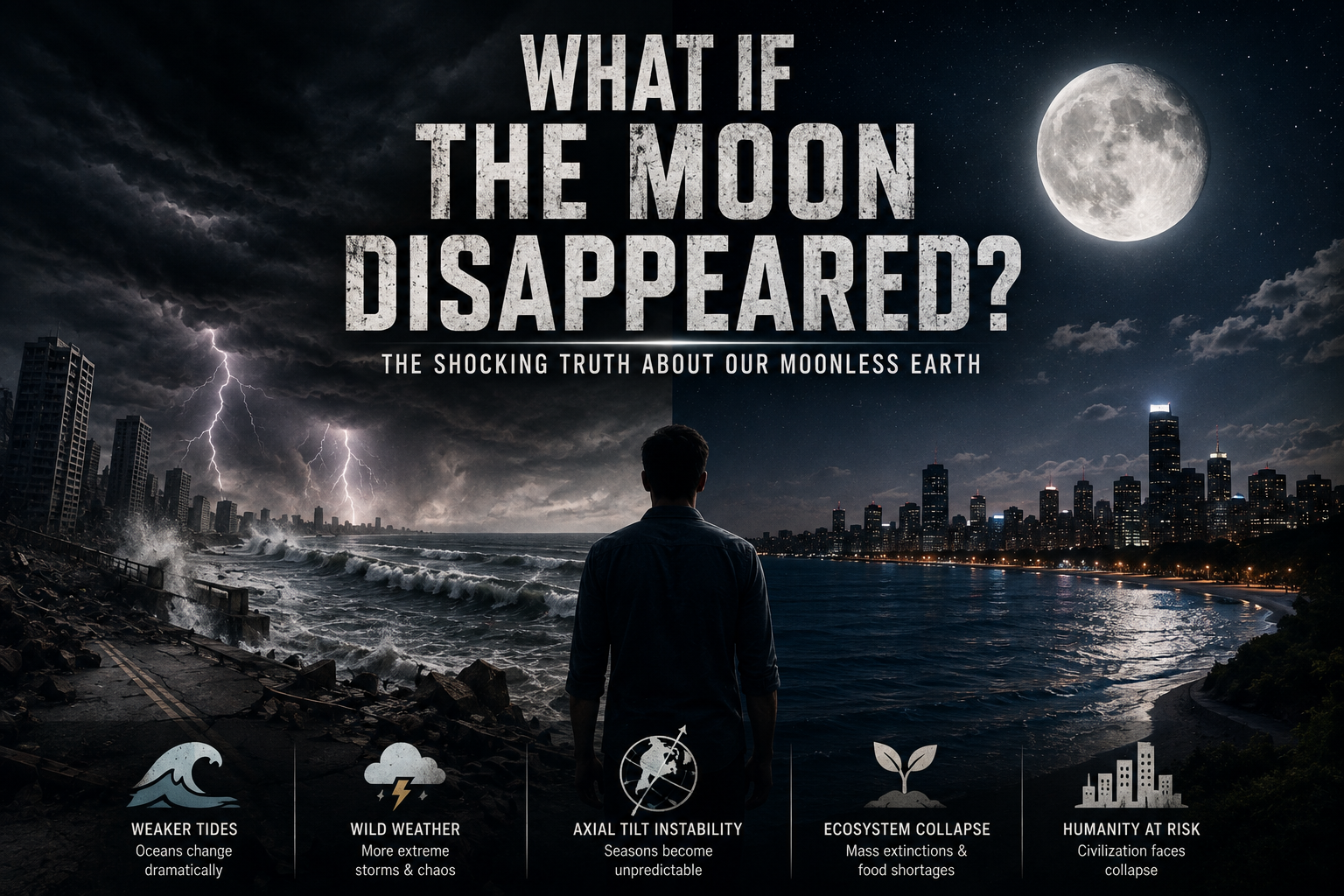
For as long as humanity has walked the Earth, our pale, cratered companion has hung in the night sky. The Moon dictates our tides, has inspired countless myths, and has even played a stabilizing role in keeping our planet's climate predictable. But have you ever stopped to wonder: What if the Moon suddenly disappeared?
It sounds like the plot of a Hollywood sci-fi blockbuster, but astrophysicists have actually modeled what would happen to Earth if the Moon vanished into thin air. The short answer? We would be in catastrophic trouble. From the oceans to the sky, and right down to the ground beneath our feet, the loss of the Moon would rewrite the laws of life on Earth.
1. The Immediate Aftermath: Silence, Darkness, and Strange Tides
The very first thing you would notice—assuming you looked up—is that the night sky would suddenly feel terribly empty. The iconic glow of a full moon would be gone forever, leaving only starlight and distant planets to illuminate the dark. But the optical shock would pale in comparison to the physical shock hitting our oceans.
The Moon’s gravity is the primary driver of Earth's ocean tides. While the Sun also exerts a gravitational pull, it is less than half as strong as the Moon's in terms of tidal generation. Without the Moon:
- Ocean tides would instantly shrink by about 70%.
- Coastal ecosystems would face immediate disruption, as marine life dependent on strong tidal currents for nutrients would struggle to survive.
- High and low tides would merge into weak, sluggish pulses dictated solely by the Sun.
2. Nighttime Becomes Pitch Black
Throughout evolutionary history, nocturnal animals have relied on moonlight to navigate, hunt, and reproduce. Without it, nocturnal predators would find themselves shrouded in near-total darkness. Prey animals might initially rejoice, but the predatory imbalance would crash entire ecosystems.
Humanity wouldn't be immune either. Urban areas would remain lit by electricity, but rural regions, shipping lanes, and traditional navigation would face a dramatic drop in nocturnal visibility. The cultural impact—the loss of the muse for poets, lovers, and stargazers—would be profound.
3. The Slow Apocalypse: Earth's Axial Tilt Goes Wild
While the immediate changes to tides and nights would be shocking, the long-term consequences are far more terrifying. Right now, Earth maintains an axial tilt of about 23.5 degrees. This tilt is what gives us our distinct seasons—summer, autumn, winter, and spring.
What keeps that tilt stable? The gravitational anchor of the Moon.
Without the Moon acting as a cosmic gyroscope, Earth’s tilt would begin to wobble wildly over thousands of years, shifting anywhere from 0 degrees to as much as 85 degrees. An 85-degree tilt would mean Earth would spin on its side, much like Uranus. The consequences of a wild axial tilt include:
- Extreme Climate Shifts: Regions currently enjoying mild temperate climates could swing violently from scorching tropical heatwaves to glacial ice ages within a single generation.
- Unfarmable Lands: Traditional agriculture would collapse. Crops rely on predictable seasonal cycles; erratic weather changes would make global food production nearly impossible.
- Mass Extinctions: Flora and fauna unable to adapt to rapid, extreme climate swings would face swift extinction.
4. Days Would Get Shorter
Did you know that the Moon is actually slowing down Earth's rotation through tidal friction? Billions of years ago, a day on Earth lasted only a few hours. As the Moon slowly recedes from Earth, our planet's rotation continues to decelerate.
If the Moon vanished, Earth's rotation would lock into its current speed trajectory, but over millions of years, the lack of lunar drag would alter how angular momentum behaves. More immediately, however, weather patterns would change. The Coriolis effect—which is driven by Earth's rotation and shapes global wind and storm patterns—would shift, creating hyper-intense hurricanes and super-storms.
5. Can Humanity Survive a Moonless Earth?
If the Moon disappeared tomorrow, humanity wouldn't go extinct on day one. We have technology, indoor agriculture, and advanced climate-control capabilities. However, civilization as we know it would buckle under the pressure.
Global supply chains would break down as coastal cities flooded or dried up due to erratic sea-level redistributions. Wars over dwindling arable land and resources would likely break out. Humanity would be forced to retreat into underground or heavily engineered geodesic habitats to survive the radical climate fluctuations caused by the lost axial stabilizer.
Conclusion: Our Indispensable Companion
We often take the Moon for granted, viewing it as a pretty ornament in the night sky or a milestone for historical space missions. In reality, the Moon is an active, vital partner in Earth’s habitability. It keeps our seasons steady, our oceans moving, and our climate balanced.
So, the next time you step outside and look up at a glowing crescent or a brilliant harvest moon, remember: that quiet rock in space is the ultimate guardian of life on Earth.