





Artificial intelligence is often described as a clean, invisible technology that exists entirely in the digital world. Every time we ask a chatbot a question, generate an AI image, or use an intelligent recommendation system, it feels as though the process happens effortlessly inside a “cloud.” In reality, there is nothing weightless about AI. Behind every response lies a vast global network of data centers packed with powerful processors, cooling systems, storage devices, and high-speed networking equipment that operate around the clock. These facilities consume enormous amounts of electricity, water, raw materials, and land, creating an environmental footprint that is growing at an unprecedented pace.
A comprehensive report published by the United Nations University Institute for Water, Environment and Health (UNU-INWEH) has brought this hidden reality into the global spotlight. The report, titled Environmental Cost of AI’s Energy Use: Carbon, Water and Land Footprints, argues that the rapid expansion of artificial intelligence is creating significant pressure on the world’s natural resources. While AI continues to unlock incredible opportunities in healthcare, education, scientific research, finance, and manufacturing, the infrastructure supporting this digital revolution carries a very real environmental cost that cannot be ignored.
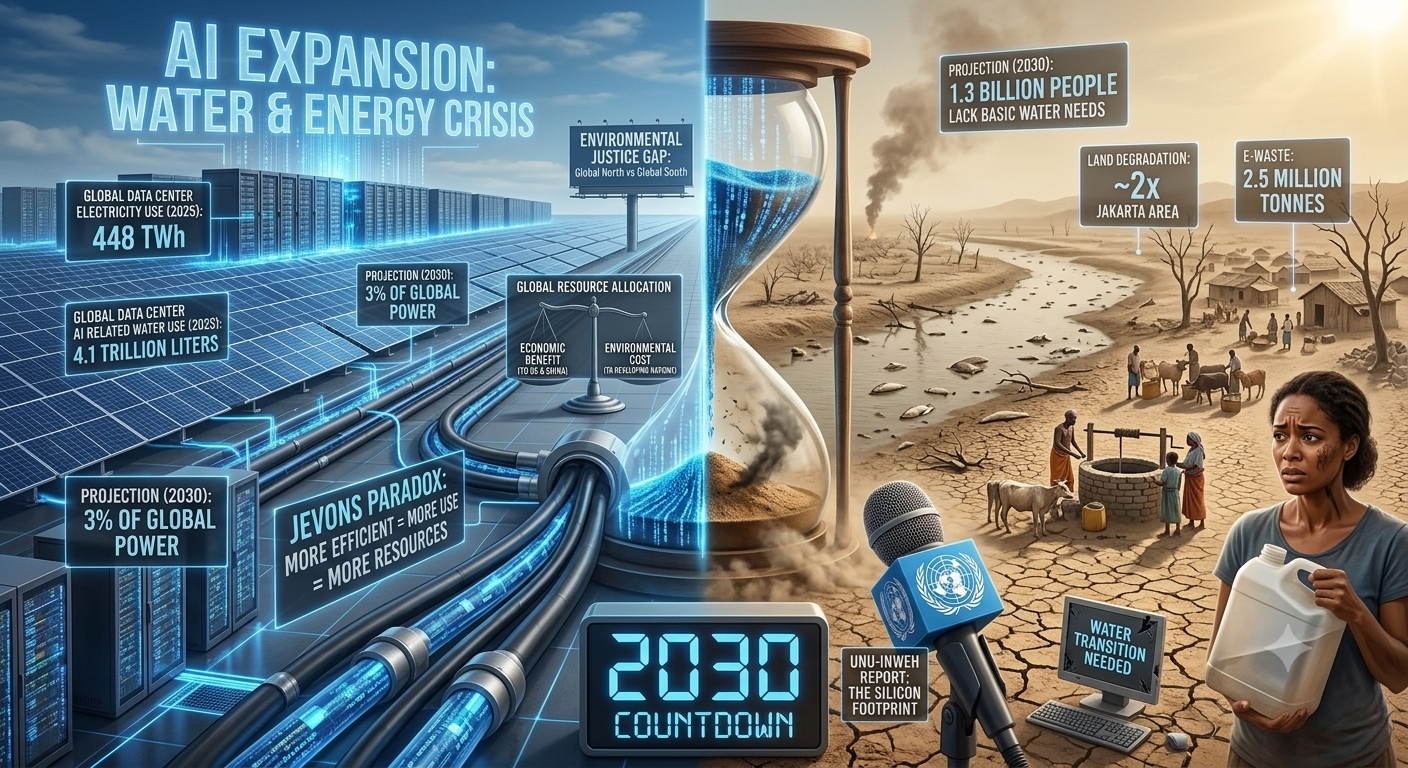
One of the report’s most striking findings concerns electricity consumption. By 2025, global data centers were estimated to consume approximately 448 terawatt-hours (TWh) of electricity each year. To understand the scale of this figure, imagine data centers as their own country. If they were treated as a nation, they would already rank among the world’s largest electricity consumers, using more power annually than many industrialized economies. Every AI model, cloud application, streaming service, and online platform contributes to this rapidly increasing demand, placing additional pressure on already stressed electrical grids worldwide.
The report warns that this demand is only beginning. As artificial intelligence becomes more deeply integrated into everyday business operations, scientific research, government services, and consumer applications, electricity requirements are projected to accelerate dramatically. By 2030, global data center electricity consumption could exceed 945 terawatt-hours annually, representing roughly 3% of total global electricity usage. Such growth would require significant expansion of energy generation capacity, transmission infrastructure, and backup power systems, creating new challenges for countries already working toward climate and energy security goals.
Electricity, however, represents only one dimension of AI’s environmental footprint. Behind every megawatt powering a server lies another critical resource: water. Modern data centers generate enormous amounts of heat as thousands of advanced processors perform billions of calculations every second. To maintain stable operating temperatures, cooling systems require vast quantities of water, either directly within cooling equipment or indirectly through power generation facilities supplying electricity to the servers. This hidden water dependency has become one of the least understood consequences of AI expansion.
According to the UN report, AI-related infrastructure could require approximately 9.3 trillion liters of water every year by 2030. To appreciate the magnitude of this figure, it is roughly equivalent to the annual domestic water needs of 1.3 billion people. As climate change intensifies droughts and freshwater shortages across many regions, balancing the needs of rapidly growing digital infrastructure with the water requirements of agriculture, industry, and local communities will become an increasingly difficult challenge. Water conservation is no longer solely an environmental issue—it is becoming a strategic component of responsible AI development.
The expansion of artificial intelligence also carries a substantial physical footprint on land. Data centers cannot simply exist in cyberspace; they require enormous campuses filled with specialized buildings, electrical substations, cooling facilities, fiber-optic networks, backup generators, and supporting infrastructure. Additional land is needed for renewable energy installations, transmission lines, mining operations, semiconductor manufacturing plants, and logistics networks that support the entire AI ecosystem. Collectively, these developments are projected to occupy more than 14,500 square kilometers by the end of the decade, transforming landscapes across multiple continents.
Public discussion often focuses on the immense computing power required to train large language models, but the report identifies another, even larger challenge: AI inference. Training an advanced AI model is an energy-intensive process, but it happens relatively infrequently. Once deployed, however, millions or even billions of users interact with that model every day. Every prompt submitted to a chatbot, every AI-assisted search, every generated image, and every automated recommendation requires fresh computational work. Over time, these continuous interactions consume far more electricity than the initial training process, accounting for an estimated 80–90% of total AI energy demand.
The difference between various AI tasks is also surprisingly large. Simple operations, such as basic text classification, require relatively little computing power. In contrast, conversational AI systems capable of generating detailed responses consume dramatically more energy because they perform complex reasoning and language generation for every interaction. Image generation requires even greater computational resources, while AI-generated video represents one of the most demanding workloads currently available. As users increasingly shift toward multimedia AI applications, the total resource demand grows exponentially.
Another major concern highlighted in the report is the Jevons Paradox, often referred to as the rebound effect. Many technology companies emphasize that newer AI chips and software models are becoming more energy efficient, and this is true from a technical perspective. However, history repeatedly demonstrates that greater efficiency frequently leads to greater overall consumption rather than lower resource usage. As AI services become faster, cheaper, and easier to access, businesses and consumers simply use them more often. The resulting surge in demand can completely offset the efficiency gains achieved through engineering improvements, causing total energy and resource consumption to continue rising despite technological progress.
Beyond environmental concerns, the report also highlights a growing issue of global inequality. More than 90% of specialized AI computing capacity remains concentrated within a small number of technologically advanced nations, particularly the United States and China. Meanwhile, over 150 countries possess limited domestic AI infrastructure and depend heavily on foreign cloud providers. This imbalance creates an uneven distribution of both economic benefits and environmental burdens, with wealthier nations capturing much of the technological value while many developing countries bear the environmental consequences associated with mining, manufacturing, and electronic waste disposal.
Electronic waste presents another rapidly growing challenge. AI hardware evolves quickly, with companies continuously replacing processors, networking equipment, memory systems, and storage devices to remain competitive. The UN projects that AI-related electronic waste could reach approximately 2.5 million tonnes annually by 2030 if current trends continue. Disposing of this equipment safely requires advanced recycling systems capable of recovering valuable materials while preventing hazardous substances from contaminating soil and water. Unfortunately, much of the world’s electronic waste is exported to developing regions where recycling infrastructure remains limited, raising serious environmental and public health concerns.
The demand for advanced semiconductors also drives significant growth in mining activities. AI chips rely on numerous critical minerals, including rare earth elements and highly purified materials extracted through energy-intensive industrial processes. Expanding global production of these resources places additional pressure on ecosystems, water supplies, and local communities while introducing new geopolitical competition over strategic mineral reserves. Building a sustainable AI future therefore requires addressing not only computing efficiency but also responsible sourcing throughout the entire supply chain.
Recognizing these growing challenges, United Nations Secretary-General António Guterres has called for stronger international cooperation through initiatives promoting environmental transparency across the AI industry. The proposed framework encourages technology companies to disclose the full carbon, water, land, and material footprints associated with their operations. Greater transparency would allow governments, investors, researchers, and consumers to better understand the environmental consequences of AI deployment while encouraging companies to compete not only on technological performance but also on sustainability.
Experts emphasize that the report is not an argument against artificial intelligence itself. AI remains one of the most transformative technologies of the modern era, with enormous potential to improve medicine, accelerate scientific discovery, optimize transportation, enhance disaster response, and increase industrial productivity. Instead, the report serves as a reminder that digital innovation must develop alongside environmental responsibility. Smarter cooling technologies, renewable energy integration, wastewater recycling, more efficient processors, sustainable data center design, and improved resource management will all play essential roles in reducing AI’s long-term ecological impact.
Ultimately, the future of artificial intelligence depends on balancing technological progress with responsible stewardship of the planet’s finite resources. Every AI-generated response may appear instantaneous and invisible, but behind that convenience lies a vast physical infrastructure consuming electricity, water, minerals, and land on an extraordinary scale. As AI becomes deeply woven into every sector of society, ensuring its growth remains environmentally sustainable will be just as important as improving its intelligence. The greatest challenge of the coming decade will not simply be building smarter machines—it will be ensuring those machines help create a smarter, more sustainable future for humanity.