



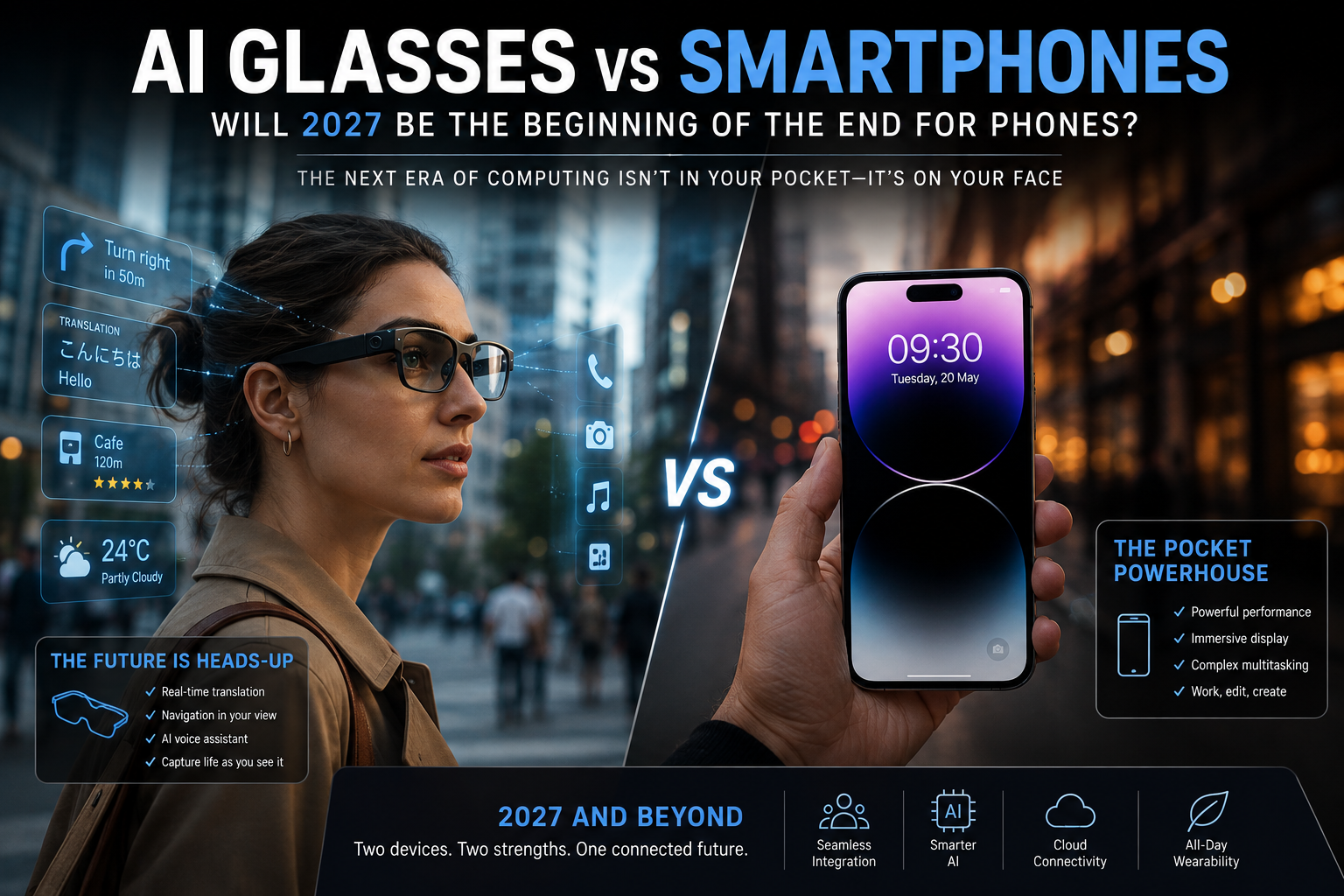
For nearly two decades, the rectangular glass slab in our pockets has served as the undisputed center of our digital universe. We check it when we wake up, clutch it anxiously during our commutes, and gaze into its glowing pixels right before we fall asleep. The smartphone has replaced our maps, cameras, wallets, and newspapers, becoming an inseparable prosthetic extension of the modern human body.
Yet, a quiet, high-stakes revolution is brewing in Silicon Valley, Shenzhen, and London. With major technology titans rolling out advanced multimodal AI assistants and lightweight frames, industry watchers are asking a provocative question: As we look toward 2027, are we witnessing the beginning of the end for the traditional smartphone? Will lightweight, voice-activated AI glasses usurp the throne, or is the pocket phone here to stay? Let’s examine the battle lines of the next great computing paradigm shift.
1. The Shift from Pocket-Bound to Heads-Up Interaction
To understand why AI glasses pose a genuine existential threat to smartphones, we must first look at the psychological friction of modern device usage. Every time we want to check a notification, translate a foreign sign, or look up a local restaurant recommendation, we are forced to break our physical engagement with the real world, reach into our pockets, unlock a screen, and navigate a maze of apps.
AI glasses eliminate this friction entirely. Powered by continuous multimodal AI models (such as advanced voice agents and computer vision), these lightweight frames allow you to simply look at your environment and ask questions aloud. Whether it's translating a street sign in real-time, identifying a rare plant species on a hike, or receiving turn-by-turn navigation cues projected gently into your field of view, the interaction model moves from manual manipulation to fluid, heads-up ambient computing.
2. The 2027 Battlefield: Ecosystems Collide
The race to dominate the post-smartphone era has officially transitioned from a theoretical science fiction concept to a cutthroat corporate arms race. The market landscape features heavyweights positioning themselves for a massive inflection point around 2027:
- Meta and EssilorLuxottica: Having successfully normalized smart eyewear with mainstream consumer adoption through successive generations of audio-and-camera AI frames, Meta continues to pave the path toward fully integrated holographic display glasses.
- Google and Android XR: Google’s strategic rollout of the Android XR ecosystem has invited hardware manufacturers like Samsung and various third-party brands to build unified operating systems tailored specifically for head-worn computing.
- Apple’s Looming Entry: Rumors from supply chains point toward Apple developing lightweight, highly refined smart eyewear set to debut in the coming years, focusing initially on seamless voice-driven AI workflows and minimalist ergonomics before tackling dense augmented reality optics.
- Agile Startups: Independent innovators like Nothing and Even Realities are proving that consumers are hungry for distinct, specialized display-first or audio-first form factors that drastically reduce reliance on traditional handsets.
3. What Smart Glasses Do Better Than Phones Today
While smart glasses cannot completely replace every function of a high-powered computer or smartphone overnight, they excel brilliantly at specific, high-frequency human tasks:
- Instant Capture and Point-of-View Sharing: Taking a photo or recording a video exactly from your natural line of sight beats fumbling for your phone camera every single time.
- Frictionless Communication: Taking calls, listening to discreet audio updates, and dictating quick text message replies via advanced noise-canceling directional microphones keeps you anchored in the physical world.
- Ambient AI Assistance: Conversing naturally with an AI assistant that can perceive what you are looking at creates a deeply intuitive partnership that text prompts on a flat screen simply cannot match.
4. The Hard Road Ahead: What’s Stopping Total Replacement?
Despite the breathless hype, the complete eradication of the smartphone by 2027 faces severe physical and cultural hurdles. Eyewear must overcome strict engineering boundaries before the mass market abandons their pocket devices:
- Thermal Management and Battery Life: Squeezing powerful processors, multi-day batteries, and high-brightness optical micro-displays into a frame weighing under 50 grams without overheating against the user's face remains a monumental engineering puzzle.
- Social Acceptance and Privacy: Continuous camera recording and data collection in public spaces raise significant privacy concerns and social etiquette questions that the industry is still struggling to navigate.
- The Need for Heavy Processing: Complex workflows—such as professional video editing, deep document multitasking, secure banking authentication, and full-screen media consumption—still require the robust graphical processing power and physical screen estate of a traditional smartphone or laptop.
Conclusion: Companion Device or True Killer App?
So, will 2027 mark the absolute end of the smartphone? The honest answer is nuanced. Smartphones are unlikely to vanish entirely by next year; rather, their role in our daily lives is beginning to undergo a fundamental transformation.
Just as the smartphone relegated desktop computers to secondary status for specific intensive tasks, AI glasses are positioned to become our primary day-to-day interface. They will take over 60 to 70 percent of our brief, glanceable, text-and-voice interactions—allowing our smartphones to transform into heavy-duty backend power banks resting quietly inside our backpacks. The screen in our pocket isn't dying tomorrow, but its monopoly on our attention is officially coming to an end.