





Introduction
Despite extraordinary advances in science, technology, and archaeology, humanity continues to face questions that remain unanswered. From the deepest reaches of space to the earliest moments of life on Earth, some mysteries continue to challenge researchers, historians, and scientists around the world. Every year, new discoveries solve old puzzles, but they also uncover new questions that deepen our curiosity. These enduring mysteries remind us that, despite all our knowledge, there is still much about our universe and our history that we have yet to understand.
Below are some of the greatest unsolved mysteries that continue to fascinate experts and the public alike.
The Frontiers of Science
Some of the world’s biggest mysteries are not hidden in ancient ruins but exist within the very laws of nature. Scientists have developed remarkable theories to explain the universe, yet several fundamental questions remain unanswered.
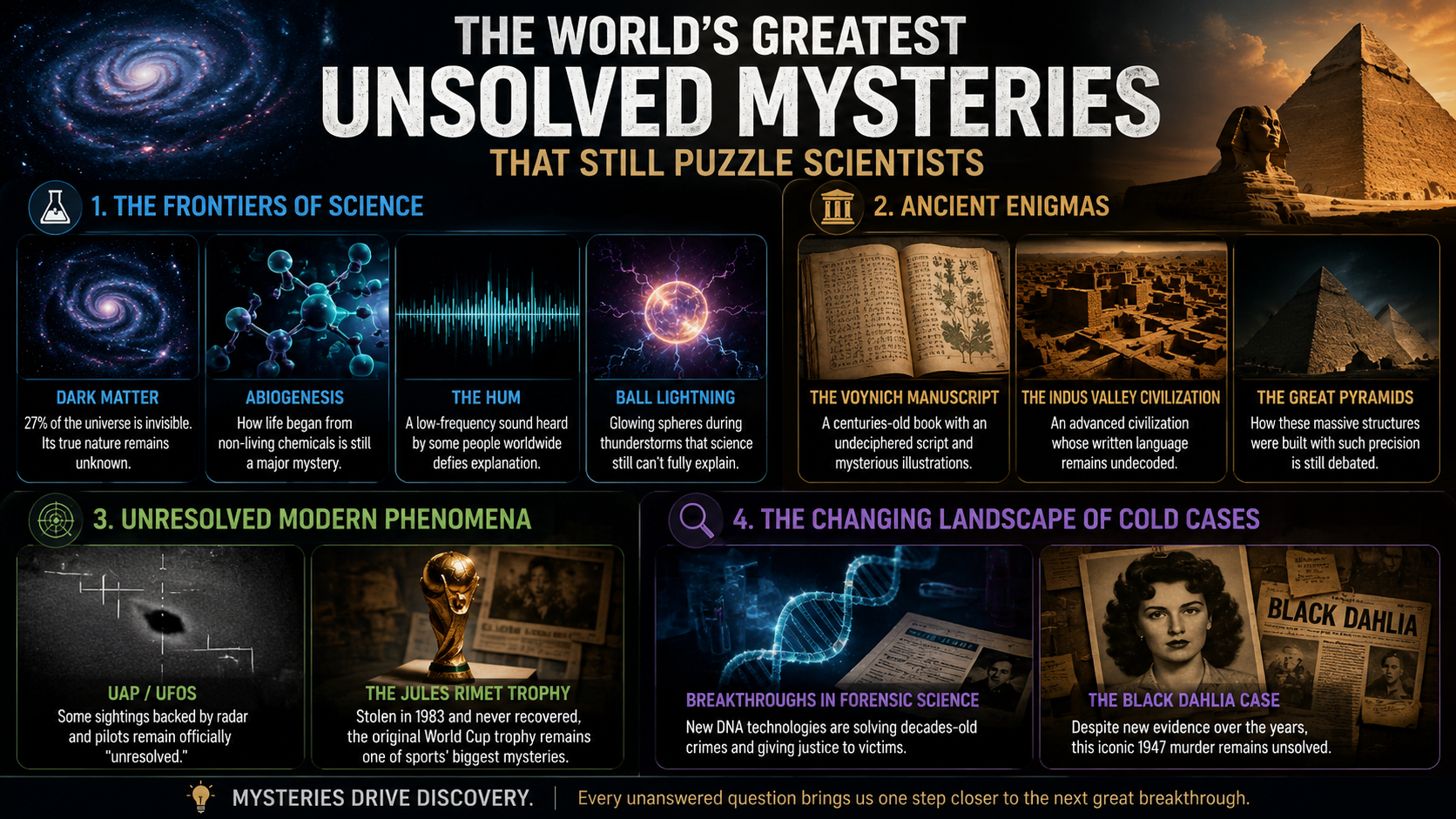
Dark Matter
Astronomers estimate that nearly 27% of the universe is made up of dark matter, an invisible substance that neither emits nor reflects light. Although scientists cannot observe dark matter directly, they know it exists because of its powerful gravitational effects on galaxies and galaxy clusters. Without dark matter, galaxies would not hold together as they do today. Despite decades of research using powerful telescopes and particle detectors, researchers still don’t know what dark matter is actually made of, making it one of the greatest mysteries in modern physics.
Abiogenesis
Evolution explains how living organisms developed over billions of years, but it does not explain how life first began. Abiogenesis refers to the process through which non-living chemicals somehow organized themselves into the first self-replicating cells. Scientists have recreated some of the chemical reactions that may have occurred on early Earth, but the exact sequence of events that transformed simple molecules into living organisms remains unknown. Understanding this process would answer one of humanity’s oldest questions: how life first appeared on our planet.
The Hum
Around the world, a small percentage of people report hearing a persistent, low-frequency humming sound that others cannot detect. Known simply as “The Hum,” this mysterious phenomenon has been reported in countries including the United States, the United Kingdom, Canada, Australia, and New Zealand. Researchers have investigated possible explanations ranging from industrial machinery and electrical systems to hearing disorders and environmental vibrations. However, no single explanation accounts for every reported case, leaving the phenomenon largely unexplained.
Ball Lightning
Ball lightning is one of the rarest and most mysterious weather phenomena ever documented. Witnesses describe glowing spheres of light that appear during thunderstorms, floating through the air for several seconds before disappearing or exploding. Despite hundreds of reports over the centuries, scientists have struggled to recreate ball lightning under controlled laboratory conditions. Various theories suggest it may involve plasma, vaporized silicon, or electromagnetic fields, but no explanation has been universally accepted.
Ancient Enigmas
History is filled with remarkable civilizations, mysterious artifacts, and engineering achievements that continue to puzzle experts. Modern technology has solved many historical mysteries, yet several significant questions remain unanswered.
The Voynich Manuscript
The Voynich Manuscript is one of history’s most mysterious books. Dating back to the early 15th century, it contains hundreds of pages filled with unknown symbols, strange botanical illustrations, astronomical diagrams, and unusual human figures. Despite extensive analysis by linguists, cryptographers, historians, and even artificial intelligence systems, no one has successfully decoded its writing. Whether it represents a real language, an elaborate code, or an ingenious hoax remains one of history’s greatest unanswered questions.
The Indus Valley Civilization
The Indus Valley Civilization was one of the world’s earliest urban societies, flourishing over 4,000 years ago across present-day Pakistan and northwestern India. Cities such as Mohenjo-daro and Harappa featured advanced drainage systems, planned streets, and sophisticated architecture. However, the civilization’s written script has never been deciphered. Because researchers cannot read its inscriptions, much about its politics, religion, culture, and daily life remains unknown, making it one of archaeology’s greatest puzzles.
The Great Pyramids
The Great Pyramids of Giza continue to amaze engineers and archaeologists. Built more than 4,500 years ago, these massive structures consist of millions of stone blocks, some weighing several tons. While historians generally agree that skilled workers built the pyramids using ingenious engineering methods, the precise construction techniques and logistical planning continue to be studied and debated. New technologies, including ground-penetrating radar and muon scanning, continue to reveal hidden chambers and deepen our understanding of these ancient wonders.
Unresolved Modern Phenomena
Even in today’s highly connected world, certain mysteries continue to resist clear explanations despite advanced technology and extensive investigation.
UAPs (Unidentified Anomalous Phenomena)
Previously known as UFOs, Unidentified Anomalous Phenomena have become the subject of increased scientific and governmental attention. Advances in radar systems, satellite monitoring, and military sensors have allowed investigators to analyze unusual aerial events more carefully than ever before. While many sightings eventually receive conventional explanations, a small number remain officially unresolved after extensive analysis. Researchers continue studying these cases without drawing conclusions about their origins, emphasizing the importance of evidence-based investigation.
The Jules Rimet Trophy
The original FIFA World Cup trophy, known as the Jules Rimet Trophy, disappeared in Brazil in 1983 after being stolen from the headquarters of the Brazilian Football Confederation. Despite extensive police investigations, the trophy has never been recovered. Some believe it was melted down and sold for its gold, while others speculate it may still exist in a private collection. Its disappearance remains one of the most famous unsolved mysteries in sports history.
The Changing Landscape of Cold Cases
Advances in forensic science are transforming criminal investigations that once seemed impossible to solve. Techniques such as forensic genetic genealogy, advanced DNA sequencing, and improved digital analysis have enabled investigators to identify previously unknown victims and suspects decades after crimes occurred.
Many long-forgotten kidnapping cases, unidentified human remains, and unsolved murders have finally been resolved through these breakthroughs, bringing long-awaited answers to victims’ families. However, some of history’s most famous cold cases continue to remain unsolved.
One of the best-known examples is the 1947 Black Dahlia murder. Despite decades of investigations, countless theories, and periodic claims of new evidence, the identity of the killer has never been definitively established. Cases like this continue to capture public imagination while reminding investigators that some mysteries may take generations to solve.
Why These Mysteries Matter
Unsolved mysteries are more than fascinating stories—they drive scientific discovery, historical research, and technological innovation. Every unanswered question encourages researchers to develop better tools, challenge existing theories, and explore new possibilities. Many of today’s scientific breakthroughs began with questions that once seemed impossible to answer.
As technology continues to evolve, mysteries that have puzzled humanity for centuries may eventually be solved. Yet each discovery often reveals even deeper questions, ensuring that curiosity remains one of humanity’s greatest strengths.
Conclusion
From invisible matter that shapes the universe to ancient civilizations whose languages remain unread, the world’s greatest mysteries continue to inspire scientists, historians, and curious minds alike. While remarkable progress has been made in solving many longstanding puzzles, some questions remain beyond our current understanding. These mysteries remind us that exploration and discovery are ongoing journeys, and the next breakthrough could be just around the corner. Until then, they continue to fuel our imagination and push humanity toward new frontiers of knowledge.