





Introduction
The artificial intelligence revolution has fundamentally transformed the content creation industry. What started as a collection of tools for generating text, images, and simple designs has evolved into an intelligent ecosystem capable of supporting nearly every stage of the creative process. In 2026, AI is no longer viewed as an optional productivity enhancer—it has become an essential part of modern content operations.
Businesses, publishers, marketers, YouTubers, bloggers, educators, and entrepreneurs are embracing AI-powered workflows to produce higher-quality content in less time while maintaining consistency across multiple platforms. However, the biggest competitive advantage no longer comes from simply subscribing to the latest AI tools. Success depends on building efficient systems that combine automation with human creativity.
The content industry has entered a new era where speed, scalability, personalization, and strategic thinking determine long-term success. AI can handle repetitive tasks with remarkable efficiency, but human expertise remains irreplaceable when it comes to storytelling, emotional connection, critical thinking, and originality. The organizations leading the market today understand that AI works best as a creative partner rather than a replacement for human talent.
This shift represents one of the most significant changes in digital publishing since the rise of social media and search engine optimization. Companies that successfully integrate AI into structured workflows are outperforming competitors while reducing production costs and increasing creative output.
The Shift from AI Tools to AI Systems
During the early years of generative AI, creators focused heavily on finding the “best AI tool.” Every month brought a new writing assistant, image generator, or automation platform promising revolutionary improvements. While these tools offered impressive capabilities, many users found themselves overwhelmed by disconnected subscriptions and inefficient workflows.
By 2026, the focus has shifted away from individual applications toward complete AI-native systems. Instead of relying on isolated tools, successful creators now build integrated workflows where AI manages repetitive production tasks while humans supervise quality, strategy, and creative direction.
This systems-first approach creates a seamless pipeline where research, planning, writing, editing, optimization, publishing, and analytics work together. Rather than starting every project from scratch, creators use AI to automate routine activities, allowing more time for innovation and audience engagement.
The result is a more organized, scalable, and sustainable content production process that delivers consistent quality without exhausting creative teams.
Systems Over Subscriptions: The New Competitive Advantage
One of the biggest lessons of 2026 is that purchasing more AI subscriptions does not automatically improve productivity. Many organizations spend thousands of dollars every year on premium AI software without achieving meaningful gains because their workflow lacks structure.
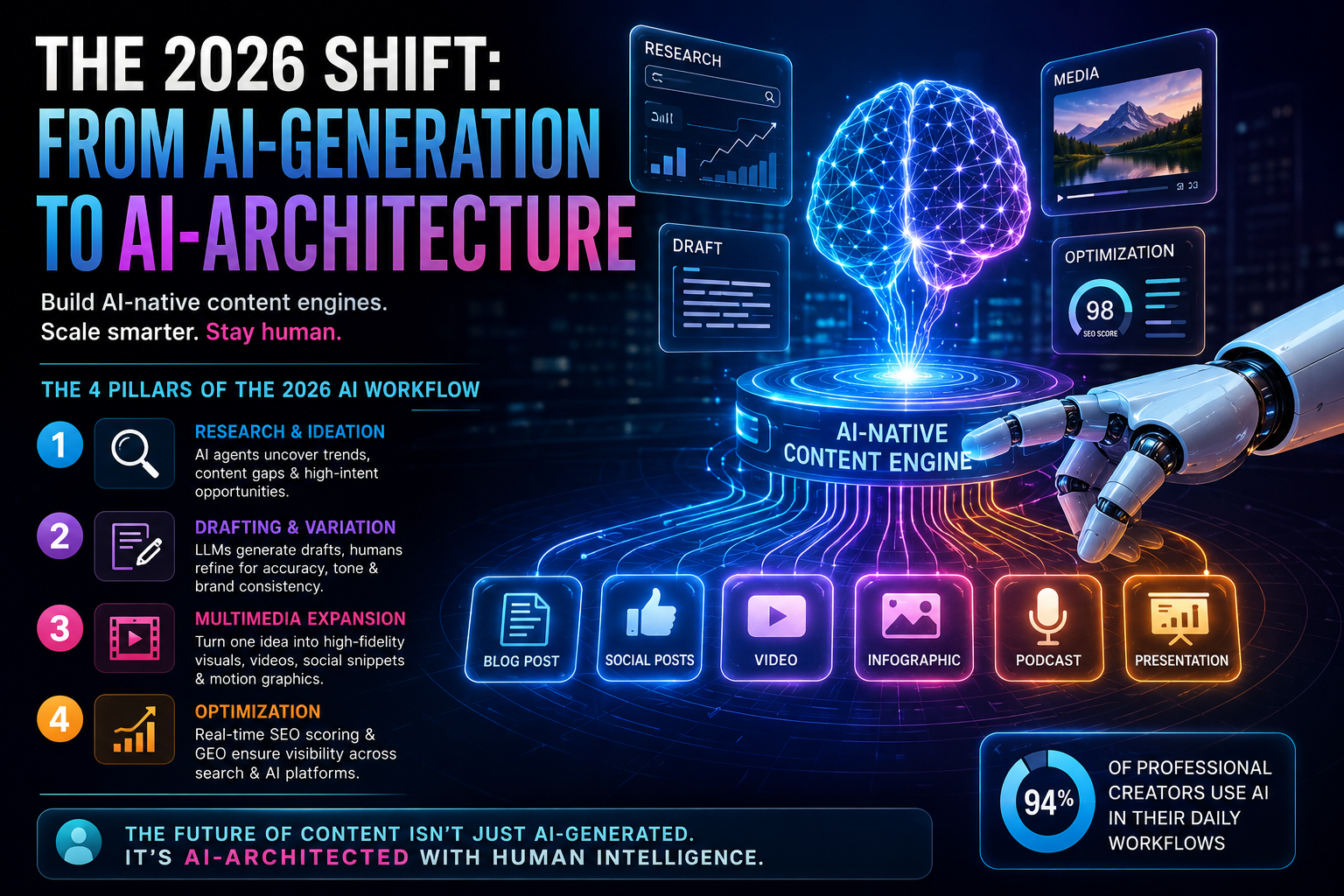
The most successful businesses build AI content engines instead of AI collections. These engines connect multiple technologies into a single production process where information flows automatically between research, drafting, editing, design, publishing, and analytics.
For example, keyword research feeds directly into content planning. AI-generated outlines become structured articles. Image generation tools automatically create visual assets. SEO optimization software analyzes content before publication, while analytics platforms monitor performance after release.
This integrated approach dramatically reduces manual work while improving consistency across all published content.
Organizations adopting AI-native systems report significant improvements in efficiency, accuracy, and scalability compared to businesses relying solely on standalone AI applications.
Production Velocity: Scaling Content Like Never Before
One of AI’s greatest strengths is its ability to increase production speed without sacrificing quality when properly supervised. Traditional content creation often requires days or even weeks to research, write, edit, and publish comprehensive articles or multimedia campaigns.
AI-powered workflows have dramatically shortened these timelines.
Modern content teams routinely produce three to five times more content than they could only a few years ago. This increase in production allows businesses to publish comprehensive topic clusters, maintain active social media channels, update existing content more frequently, and respond quickly to emerging trends.
Higher production velocity also supports better search visibility. Search engines increasingly reward websites that consistently publish authoritative, high-quality content covering complete subject areas.
Instead of producing one article each week, organizations can now create multiple interconnected resources that strengthen topical authority and improve long-term organic rankings.
This speed advantage enables brands to capture opportunities before competitors even begin producing similar content.
The Human-Native Correction
Although AI has dramatically improved productivity, it has also created a new challenge: content saturation.
Millions of AI-generated articles, social media posts, videos, and images are published every day. Much of this content sounds generic, repetitive, and emotionally disconnected. This phenomenon is often described as “AI slop”—content that is technically correct but lacks originality, personality, and genuine value.
As audiences become more familiar with AI-generated writing, they increasingly recognize formulaic language and repetitive structures.
This has created a powerful market correction.
Rather than rewarding purely automated content, readers now value authenticity, personal experience, unique perspectives, and expert insights more than ever before.
Successful creators combine AI’s efficiency with distinctly human qualities such as storytelling, humor, empathy, creativity, and critical analysis.
The future belongs not to fully automated content but to hybrid content where AI handles repetitive production while humans contribute expertise, originality, and emotional resonance.
Pillar One: AI-Powered Research and Ideation
Every successful piece of content begins with strong research.
Modern AI search agents have transformed this stage by rapidly analyzing massive amounts of information from across the internet. Instead of manually reviewing dozens of websites, creators can now identify trending topics, competitor strategies, audience questions, and keyword opportunities within minutes.
AI research tools help creators discover:
- Emerging industry trends before they become mainstream.
- High-intent search queries with commercial potential.
- Frequently asked customer questions.
- Competitor content gaps.
- Seasonal content opportunities.
- Audience pain points.
- Content performance patterns.
- Semantic keyword relationships.
These insights allow marketers and publishers to make data-driven editorial decisions rather than relying on intuition alone.
The result is content that better aligns with user intent and delivers greater long-term visibility.
Pillar Two: Drafting and Human-Guided Writing
Large Language Models have become exceptionally capable at generating structured first drafts.
They can organize complex topics, summarize information, generate outlines, rewrite paragraphs, and adapt writing styles for different audiences.
However, leading organizations no longer publish AI-generated drafts without review.
Instead, they implement human-in-the-loop editing systems where experienced writers evaluate every draft for:
- Accuracy
- Clarity
- Brand consistency
- Originality
- Tone
- Compliance
- Readability
- Audience relevance
Editors also add proprietary research, real-world examples, case studies, expert opinions, and company-specific insights that AI cannot independently create.
This collaborative process produces content that combines AI’s speed with human credibility.
Pillar Three: Multimedia Expansion
Modern content marketing extends far beyond written articles.
Every successful idea now expands across multiple formats including images, videos, podcasts, infographics, newsletters, short-form social content, and interactive experiences.
Advanced AI platforms make this transformation remarkably efficient.
A single article can become:
- Multiple Instagram posts
- LinkedIn articles
- Facebook updates
- X (Twitter) threads
- YouTube Shorts
- TikTok videos
- Pinterest graphics
- Email newsletters
- Podcast scripts
- Presentation slides
- Infographics
- Motion graphics
Image generation technology has reached cinematic quality, while video generation models produce increasingly realistic animations from simple prompts.
This multimedia approach maximizes audience reach while maintaining consistent messaging across platforms.
Pillar Four: Optimization for Search and AI Discovery
Publishing quality content is only part of the equation.
Content must also be optimized for discoverability.
Traditional SEO remains important, but 2026 has introduced a new discipline known as Generative Engine Optimization (GEO).
Unlike traditional SEO, which focuses on search engine rankings, GEO aims to increase the likelihood that AI-powered search assistants reference, summarize, or cite content when answering user questions.
Effective optimization now includes:
- Clear heading structures.
- Semantic keyword coverage.
- Authoritative sources.
- Comprehensive topic depth.
- Well-organized formatting.
- Structured data.
- Fast-loading pages.
- Internal linking.
- Citation-friendly writing.
- Factual accuracy.
Businesses investing in both SEO and GEO gain greater visibility across search engines as well as AI-powered discovery platforms.
AI Is Changing the Role of Content Creators
The traditional image of the lone writer creating every piece of content manually is gradually disappearing.
Modern creators increasingly function as creative directors who manage AI systems, coordinate production workflows, evaluate quality, and shape strategic direction.
Their responsibilities include:
- Developing content strategies.
- Defining brand voice.
- Reviewing AI outputs.
- Ensuring factual accuracy.
- Supervising creative campaigns.
- Maintaining ethical standards.
- Building audience relationships.
- Monitoring performance metrics.
Instead of spending hours formatting articles or generating repetitive copy, creators invest their time in high-value decision-making.
This shift elevates creativity rather than reducing it.
Ethical Considerations in AI Content Creation
As AI adoption grows, ethical responsibility becomes increasingly important.
Creators must prioritize transparency, originality, and factual accuracy while avoiding plagiarism, misinformation, and deceptive automation.
Responsible AI use includes verifying facts, citing reliable sources, respecting copyright, protecting user privacy, and disclosing AI assistance when appropriate.
Organizations that maintain ethical standards build stronger trust with audiences while reducing legal and reputational risks.
Ethics will become a major competitive advantage as regulations surrounding AI continue to evolve.
The Business Impact of AI Integration
The financial benefits of AI-native workflows extend well beyond productivity.
Companies implementing integrated AI systems report:
- Lower production costs.
- Faster publishing schedules.
- Improved marketing efficiency.
- Greater search visibility.
- Higher audience engagement.
- Increased revenue opportunities.
- Better resource allocation.
- Faster campaign execution.
Small businesses particularly benefit because AI allows lean teams to compete with much larger organizations.
Entrepreneurs who once required large creative departments can now produce professional-quality content with significantly fewer resources.
Skills That Will Matter Most in the AI Era
While technical AI knowledge is valuable, the most important skills in 2026 are surprisingly human.
Successful professionals combine technology with:
- Critical thinking.
- Strategic planning.
- Emotional intelligence.
- Storytelling.
- Creativity.
- Communication.
- Research expertise.
- Cultural awareness.
- Leadership.
- Adaptability.
AI can generate content, but it cannot fully understand human emotions, cultural nuances, or long-term brand relationships.
These uniquely human abilities will continue to define exceptional creators.
The Future of AI-Powered Creativity
Artificial intelligence will continue improving rapidly over the coming years.
Future systems will become more collaborative, context-aware, personalized, and multimodal. Rather than replacing creators, they will function as intelligent production partners capable of supporting increasingly complex creative projects.
The future content ecosystem will emphasize orchestration over manual execution.
Creators who master AI workflows while preserving originality, authenticity, and strategic thinking will remain highly competitive regardless of technological advances.
Businesses that invest in people as much as technology will build stronger brands and more meaningful customer relationships.
Conclusion
The AI revolution in content creation has entered a new phase defined by integration rather than experimentation. Success no longer depends on owning the latest AI software but on building intelligent workflows that combine automation with human expertise.
AI-native systems dramatically improve productivity by handling repetitive tasks such as research, drafting, formatting, optimization, and multimedia production. At the same time, human creators remain essential for providing creativity, strategic thinking, emotional storytelling, ethical judgment, and authentic brand identity.
The rise of AI has not diminished the importance of human creativity—it has elevated it. As automation takes over routine production, creators are free to focus on innovation, connection, and meaningful experiences that machines cannot replicate.
Organizations embracing this balanced approach will continue leading the digital economy, while those relying solely on automation risk producing forgettable content in an increasingly competitive landscape.
The future belongs to creators who understand that artificial intelligence is not the destination but a powerful tool within a larger creative ecosystem. Those who successfully combine AI efficiency with human originality will define the next generation of content creation and build lasting relationships with audiences around the world.