





Introduction
Artificial intelligence has completely transformed the modern workplace. What began as a productivity tool has evolved into the backbone of business operations, marketing, customer service, and decision-making. In 2026, the professionals earning more than $10,000 per month aren’t simply using AI to complete tasks faster—they’re building systems, solving expensive business problems, and creating long-term value for companies.
Businesses are no longer interested in hiring people who only know how to write prompts or generate AI content. Instead, they are investing in professionals who understand how to combine artificial intelligence with strategy, automation, creativity, and business growth. These individuals act as the bridge between powerful AI technology and measurable business outcomes.
Whether you’re a freelancer, entrepreneur, marketer, developer, or business consultant, understanding these emerging roles can help you position yourself for one of the fastest-growing career opportunities of the decade.
Here are the highest-paying AI careers shaping 2026.
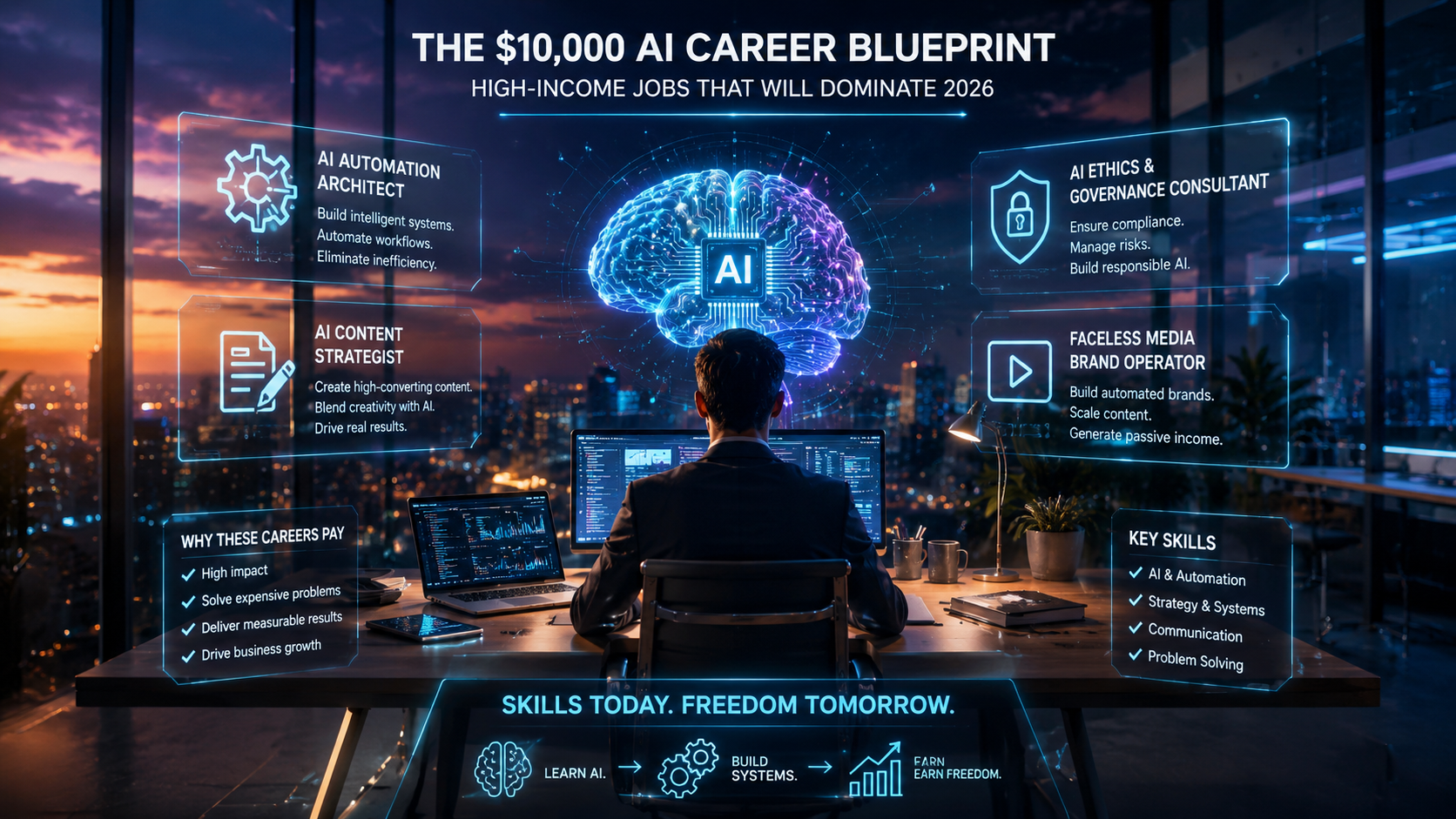
AI Automation Architect
One of the highest-paying AI careers today is the AI Automation Architect.
Modern businesses use dozens of software platforms for customer management, marketing, sales, finance, communication, and project management. Unfortunately, these systems often operate independently, creating inefficiencies and wasting valuable employee time.
An AI Automation Architect designs intelligent workflows that connect these separate systems into one seamless process.
Using platforms like n8n, Zapier, Make, or custom Python solutions, they automate repetitive business operations such as customer support, lead qualification, appointment scheduling, invoice generation, employee onboarding, social media publishing, and internal reporting.
Instead of hiring additional employees to perform repetitive administrative work, companies rely on automated systems that operate 24 hours a day with minimal supervision.
This role commands premium pricing because automation directly reduces operational costs while increasing productivity.
Many automation specialists charge thousands of dollars for system implementation and continue earning recurring monthly retainers to maintain and improve those workflows.
Specialized AI Content Strategist
Artificial intelligence can generate thousands of articles, advertisements, and social media posts within minutes.
However, businesses quickly discovered that quantity doesn’t guarantee quality.
Generic AI-generated content often lacks personality, strategic messaging, emotional connection, and brand consistency.
This created enormous demand for Specialized AI Content Strategists.
These professionals combine expert copywriting skills with advanced prompt engineering to produce content that converts readers into customers.
Their responsibilities include developing marketing strategies, maintaining consistent brand voice, creating sales funnels, writing high-converting email campaigns, optimizing SEO content, and reviewing AI-generated material before publication.
Rather than replacing human creativity, AI becomes a collaborative assistant while the strategist focuses on storytelling, persuasion, customer psychology, and business objectives.
Companies happily invest in experienced content strategists because effective marketing directly influences revenue growth.
AI Ethics and Governance Consultant
As artificial intelligence becomes more powerful, businesses face increasing legal, ethical, and regulatory responsibilities.
Incorrect AI outputs, biased algorithms, inaccurate recommendations, copyright violations, and privacy breaches can result in significant financial losses and reputational damage.
This growing challenge has created one of the newest high-income careers—the AI Ethics and Governance Consultant.
These specialists evaluate AI systems for fairness, transparency, security, compliance, and accuracy.
They establish internal policies governing responsible AI usage while ensuring organizations comply with emerging regulations concerning data privacy and automated decision-making.
Consultants also educate employees about responsible AI implementation and monitor systems to reduce risks associated with inaccurate or misleading outputs.
Because these professionals help protect organizations from legal consequences and public controversy, their expertise commands premium consulting fees.
Faceless Media Brand Operator
Content creation has evolved dramatically with the help of artificial intelligence.
Many successful entrepreneurs now operate multiple YouTube channels, newsletters, blogs, TikTok accounts, and LinkedIn pages without ever appearing on camera.
These businesses are known as faceless media brands.
Artificial intelligence assists with topic research, script writing, voice generation, video editing, thumbnail creation, subtitle generation, and multilingual content adaptation.
The creator’s primary responsibility shifts from producing every piece of content manually to managing systems that continuously generate valuable content.
Revenue comes from advertising, sponsorships, affiliate marketing, digital products, premium memberships, and online courses.
Once these content systems become established, they continue producing income with relatively little day-to-day involvement.
Because this model is highly scalable, many successful operators manage several profitable media brands simultaneously.
Why These Careers Pay So Well
High-income AI professionals are not paid simply because they know how to use artificial intelligence.
They are paid because they solve expensive business problems.
Companies invest significant amounts of money when AI professionals help them:
- Reduce operating costs
- Increase sales and revenue
- Improve customer experience
- Save employee time
- Strengthen decision-making
- Minimize legal and compliance risks
- Scale operations efficiently
Businesses don’t purchase AI technology—they purchase business outcomes.
Professionals who consistently deliver measurable results naturally command higher salaries and consulting fees.
The Shift From Task-Based Work to Outcome-Based Services
One of the biggest mindset changes separating average freelancers from high-income consultants is moving away from selling individual tasks.
Traditional freelancers often charge clients for writing articles, editing videos, creating graphics, or designing websites.
Today’s highest earners package those individual skills into complete business solutions.
Instead of selling blog writing, they sell SEO growth.
Instead of selling automation software, they sell operational efficiency.
Instead of selling AI prompts, they sell revenue generation.
Instead of creating marketing content, they build complete customer acquisition systems.
This outcome-focused approach allows professionals to justify significantly higher prices because clients care about results rather than the tools used.
Essential Skills Needed for High-Income AI Careers
Success in the AI economy requires more than technical knowledge.
Professionals earning premium incomes combine several complementary skills, including:
- Artificial intelligence fundamentals
- Prompt engineering
- Workflow automation
- Business strategy
- Marketing psychology
- Data analysis
- Copywriting
- Communication
- Project management
- Critical thinking
- Problem-solving
- Client relationship management
The combination of technical expertise and business understanding creates professionals who deliver real organizational value.
Building a $10,000-Per-Month AI Business
Reaching a monthly income of $10,000 rarely happens overnight.
Most successful AI professionals follow a structured growth strategy.
They begin by mastering one specialized niche rather than offering generic AI services.
They build a portfolio demonstrating measurable business results.
They develop repeatable systems that reduce manual work.
They focus on long-term client relationships instead of one-time projects.
They continuously learn as AI technology evolves.
Finally, they transition from hourly pricing toward project-based and retainer-based business models that provide predictable recurring income.
This approach allows income to grow alongside expertise and reputation.
Challenges to Expect
Although AI creates enormous opportunities, competition is increasing rapidly.
Generic AI services have become increasingly inexpensive as more people gain access to advanced tools.
Professionals who fail to specialize may struggle to differentiate themselves.
Clients also expect greater accountability because AI-generated mistakes can affect important business decisions.
Continuous learning is essential.
New AI models, regulations, automation platforms, and industry standards emerge every few months.
Professionals who consistently update their skills will remain competitive in this rapidly changing market.
The Future of AI Careers
Artificial intelligence will continue reshaping industries throughout the remainder of the decade.
Rather than replacing skilled professionals, AI will increase demand for individuals capable of managing, directing, and optimizing intelligent systems.
Future organizations will require experts who understand both technology and human business needs.
Those who position themselves as strategic advisors instead of software users will enjoy the greatest career opportunities.
The highest incomes will belong to professionals who create measurable business impact rather than simply completing individual tasks.
Conclusions
The AI economy of 2026 rewards people who think like business owners instead of tool users. High-income professionals are no longer selling prompts, software, or isolated services. They are delivering automation, revenue growth, operational efficiency, compliance, and scalable business systems.
Whether you choose to become an AI Automation Architect, Specialized AI Content Strategist, AI Ethics Consultant, or Faceless Media Brand Operator, the principle remains the same: focus on solving meaningful business problems.
Artificial intelligence is no longer the competitive advantage. Knowing how to apply it strategically is.
The path to earning more than $10,000 per month isn’t about using more AI tools—it’s about becoming the expert who transforms AI capabilities into real-world business success.