




Apple Says OpenAI Turned Job Interviews Into a Trade-Secret Pipeline
Apple’s lawsuit against OpenAI begins with allegations that will sound familiar to anyone who has followed Silicon Valley’s history of employee departures and trade-secret disputes: a departing engineer allegedly retained company equipment, accessed internal systems and downloaded confidential files after joining a competitor.
But Apple’s 41-page complaint makes a much broader accusation.
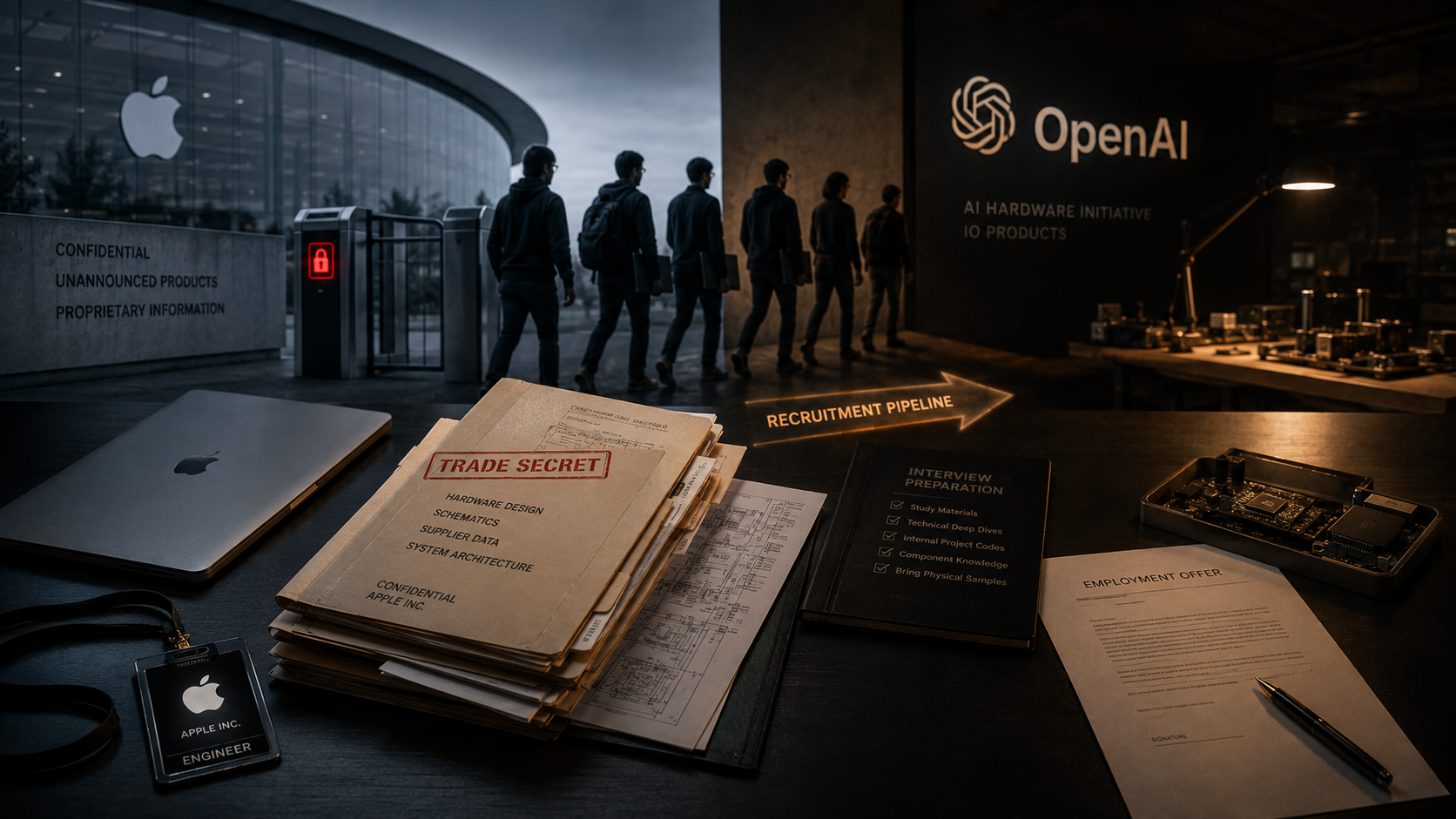
It alleges that recruitment itself became the extraction mechanism. According to Apple, candidates were encouraged to prepare presentations about confidential work, discuss unreleased products using internal project language, bring physical components to interviews and learn how to avoid the security procedures designed to examine departing employees.
The files matter. Apple’s larger claim, however, is that the job interview was allegedly being used as a controlled point of access into the company’s hardware knowledge.
What Apple Actually Filed
Apple filed the lawsuit on July 10, 2026, in the US District Court for the Northern District of California.
The named defendants are former Apple employees Chang Liu and Tang Yew Tan, OpenAI Foundation, OpenAI Group PBC and io Products, the hardware company acquired by OpenAI.
Yu-Ting “Alyssa” Peng appears throughout the complaint because of her alleged communications with Liu before she joined OpenAI, but Apple did not name her as a defendant.
Apple asserts claims under the federal Defend Trade Secrets Act and accuses Liu and Tan of breaching intellectual-property agreements signed during their Apple employment. It is seeking damages, the return of its property and injunctions preventing the defendants from possessing, using or disclosing its confidential information.
No judge or jury has determined that any defendant stole or used an Apple trade secret. At this stage, the complaint presents Apple’s version of events.
The Liu Allegations Begin With a Serious Offboarding Failure
Chang Liu worked at Apple for more than eight years as a senior systems electrical engineer on the iPhone product line before joining OpenAI in January 2026.
Apple alleges that Liu stopped responding when the company attempted to arrange an exit interview, confirm that he had completed its security procedures and determine whether he had returned his Apple devices. The complaint says he failed to return at least one Apple-owned computer.
However, Apple does not simply allege that Liu downloaded files onto the unreturned laptop.
It claims he also used the Apple-issued computer of Peng, who remained an Apple employee at the time, and later discovered that an authentication vulnerability still allowed him to reach Apple’s network storage after his departure.
Apple says Liu did not report that access. Instead, the complaint alleges that he downloaded dozens of technical presentations, spreadsheets, documents and other files, including a compilation exceeding one thousand pages.
The materials allegedly included information about unreleased products, logic-board manufacturing, testing systems, engineering decisions and proprietary project work.
Apple says it discovered the activity through its own investigation and terminated the remaining access.
The Digital Trail Is Apple’s Most Concrete Evidence
The allegations involving Liu are the most detailed portion of the complaint because Apple says they are based partly on activity visible through its own systems and company-owned devices.
Apple cites network logs, downloaded file records and messages allegedly left on Apple equipment. In one exchange described in the complaint, Liu celebrated discovering that he could still access the company’s network storage, calling it “so funny.”
Those digital records could become important because trade-secret cases often depend on proving not only that someone possessed sensitive knowledge, but that specific protected information was acquired through improper means.
OpenAI can recruit engineers who understand consumer hardware. It can benefit from the general skills and experience they developed during their careers. What it cannot lawfully do is obtain protected files or induce employees to violate duties of confidentiality.
Peng Allegedly Completed the Loop From Employee to Candidate
Apple says Liu remained in frequent contact with Peng between his January departure and her move to OpenAI in April.
During that period, Peng was still working at Apple while Liu was developing hardware at OpenAI.
The complaint alleges that Peng sent Liu regular information about active projects, vendors and engineering decisions. Apple characterizes those communications as a steadily flowing stream of confidential information entering Liu’s OpenAI work.
Apple further alleges that Liu advised Peng on how to access and copy files without attracting the attention of Apple’s security team. Before her OpenAI interviews, he allegedly directed her toward specific project folders and told her which confidential materials she should study.
According to the complaint, Liu discussed questions that OpenAI hardware chief Tang Tan had previously asked another Apple candidate about a secret project. He then allegedly helped Peng prepare so she would perform better when questioned about similar material.
If proven, that sequence would be more significant than an employee carelessly oversharing during an interview. It would suggest that someone already inside OpenAI helped a current Apple employee identify and study information valued by the recruiting team.
Tang Tan Is Central to Apple’s Institutional Claim
Tang Yew Tan spent 24 years at Apple and most recently served as vice president of product design for the iPhone and Apple Watch. He later co-founded io Products and is now OpenAI’s chief hardware officer.
Apple alleges that Tan emailed himself information about suppliers and internal industry assessments before leaving the company.
The complaint then connects Tan’s knowledge of Apple with OpenAI’s recruiting process.
Apple says Tan used an internal Apple project codename while questioning candidates about an unreleased product. It also alleges that he directed Apple employees to bring “actual parts” to OpenAI interviews for “show and tell” sessions.
One candidate was allegedly surprised by the instruction and questioned whether the parts could legally be removed from Apple’s office.
The complaint also says OpenAI candidates were asked to prepare mandatory technical presentations and discuss system integration, component selection, manufacturing methods, software tools, supplier relationships and vendor-management practices.
None of those subjects is automatically illegal to discuss. Engineers routinely explain their experience in technical interviews. Apple’s argument is that the requested level of specificity could not be provided without exposing confidential information.
The Alleged Pipeline Had Several Stages
Read as a whole, Apple’s complaint describes an alleged recruitment pipeline with several connected stages.
First, OpenAI identifies Apple employees with valuable hardware experience.
Second, candidates are allegedly encouraged to study internal documents, prepare detailed presentations or bring design materials and components to interviews.
Third, former Apple leaders use their familiarity with Apple’s internal projects, suppliers and terminology to ask more targeted questions.
Fourth, successful candidates are allegedly given advance information about Apple’s offboarding security procedures before announcing their departures.
Finally, Apple claims the information continues flowing after the employee joins OpenAI through retained files, institutional knowledge and access to Apple’s manufacturing partners.
Apple explicitly describes this as an attempt to use recruiting to “prime the pump” so that confidential information continues reaching OpenAI after the candidate becomes an employee.
The Offboarding Document May Become a Major Issue
Apple alleges that Tan retained or obtained an internal management document marked “Need to Know” that described the company’s employee-departure security procedures.
The complaint says OpenAI personnel referred to it as a checklist prepared by Tan and circulated it to new hires before they gave Apple notice.
Apple claims the document gave departing employees advance knowledge of forensic reviews, exit interviews and other checks designed to identify the removal of confidential information.
The complaint also alleges that employees were advised not to disclose that they were joining OpenAI, potentially allowing them to remain at Apple for a normal notice period rather than face an immediate “walkout” that would terminate their system access.
Possessing a competitor’s offboarding checklist is not the same as proving that every new hire used it to steal information. But it supports Apple’s central narrative that the alleged conduct extended beyond individual engineers acting without coordination.
Apple Also Accuses OpenAI of Targeting Its Suppliers
The alleged recruiting activity is only one part of the case.
Apple says OpenAI and io approached companies in Apple’s tightly controlled supply chain while using confidential knowledge obtained from former employees.
One supplier allegedly performed a proprietary metal-finishing process for OpenAI after being led to believe that Apple had approved the work.
Apple also claims OpenAI used its internal terminology and component knowledge when approaching another supplier involved with manufacturing, power systems and batteries.
This matters because Apple’s trade secrets do not consist only of product drawings. Its complaint identifies manufacturing processes, component technologies, supplier arrangements, testing methods and the ability to produce hardware at scale as part of the information it is attempting to protect.
Hiring Apple Employees Is Not Illegal
Apple says more than 400 former Apple employees now work at OpenAI, but that number does not prove misconduct.
California strongly protects employee mobility. Engineers are generally free to leave one company, join a competitor and apply the knowledge, professional judgment and general skills they have developed.
Trade-secret law also prevents courts from blocking employment merely because someone possesses valuable experience or remembers information from a previous job.
The legal boundary is crossed when protected information is acquired, disclosed or used through improper means, including theft, deception or inducing someone to breach a confidentiality obligation.
Stanford law professor Mark Lemley described the scale of the case as potentially significant while emphasizing that recruiting Apple employees is lawful. The more serious issue, he said, would be proof that confidential documents were taken and used.
Apple’s Strongest Evidence and Its Biggest Gap
Apple’s strongest allegations involve conduct it claims to have observed directly: unreturned equipment, network access, downloads, internal messages and files stored on company systems.
The broader claim that OpenAI adopted trade-secret extraction as an institutional strategy is harder to establish.
Apple repeatedly alleges that OpenAI leadership coordinated the misconduct, but much of the evidence described publicly concerns individual employees, interview instructions and communications found on Apple-controlled devices.
Axios noted that the complaint contains limited direct evidence showing OpenAI ordered a deliberate espionage programme. Apple’s position is that discovery will expose what happened inside OpenAI and reveal conduct beyond the examples currently available.
That makes discovery the decisive phase. Apple will seek recruiting documents, internal messages, interview presentations, prototype-development records, supplier communications and evidence showing whether confidential Apple information reached OpenAI’s hardware programme.
Jony Ive Is Important Context, but He Is Not Accused
Jony Ive’s involvement makes the case more commercially dramatic, but the legal distinction must remain clear.
Ive formerly led design at Apple and founded io with Tang Tan, Scott Cannon and Evans Hankey. OpenAI later acquired io, while Ive and his design firm LoveFrom assumed major design responsibilities across OpenAI’s hardware effort.
He is not named as a defendant in Apple’s lawsuit, and the complaint does not publicly accuse him of participating in the alleged theft.
His absence should not be used to imply that Apple is quietly accusing him without evidence. Discovery could reveal additional information about many people, but the filed complaint currently directs its specific misconduct allegations toward Liu, Tan, OpenAI and io.
Apple and OpenAI Remain Partners and Rivals
The dispute is unusual because OpenAI is still integrated into Apple products through Apple Intelligence.
ChatGPT remains available through Siri, Writing Tools and other supported Apple features. Apple’s complaint specifically states that the written agreement governing that integration is not being challenged and that the alleged trade-secret conduct does not arise from the partnership.
That legal separation may allow the integration to continue while the hardware case proceeds.
Commercially, however, the relationship has changed. OpenAI is attempting to build a direct consumer-hardware business that could compete for the attention currently controlled by smartphones and operating systems.
OpenAI previously considered legal options of its own against Apple concerning their partnership, according to Reuters. The companies are therefore cooperating inside Apple devices while becoming increasingly direct competitors outside them.
The Lawsuit Threatens More Than Monetary Damages
Apple is not asking only for financial compensation.
It wants preliminary and permanent injunctions preventing the defendants from using or possessing its trade secrets. It also seeks the return of its property and orders preserving evidence connected to the dispute.
An injunction would not automatically shut down OpenAI’s entire hardware division. Federal law limits courts from preventing lawful employment merely because workers possess knowledge from a former employer.
But if Apple can identify specific technologies, processes or prototype features derived from misappropriated information, the court could restrict their use and require OpenAI to redesign parts of its programme.
That could be more damaging than a damages award. OpenAI spent approximately $6.5 billion acquiring io and is reportedly preparing its first consumer device for 2027. A forced redesign or delayed launch could weaken the strategic reason for that investment.
The IPO Timing Adds Pressure but Proves Nothing About Apple’s Motive
The case also arrives while OpenAI is reportedly preparing for a possible public offering.
A major unresolved trade-secret dispute would likely need to be disclosed to potential investors, particularly if Apple is seeking an injunction against technology connected to OpenAI’s future hardware products.
That does not prove Apple deliberately timed the lawsuit to damage an IPO. Apple says it raised concerns with OpenAI in February, received no response and continued investigating before filing in July.
The immediate financial importance is straightforward: investors attempting to value OpenAI would now have to consider the possibility of years of litigation, discovery into internal recruiting practices and restrictions affecting a multibillion-dollar hardware programme.
OpenAI Denies the Central Accusation
OpenAI has rejected Apple’s characterization of its conduct.
“We have no interest in other companies’ trade secrets,” the company said after the lawsuit was filed.
OpenAI has not yet presented a detailed defence in court. It may challenge whether the information qualifies as legally protected trade secrets, whether Apple took reasonable measures to protect it, whether OpenAI acquired or used it and whether the conduct of individual employees can be attributed to the company.
Those questions cannot be resolved from Apple’s complaint alone.
Final Verdict
Apple’s lawsuit is not simply a story about an engineer leaving with confidential files.
The complaint alleges that OpenAI converted ordinary stages of employee recruitment into a system for acquiring knowledge that Apple had spent decades protecting.
The interview allegedly identified the desired secrets. Former Apple leaders allegedly knew which questions to ask. Candidates were allegedly encouraged to bring technical artifacts and study confidential materials. Offboarding instructions allegedly reduced the chance that Apple would discover what had happened.
That is Apple’s actual theory of the case: recruitment was not merely how OpenAI obtained Apple’s engineers. It was allegedly how OpenAI obtained access to Apple itself.
The theory is serious and supported by unusually specific allegations involving messages, access records and internal documents. But it remains a theory that Apple must prove. Hiring competitors’ employees is legal, technical interviews are normal and Jony Ive has not been accused of misconduct.
The decisive evidence will not come from Apple’s aggressive language or OpenAI’s brief denial. It will come from discovery showing whether Apple’s confidential information entered OpenAI’s hardware programme, who knew about it and whether recruiting was genuinely designed to extract secrets or simply became the setting in which individual employees crossed legal boundaries.