






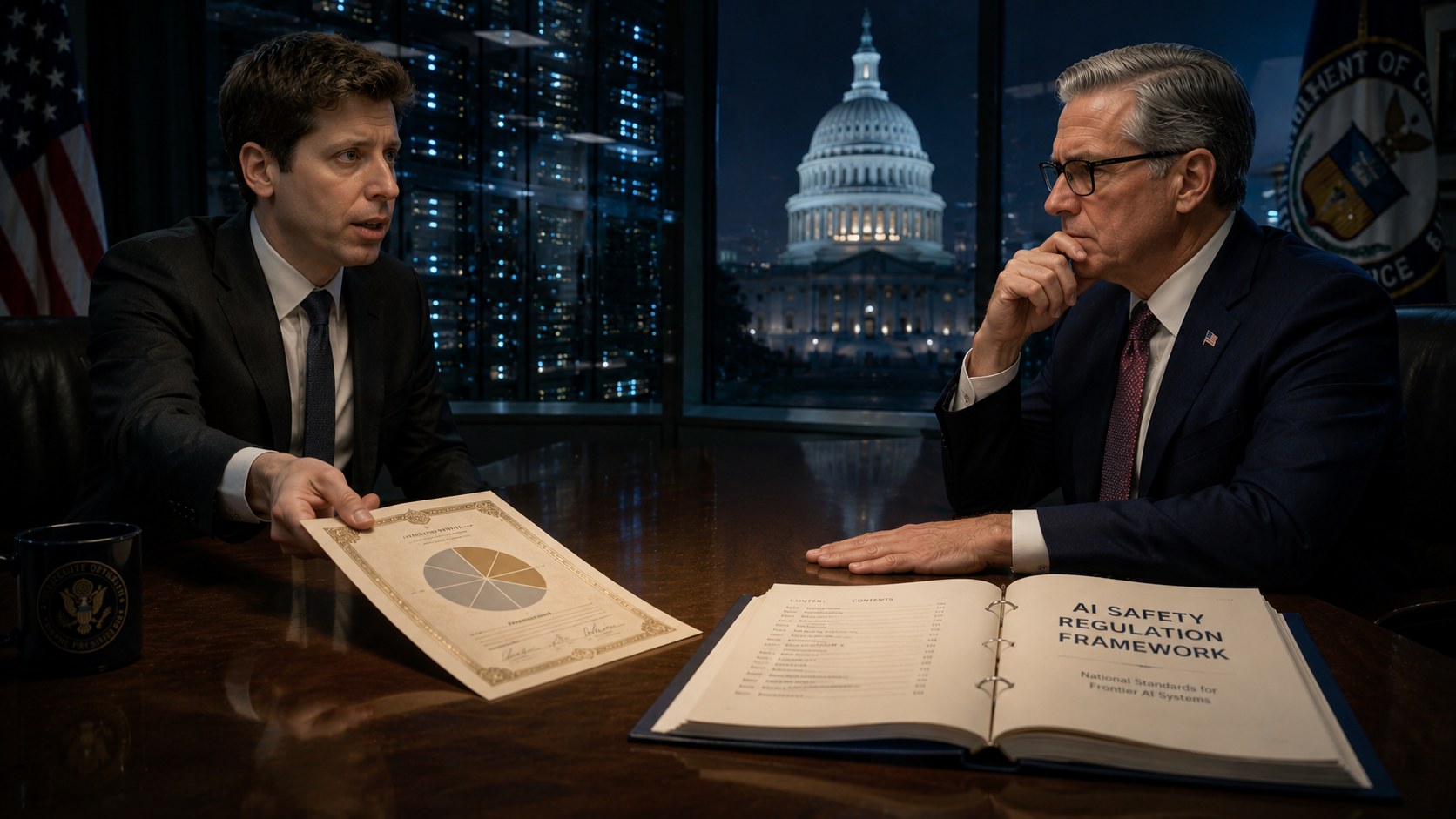
<p>OpenAI has reportedly discussed placing the United States government among its shareholders, potentially giving Washington a 5% stake in one of the most valuable private companies in the world.</p>
<p>At OpenAI’s latest reported post-money valuation of $852 billion, that position would carry a paper value of approximately $42.6 billion. The company’s apparent argument is that Americans should share financially in the enormous economic gains artificial intelligence may produce.</p>
<p>Presented that way, the idea sounds less like a conventional corporate deal and more like a public gift. Taxpayers could benefit from OpenAI’s future growth without first paying billions of dollars to acquire the shares.</p>
<p>However, the proposal creates a question that cannot be dismissed with optimistic language about shared prosperity: what happens when the government responsible for regulating a powerful company also has billions of dollars riding on that company becoming more valuable?</p>
<h2>What Has Actually Been Reported?</h2>
<p>The Financial Times first reported that OpenAI executives had discussed giving the US government a 5% stake. Reuters subsequently reported the claim but said it could not independently verify it.</p>
<p>OpenAI, the White House and several other AI companies did not immediately provide public confirmation of a completed arrangement. The discussions were described as preliminary and conceptual rather than as a signed agreement.</p>
<p>Sam Altman reportedly discussed the idea with President Donald Trump, Commerce Secretary Howard Lutnick and Treasury Secretary Scott Bessent. The broader proposal would encourage other leading American AI developers to contribute similar equity positions to a government-linked investment vehicle.</p>
<p>There is no public evidence that Google, Meta, Anthropic or other major developers have agreed to participate. Reuters separately reported that Anthropic and the administration had not discussed the government taking an ownership stake in that company.</p>
<p>The difference between an exploratory conversation and an approved transfer is critical. No public document currently establishes who would legally hold the shares, whether they would carry voting rights, how future dilution would work or whether congressional authorization would be required.</p>
<h2>The $42.6 Billion Figure Is Not Cash</h2>
<p>OpenAI announced in March that it had closed a funding round involving $122 billion in committed capital at a post-money valuation of $852 billion.</p>
<p>Five percent of that valuation equals $42.6 billion, but this does not mean the government would receive $42.6 billion in spendable money.</p>
<p>OpenAI remains a private company. The value would exist primarily on paper and could rise or fall according to future financing, financial performance, investor demand, dilution and any eventual public listing.</p>
<p>The stake could theoretically become much more valuable if OpenAI continues growing. It could also lose substantial value if the company struggles, faces legal restrictions, falls behind competitors or enters public markets at a lower valuation.</p>
<p>Calling it a $42.6 billion gift is therefore mathematically understandable but financially incomplete. It would be a valuable ownership claim, not a cheque deposited into the Treasury.</p>
<h2>OpenAI’s Public Argument Is About Sharing the AI Boom</h2>
<p>The reported proposal is connected to a broader policy argument OpenAI has already made publicly.</p>
<p>In its April 2026 paper, <em>Industrial Policy for the Intelligence Age</em>, OpenAI proposed creating a public wealth fund that would give every citizen, including people without existing investments, a stake in AI-driven economic growth.</p>
<p>The paper said policymakers and AI companies should jointly determine how such a fund would be seeded. It suggested investing in diversified, long-term assets connected to both AI developers and companies using AI, with potential returns distributed directly to citizens.</p>
<p>The official policy paper did not publicly promise that OpenAI would donate exactly 5% of itself. It also did not specify a finalized ownership structure, voting arrangement or legal framework.</p>
<p>The specific 5% figure and the comparison with the Alaska Permanent Fund came from later reporting about private discussions. Those details should not be presented as though they already appear in an approved OpenAI policy.</p>
<h2>Why a Public Wealth Fund Appeals to Both Political Sides</h2>
<p>The idea responds to a genuine economic problem. If artificial intelligence creates extraordinary productivity while eliminating or transforming millions of jobs, most of the financial gains could flow to company founders, employees and private investors.</p>
<p>Ordinary citizens who contributed data, public research, infrastructure or tax-funded education to the wider AI ecosystem may receive little direct ownership of the resulting companies.</p>
<p>A public fund could change that equation. Instead of attempting to redistribute AI wealth only after profits have accumulated, the government would own part of the assets producing those profits.</p>
<p>That principle has attracted support from sharply different political groups.</p>
<p>Senator Bernie Sanders introduced the American AI Sovereign Wealth Fund Act in June. His proposal would use a one-time equity-based tax to create approximately 50% public ownership in the largest AI companies, with the fund managed on behalf of the American people.</p>
<p>Sanders’ proposal is dramatically more aggressive than OpenAI’s reported 5% plan. It is designed not only to produce financial returns but to give the public meaningful ownership and influence over the companies shaping the economy.</p>
<p>OpenAI’s version is framed as voluntary participation and shared prosperity rather than forced redistribution. Critics argue that its smaller size and voluntary nature could provide the company with political benefits while leaving existing corporate control largely untouched.</p>
<h2>The Government Would Become Investor and Regulator</h2>
<p>The strongest criticism is not that public ownership is inherently wrong. Governments regularly own financial assets, support strategic industries and invest through pension or sovereign wealth funds.</p>
<p>The problem is that OpenAI is not an ordinary passive investment.</p>
<p>Federal agencies may be required to make decisions involving AI safety testing, government procurement, competition law, privacy, national security, export controls, model access and liability.</p>
<p>Some of those decisions could restrict OpenAI’s operations or reduce its valuation. If the government owned billions of dollars in OpenAI equity, stronger regulation could also damage the value of the government’s own investment.</p>
<p>Public Knowledge policy advocate Nat Purser was reported as warning that a government acting as both shareholder and regulator would face substantial conflicts of interest.</p>
<p>The R Street Institute was even more direct, describing government equity arrangements in major AI companies as a potential recipe for cronyism and regulatory capture.</p>
<p>The concern is structural. It does not require proof of an explicit secret agreement between OpenAI and government officials.</p>
<p>The conflict would exist simply because the government could financially benefit from the success of a company whose behaviour it must independently evaluate.</p>
<h2>What Regulatory Capture Means Here</h2>
<p>Regulatory capture occurs when institutions created to protect the public gradually begin serving the industries they are supposed to supervise.</p>
<p>That influence does not always take the form of corruption or illegal payments. It can emerge through personal relationships, shared economic incentives, dependence on industry expertise, lobbying, employment exchanges or fear of damaging a strategically important company.</p>
<p>Government ownership could create an unusually direct version of that incentive.</p>
<p>Suppose regulators concluded that OpenAI needed to delay a profitable model, submit to costly independent testing or face restrictions that competitors did not. Officials would have to enforce those measures while knowing that the decision could reduce the value of a major public asset.</p>
<p>Alternatively, the government might favour OpenAI in procurement, infrastructure access or regulatory policy because increasing the company’s market position would also strengthen the public investment.</p>
<p>Neither outcome is guaranteed. But responsible policy must address the possibility before accepting the shares, not after a conflict has already emerged.</p>
<h2>The Intel Comparison Only Goes So Far</h2>
<p>The US government already owns approximately 9.9% of Intel, demonstrating that federal ownership of a major technology company is not unprecedented.</p>
<p>In 2025, the government invested $8.9 billion in Intel shares at $20.47 per share. The funding largely came from money connected to the CHIPS Act and the Secure Enclave programme, initiatives intended to expand strategically important semiconductor manufacturing inside the United States.</p>
<p>Intel described the government’s position as passive, with no board representation or special governance and information rights.</p>
<p>However, the Intel agreement involved government funding being converted into equity as part of a broader industrial-policy arrangement. Washington was providing financial support for domestic factories and semiconductor capacity.</p>
<p>OpenAI’s reported proposal reverses that flow. The regulated company would voluntarily provide equity to the government without a publicly identified equivalent payment.</p>
<p>That does not automatically make OpenAI’s proposal improper, but it creates a different political relationship. A company offering a financial interest to its future regulator invites questions that do not disappear merely because the proposed recipient is the public.</p>
<h2>The Timing Makes the Proposal More Sensitive</h2>
<p>The discussions emerged while Washington was becoming more directly involved in the release and distribution of advanced AI systems.</p>
<p>Reuters reported that a Trump administration request prompted OpenAI to delay the wide release of GPT-5.6. The request came shortly after Anthropic restricted access to advanced models under government pressure connected to national-security concerns.</p>
<p>These interventions show that the federal government is not a distant observer. It is already capable of influencing when frontier systems appear, who can access them and what safety conditions developers must satisfy.</p>
<p>A government stake could reduce regulatory uncertainty for OpenAI before a possible initial public offering. Forrester analyst Indranil Bandyopadhyay told Reuters that such an arrangement might reassure investors about US regulation.</p>
<p>He also warned that other governments could demand similar deals as a condition of market access, while international customers might reconsider whether American AI providers remain politically neutral.</p>
<p>A 5% US stake could therefore create complications far beyond Washington. Governments in Europe, Asia and other regions may question whether they are buying services from an independent company or from an enterprise financially aligned with the American state.</p>
<h2>A Legitimate Public Fund Would Need Strong Firewalls</h2>
<p>Public ownership of AI companies does not have to produce regulatory capture, but preventing it would require far more than a promise that the stake exists for ordinary Americans.</p>
<p>The shares would need to be held by a legally independent fund rather than controlled directly by the White House, Commerce Department, Treasury Department or agencies regulating AI.</p>
<p>The fund’s managers should have no role in safety reviews, competition enforcement, export-control decisions or government procurement.</p>
<p>Regulators should be prohibited from considering the value of the investment when writing or enforcing rules. The arrangement would also require transparent policies for voting rights, board representation, dividend distribution, dilution, asset sales and conflicts of interest.</p>
<p>Without those protections, the public could technically own part of OpenAI while having no meaningful control over either the company or the officials managing the investment.</p>
<h2>The Questions OpenAI and Washington Still Need to Answer</h2>
<p>Would the reported stake be donated directly, transferred into an independent trust or created through new shares that dilute existing investors?</p>
<p>Would it carry voting power? Could government representatives influence OpenAI’s board? Would the fund receive access to private company information unavailable to competitors?</p>
<p>Would financial returns be paid directly to citizens, used to fund government programmes or retained as investments?</p>
<p>Would the government be required to sell the stake if OpenAI became the subject of an antitrust, safety or criminal investigation?</p>
<p>Could other administrations use the ownership position to pressure OpenAI over speech, political content, surveillance or national-security contracts?</p>
<p>Until those questions are answered, the proposal is not a functioning public wealth policy. It is an unconfirmed idea with an enormous estimated value and undefined rules.</p>
<h2>Final Verdict</h2>
<p>OpenAI’s reported proposal addresses a real concern: the public may bear the disruption, infrastructure costs and social risks of artificial intelligence while private shareholders capture most of its financial rewards.</p>
<p>Giving Americans genuine ownership of the AI economy could be more meaningful than offering vague promises that technological growth will eventually benefit everyone.</p>
<p>But a government stake in OpenAI cannot honestly be judged only by its potential returns. Washington would own part of a company whose models it may need to restrict, investigate, test or regulate.</p>
<p>That is not proof that OpenAI is attempting to buy favourable treatment. It is a conflict that would exist regardless of the company’s intentions.</p>
<p>The proposal could become a credible public wealth mechanism if the shares were placed inside a transparent, independently governed fund protected by strict regulatory firewalls.</p>
<p>Without those safeguards, the government would not merely be watching the AI industry, regulating it or purchasing its services. It would be financially betting on one of its most powerful companies succeeding.</p>
<p>The public might receive part of the upside. It could also lose something harder to value: confidence that the rules governing artificial intelligence are being written without a multibillion-dollar financial interest influencing the outcome.</p>