




The Knicks Broke a 53-Year Curse by Coming Back From the Dead Four Times
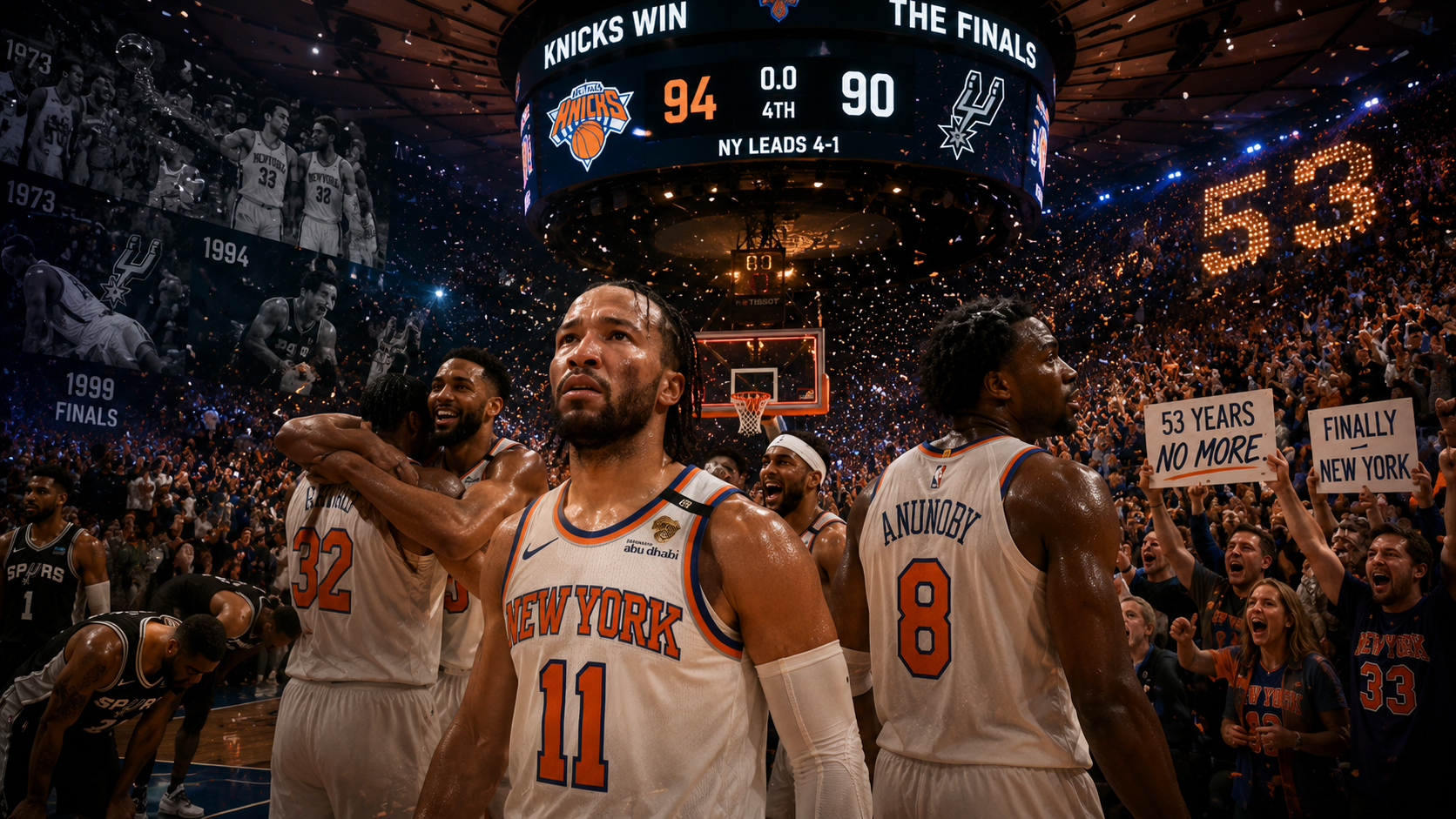
On June 13, 2026, the New York Knicks defeated the San Antonio Spurs 94-90 in Game 5 of the NBA Finals and won their first championship since 1973.
The two titles were separated by 19,392 days. At 53 years, it became the longest gap between championships in NBA history.
That statistic alone would have made the victory historic. But the number of years does not fully explain what made this Knicks championship run extraordinary.
New York did not simply survive one dramatic comeback before dominating the rest of the series. The Knicks fell behind by double digits in every game they won during the Finals. Four victories, four serious deficits and four separate occasions when San Antonio appeared to have control of the championship series.
The Knicks ended a drought defined by decades of failure by repeatedly refusing to accept that a game was already lost.
Every Finals Victory Began With the Knicks in Trouble
The pattern began immediately in San Antonio.
New York trailed by 14 points during the third quarter of Game 1 before recovering to win 105-95. Jalen Brunson scored 13 points in the fourth quarter and delivered the difficult late shots that turned the opening game from a likely road defeat into a ten-point victory.
The Knicks then survived another double-digit deficit to win Game 2 by one point, taking a 2-0 series lead before returning to Madison Square Garden.
San Antonio responded by winning Game 3, ending New York’s 13-game playoff winning streak and reducing the series deficit to 2-1.
That result made Game 4 the decisive emotional moment of the Finals. A Spurs victory would have tied the series. Instead, the Knicks produced the largest comeback ever recorded in an NBA Finals game.
The 29-Point Deficit That Should Have Ended the Run
San Antonio overwhelmed New York during the first half of Game 4.
The Spurs scored 76 points before halftime and entered the break leading 76-49. Their 27-point halftime advantage was the largest held by a true road team in NBA Finals history.
The deficit later reached 29 points.
At that stage, the game was not merely slipping away from the Knicks. It appeared finished. The Spurs were shooting confidently, moving the ball freely and silencing Madison Square Garden while standing one victory away from completely resetting the series.
New York responded with a 55-25 run after Victor Wembanyama was called for a flagrant foul on Karl-Anthony Towns during the third quarter.
The Knicks held San Antonio to 30 second-half points. Brunson scored 36. OG Anunoby scored 33. With the Knicks trailing by one in the final seconds, Anunoby followed a missed shot and tipped the ball into the basket with 1.2 seconds remaining.
New York won 107-106.
Before that game, teams trailing by at least 17 points during the final nine minutes of an NBA Finals game had gone 0-96 since 1971. The Knicks were still down 17 with fewer than nine minutes remaining and won anyway.
The 29-point comeback did more than give New York a 3-1 series lead. It transformed the entire meaning of the championship run.
Game 5 Forced Them to Do It Again
The Knicks travelled back to San Antonio with three opportunities to finish the series. They immediately found themselves in another major hole.
New York scored only 13 points in the first quarter and trailed by 16 during the second. The Spurs later rebuilt their advantage to 15 points in the third quarter.
Once again, San Antonio had every reason to believe it had finally built a lead the Knicks could not erase.
Once again, the lead disappeared.
New York closed the third quarter with a 10-2 run. Brunson then took control of the fourth, scoring ten consecutive Knicks points to tie the game with fewer than five minutes remaining.
His floater with just over a minute left gave New York the lead for good. The Knicks survived the final possessions, won 94-90 and completed the series in five games.
The team had overcome double-digit deficits in all four of its Finals victories. The championship was not won by avoiding disaster. It was won by repeatedly entering disaster and finding a way back out.
Jalen Brunson Delivered a Historic Closing Performance
Brunson scored 45 points in Game 5, including 29 in the second half.
That performance broke Willis Reed’s Knicks record of 38 points in an NBA Finals game, set against the Los Angeles Lakers in 1970.
Brunson became only the fourth player in NBA history to score at least 45 points in a championship-clinching Finals game. The other three were Bob Pettit, Michael Jordan and Giannis Antetokounmpo.
Only Brunson and Jordan produced those performances while playing on the road.
Brunson finished the five-game series with 163 points, the highest total by a Knicks player in a single Finals. He averaged 32.6 points, 4.6 assists, 4.2 rebounds and 2.2 steals.
He received all 11 votes from the media panel selecting the Finals MVP.
Those numbers explain why Brunson won the award, but they do not entirely capture his role. The Knicks repeatedly reached the stage of games where offensive systems broke down, possessions slowed and one player had to create a shot against a set defence.
Brunson became the player New York trusted when every possession carried the weight of 53 years.
The Entire Postseason Combined Dominance With Survival
The Finals comebacks could make the Knicks appear like a team that constantly played poorly before escaping at the end.
The complete postseason tells a different story.
New York finished the playoffs 16-3 and outscored its opponents by 283 points, the largest total postseason point differential in NBA history.
Its average playoff margin was plus 14.9 points across 19 games, also the highest recorded in league history. Twelve of the Knicks’ 16 victories came by double digits, and five came by at least 29 points.
The team also won 13 consecutive playoff games at one stage, the second-longest postseason winning streak in NBA history.
New York therefore managed to be both historically dominant and unusually resilient. It frequently destroyed opponents when playing well, but it also won six playoff games after falling behind by double digits.
The Knicks were not champions because they needed miraculous comebacks every night. They were champions because even their worst stretches did not automatically become losses.
The NBA Cup Was the First Warning
Six months before defeating San Antonio in the Finals, the Knicks had already beaten the Spurs 124-113 to win the 2025 NBA Cup.
The Finals victory made New York the first team to win both the NBA Cup and the NBA championship, either in the same season or across separate seasons.
The Cup should not be treated as equal to an NBA championship, but it demonstrated that this Knicks team had already learned how to win a concentrated knockout tournament before entering the playoffs.
By June, the same opponent stood between New York and the larger trophy.
The Knicks beat the Spurs again, although the Finals demanded something far more difficult than the December victory. San Antonio led by double digits in every game New York won and still could not prevent the series from ending in five.
Why the 1973 Team Cast Such a Long Shadow
The Knicks were not chasing an ordinary championship memory.
Their 1973 title team remains one of the most decorated rosters in league history. Willis Reed, Walt Frazier, Dave DeBusschere, Bill Bradley, Jerry Lucas, Earl Monroe and Phil Jackson all became Basketball Hall of Famers, as did head coach Red Holzman.
Every Knicks generation that followed was measured against a team built around defence, intelligence, passing and collective sacrifice.
New York returned to the Finals in 1994 but lost to the Houston Rockets in seven games. The Knicks reached the championship series again as an eighth seed in 1999, only to lose to the Spurs.
After that, they did not reach another Finals for 27 years.
For much of the drought, the franchise was not repeatedly losing at the final obstacle. It was failing to get close enough for the championship to become realistic.
That made the 1973 team feel less like the previous generation and more like a piece of distant history the modern franchise could never reach.
The Previous Drought Record Belonged to Milwaukee
Before New York’s victory, the longest gap between NBA championships belonged to the Milwaukee Bucks.
Milwaukee won in 1971 and did not claim another title until 2021, ending a 50-year wait.
The Knicks extended that record to 53 years.
Several franchises continue to live with longer active waits. The Sacramento Kings have not won since the Rochester Royals captured the 1951 championship. The Atlanta Hawks last won in 1958, while the Phoenix Suns and Los Angeles Clippers have never won NBA titles.
The distinction is important. New York did not enter the season with the longest active drought in the league. It completed the longest gap between two championships that any NBA franchise has successfully ended.
The Comebacks Were Not Random Accidents
A comeback can sometimes be explained by one team suddenly making difficult shots while the other collapses.
Repeating the pattern throughout an entire series suggests something deeper.
The Knicks defended harder as games progressed. Their playoff defence allowed 104.5 points per 100 possessions, the best mark in the postseason, and became even more restrictive during clutch situations in the Finals.
They remained physically aggressive, continued attacking the basket and trusted Brunson to control late possessions. They also possessed enough experienced players to avoid responding emotionally when San Antonio built a lead.
That does not mean every comeback was predictable. Anunoby’s Game 4 tip-in required timing, positioning and an opportunity created by a missed shot. The Knicks also needed San Antonio to repeatedly fail to protect large advantages.
But New York created the conditions in which those opportunities remained available. It kept games alive long enough for the impossible to become possible.
The 29 Points Explain the Championship Better Than the 53 Years
The drought gives the championship historical scale. The comeback gives it an identity.
Fifty-three years describe how long Knicks supporters waited. Twenty-nine points describe what this particular team had to overcome once the opportunity finally arrived.
A franchise associated with disappointment entered the fourth quarter of Game 4 facing a deficit that no team in the same situation had ever erased.
Instead of becoming another painful chapter in Knicks history, it became the defining victory of the championship run.
Three nights later, New York fell behind by 15 again and completed one final comeback to win the trophy.
Final Verdict
The simplest version of the story is that the New York Knicks won their first NBA championship since 1973.
The more revealing version is that they won by repeatedly surviving the exact moments that had defined the franchise for decades: the point when optimism disappears, the opponent takes control and another failure begins to feel inevitable.
The Knicks trailed by double digits in every Finals victory. They came back from 14 in Game 1, survived another deficit in Game 2, erased an NBA Finals-record 29-point hole in Game 4 and recovered from 15 down in the championship-clinching Game 5.
They finished the playoffs with a record point differential, a 16-3 record and the first NBA Cup–championship double in league history.
But the statistic that will define the run is still 29.
That was the deficit that should have tied the Finals, broken New York’s momentum and returned the weight of five decades to Madison Square Garden.
Instead, it became the moment the Knicks proved this championship team would not behave like the versions that came before it.
The 53-year curse ended because the Knicks finally built a team that refused to stay buried.