






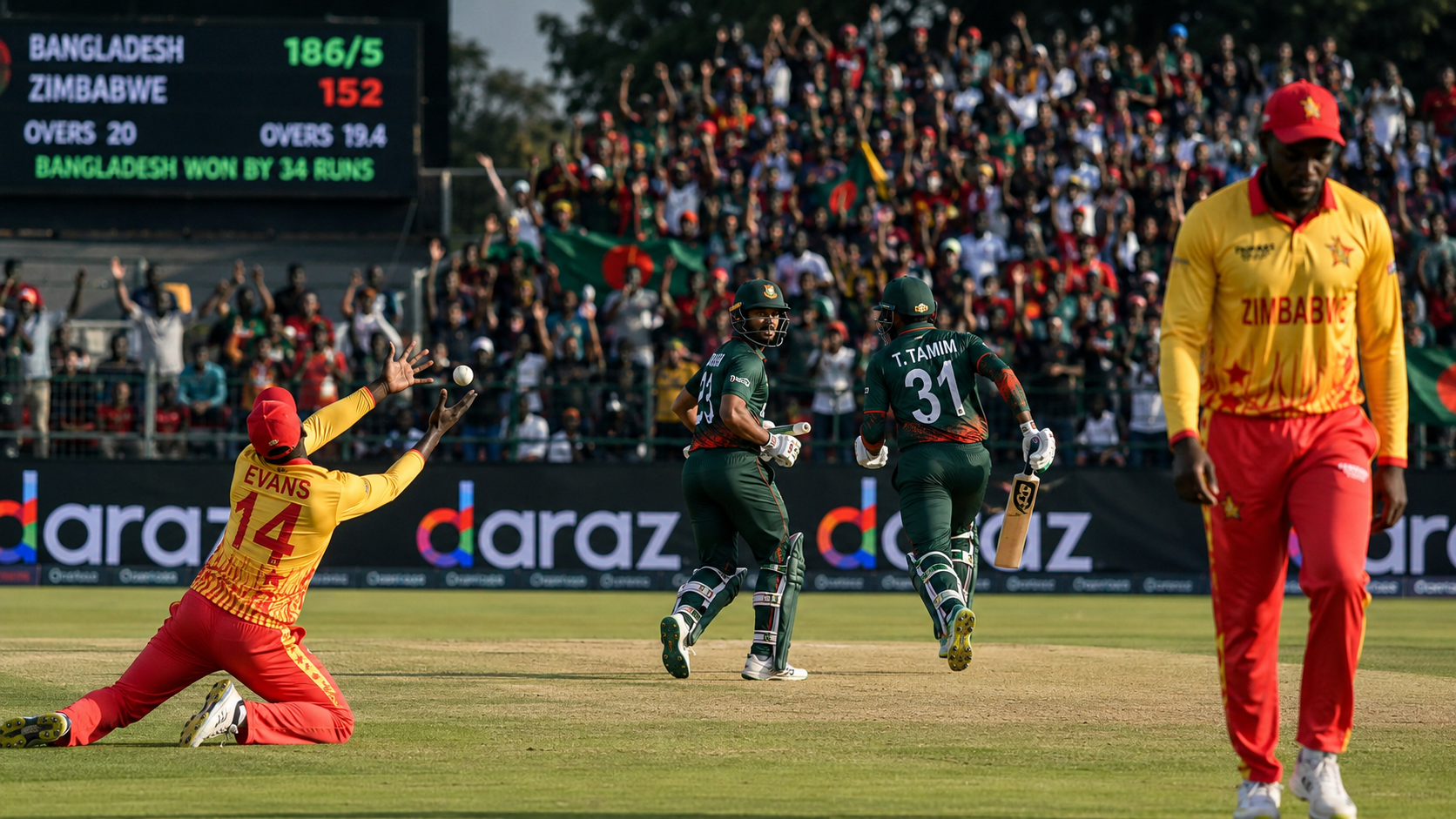
Seven Dropped Catches, One Brutal Collapse: Zimbabwe Hand Bangladesh a Lifeline
Zimbabwe entered the second T20I against Bangladesh with the series under their control. They left Queens Sports Club wondering how a match that offered so many opportunities had slipped so completely from their hands.
Bangladesh defeated Zimbabwe by 34 runs in Bulawayo on Friday, July 17, levelling the three-match series at 1–1 and transforming Sunday’s final encounter into a winner-takes-all decider.
The scoreboard showed Bangladesh 186 for five and Zimbabwe 152 all out, but those numbers only reveal part of the story. Zimbabwe’s defeat was shaped by dropped catches, a punishing final over and a batting collapse that prevented the hosts from seriously challenging the target.
Zimbabwe’s Fielding Nightmare Changes the Match
Zimbabwe won the toss and chose to bowl, hoping to repeat the disciplined performance that had earned them victory in the opening T20I. Instead, their fielding became the defining weakness of the match.
The hosts dropped approximately seven catches during Bangladesh’s innings. Several of those chances came during the opening partnership, allowing Saif Hassan and Tanzid Hasan Tamim to remain at the crease and build the foundation Bangladesh desperately needed.
Saif scored 55 from 45 deliveries, while Tanzid made 58 from 44. Together, they added 120 runs for the first wicket and forced Zimbabwe to chase the game rather than control it.
Neither innings was entirely flawless. Both batters offered opportunities, but Zimbabwe repeatedly failed to convert those chances into wickets. Every dropped catch increased Bangladesh’s confidence while adding more pressure on the bowlers.
Zimbabwe captain Sikandar Raza later admitted that the fielding performance affected the rest of the team. What began as a series of missed chances eventually influenced Zimbabwe’s bowling plans, body language and approach during the run chase.
Zimbabwe Fight Back Before Saifuddin’s Final-Over Assault
Despite the poor fielding, Zimbabwe briefly found a route back into the match. Bangladesh fell from 120 without loss to 141 for five as the hosts removed both openers and attacked the new batters.
Richard Ngarava delivered Zimbabwe’s most controlled bowling performance, taking two wickets while conceding only 23 runs from his four overs. Sikandar Raza also kept the scoring under control, finishing with one wicket for 20 runs.
At the end of the 19th over, Bangladesh appeared likely to finish with a competitive but manageable total. Mohammad Saifuddin then produced the most damaging ten-ball innings of the match.
Saifuddin struck an unbeaten 31 from only 10 deliveries. He smashed four sixes in the final over bowled by Brad Evans, pushing Bangladesh to 186 for five and completely changing the emotional direction of the contest.
The late attack did more than add runs. It forced Zimbabwe to begin their chase with a required rate above nine runs per over and left Evans with expensive figures of two wickets for 65 runs.
Zimbabwe’s Chase Collapses Before It Can Begin
Zimbabwe needed a stable opening partnership to make the target manageable. Instead, Bangladesh removed three batters inside the opening three overs.
Tadiwanashe Marumani, Brian Bennett and Dion Myers departed with only 21 runs on the board. The early wickets immediately placed responsibility on Sikandar Raza and Zimbabwe’s middle order.
Raza attempted to counterattack, scoring 28 from 12 balls, but he could not stay long enough to rebuild the innings. Ryan Burl followed with 29 from 19 deliveries, while Brad Evans added 25 from 14 near the end.
Several Zimbabwe batters made aggressive starts, but nobody converted those starts into the major innings required during a chase of 187. The hosts continued losing wickets whenever a partnership appeared to be developing.
Zimbabwe were eventually dismissed for 152 in 19.4 overs. No batter reached 30, leaving Bangladesh with a comfortable 34-run victory.
Rishad Hossain Destroys Zimbabwe’s Middle Order
Leg-spinner Rishad Hossain produced the best bowling figures of the match, taking four wickets for 26 runs. His spell removed Milton Shumba, Sikandar Raza, Ryan Burl and Blessing Muzarabani.
Rishad’s ability to attack during the middle overs prevented Zimbabwe from building momentum. Whenever the hosts attempted to increase the scoring rate, he responded with another breakthrough.
Mahedi Hasan provided equally important support, claiming three wickets for 24 runs. His early dismissals placed Zimbabwe under immediate pressure before Rishad attacked the middle and lower order.
Mohammad Saifuddin was named Player of the Match after combining his explosive unbeaten 31 with one wicket during Zimbabwe’s chase. His final-over hitting ultimately created a target that proved too demanding for the hosts.
Why This Match Is Drawing Attention in Pakistan
The result has attracted interest among cricket followers in Pakistan because it has turned an apparently one-sided series into a genuine final. Zimbabwe had dominated the opening match and appeared capable of sealing the contest before Sunday.
Bangladesh’s comeback has changed that expectation. Their response also featured the type of leg-spin and late-innings power hitting closely followed by Pakistani T20 audiences.
Zimbabwe’s seven dropped catches have added another talking point. In modern T20 cricket, one missed chance can change an innings. Zimbabwe offered Bangladesh several opportunities to recover, and the visitors punished almost every mistake.
Everything Now Depends on the Final T20I
The third and final T20I will be played at Queens Sports Club in Bulawayo on Sunday, July 19. The match is scheduled to begin at approximately 3:30 PM Pakistan Standard Time.
Zimbabwe must repair their fielding and prevent the mistakes of the second match from affecting their confidence. Bangladesh, meanwhile, will enter the decider believing they have finally adapted to the conditions after a difficult start to the series.
The hosts have already shown they can defeat Bangladesh, but the second T20I exposed how quickly control can disappear when basic chances are missed. Sunday’s winner will take the series, making every catch, partnership and final-over decision critical.
Final Verdict
Zimbabwe did not lose the second T20I because of one bad over. They lost control through a chain of mistakes that began in the field and followed them into the run chase.
Bangladesh deserve credit for taking full advantage. Saif Hassan and Tanzid Hasan Tamim built the platform, Mohammad Saifuddin delivered the late explosion, and Rishad Hossain finished the job with the ball.
Zimbabwe now have one match to prove that their second-T20I collapse was an exception rather than a turning point. After seven dropped catches and a 34-run defeat, the series that once appeared to belong to them is suddenly balanced on a knife-edge.