




Christopher Nolan Has Been Making The Odyssey for 25 Years — Here’s the Proof
Explore the movie: Visit FindEdition’s complete The Odyssey (2026) movie listing for the trailer, cast, runtime, release information, characters, production details and IMAX guide.
Christopher Nolan’s The Odyssey arrived in cinemas on July 17, 2026, accompanied by the kind of technical and commercial attention now expected whenever Nolan releases a film.
The enormous cast, IMAX production, runtime and mythological source material are already covered in FindEdition’s dedicated movie listing. The more interesting question is not what happens in the film, who plays each character or how much it cost.
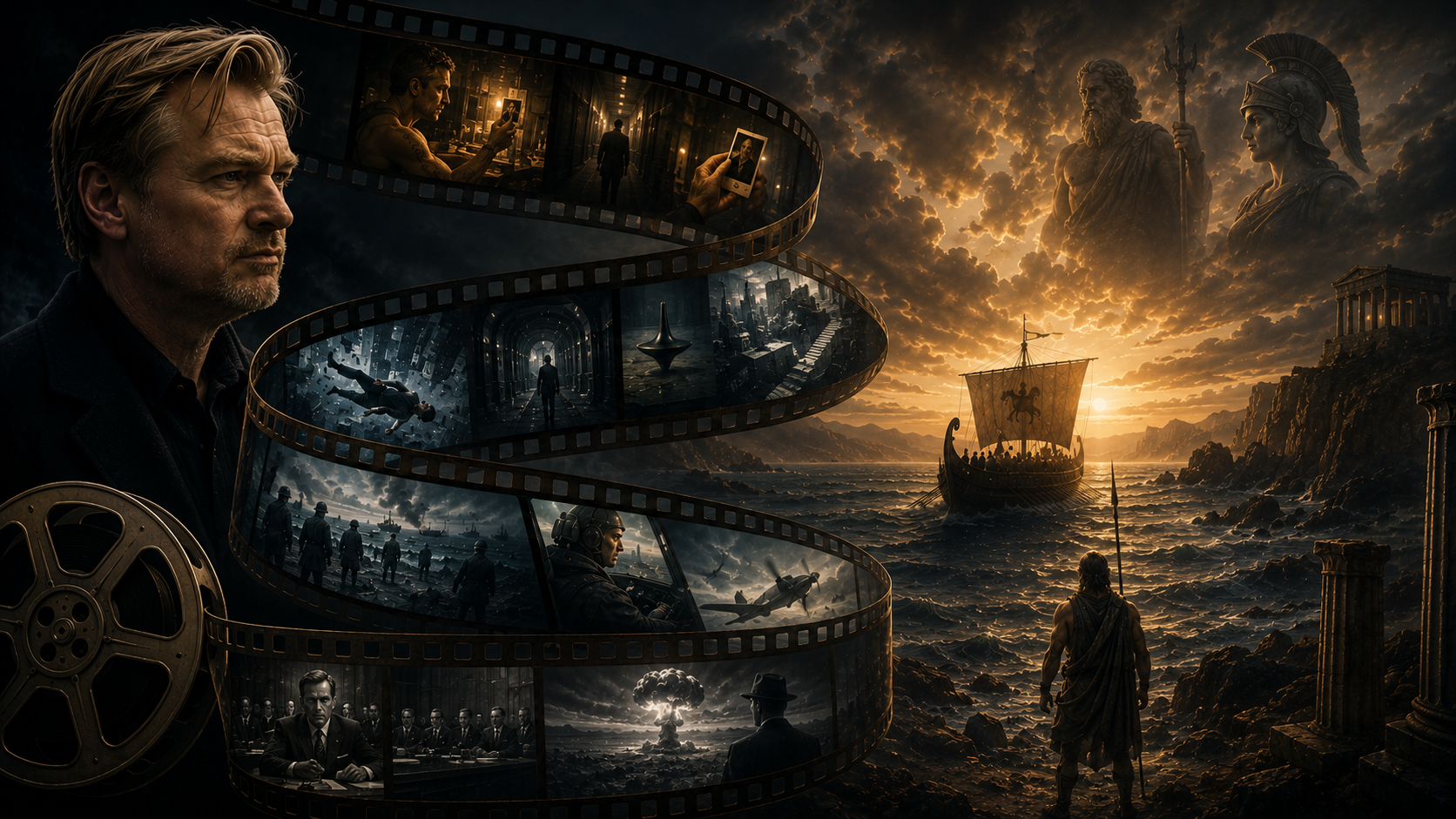
The real question is why Christopher Nolan appears to have spent his entire directing career preparing audiences for this particular story.
Nolan did not simply choose one of history’s most famous myths. He chose a narrative built from fractured chronology, conflicting perspectives, unreliable memories, absent family members and a central character whose identity depends on the stories told about him.
That description could apply to Homer’s poem. It could also describe almost every major film Nolan has made since Memento.
Nolan Did Not Turn Homer Into a Nolan Story
The easiest prediction about a Christopher Nolan adaptation of The Odyssey was that he would rearrange it.
That assumption misses the point. Homer had already done much of the rearranging.
The original epic does not begin at the beginning of Odysseus’ journey. Its hero has already been absent for years, his family has learned to live around that absence and other characters possess only fragments of information about what happened to him.
Some of the journey’s most famous events are not presented as they happen. They are reconstructed later through Odysseus’ own account.
Nolan therefore did not need to impose a fractured structure on a straightforward adventure. He found an ancient narrative that was already concerned with how stories are assembled, remembered and manipulated.
Memento Taught Audiences to Discover the Cause After the Effect
Memento established the central rule of Nolan’s filmmaking career: chronology and understanding are not the same thing.
The audience frequently sees the result of an action before learning what caused it. That reversal changes how viewers judge every decision because context arrives only after an opinion has already begun to form.
The same principle makes Odysseus such a suitable Nolan protagonist.
His reputation reaches places before he does. People know the warrior, king, strategist and survivor before they encounter the exhausted man attempting to return home. The legend functions like an effect whose causes must gradually be uncovered.
As with Leonard in Memento, the audience must also question whether the central character’s version of events can be trusted completely. Odysseus is intelligent, persuasive and unusually skilled at controlling how other people perceive him.
Nolan has always been interested in protagonists who do not merely experience a story. They actively construct one.
Inception Made Storytelling Look Like Architecture
Inception presented narratives as designed environments. Characters entered artificial worlds, planted ideas and manipulated perception while moving through realities operating at different speeds.
The film’s deeper subject was not dreaming. It was the power of a carefully constructed story to change what someone believes.
That idea sits naturally beside Odysseus.
He survives partly because he understands that identity can be performed. He changes names, conceals intentions and presents different versions of himself depending on the audience in front of him.
His greatest weapon is not physical strength. It is his ability to control information.
This makes him less like a conventional action hero and more like one of Nolan’s architects: someone who enters a dangerous environment, studies its rules and builds a convincing narrative inside it.
Dunkirk Proved Separate Timelines Could Share One Emotion
Dunkirk divided one historical event across three timelines operating over different durations. The land story unfolded across a week, the sea across a day and the air across an hour.
The film did not connect those strands through traditional exposition. Editing, sound and repeated events gradually revealed how each timeline occupied a different part of the same experience.
That technique prepared Nolan for the emotional structure of The Odyssey.
Odysseus’ journey is only one side of the story. His absence also transforms the lives of Penelope and Telemachus. Each character experiences a different form of waiting, uncertainty and survival.
Their timelines may be separated by distance, but they are driven by the same question: can a family remain connected when every member has been changed by time?
Nolan’s challenge was never simply to combine monsters, battles and homecoming into one film. It was to make separation itself feel like a shared event.
Tenet Turned Returning Into Something More Complicated
Tenet treated movement in opposite directions as part of the same system. Events could be approached from different temporal perspectives, forcing characters to reconsider what cause, consequence and free will actually meant.
The Odyssey is not a time-travel story, but it contains a related problem: returning to a place does not mean returning to the life that existed there before.
Odysseus may travel toward Ithaca, but time continues moving without him. His son grows older. His wife’s position becomes more dangerous. His home develops new power structures around the assumption that he may never return.
The destination remains physically familiar while becoming emotionally unfamiliar.
That contradiction is deeply Nolan-like. His films frequently follow people who believe they can restore something that time has already transformed permanently.
Oppenheimer Reconstructed a Man From Conflicting Testimony
Oppenheimer did not present its central figure through a single authoritative account. It moved between personal memories, political hearings, private conversations and the interpretations of people who admired or resented him.
The audience was asked to reconstruct a man whose public mythology could not be separated from private guilt and institutional judgment.
Odysseus presents a similar opportunity.
He can be understood as a heroic survivor, a damaged veteran, a manipulative storyteller, an absent husband or a destructive leader. None of those interpretations completely cancels the others.
A weaker adaptation would choose one version and simplify him. Nolan’s filmography suggests he is more interested in the contradiction itself.
The important question is not whether Odysseus deserves to be called a hero. It is whether the title “hero” can contain everything he did to survive.
The Most Nolan-Like Element Is Not the Timeline
The obvious connection between Nolan and Homer is nonlinear storytelling. The deeper connection is uncertainty about the person telling the story.
Nolan’s films repeatedly ask whether memory can be evidence.
Leonard cannot retain it in Memento. Cobb cannot separate it safely from guilt in Inception. Oppenheimer’s memory is examined by political institutions with their own motives. Bruce Wayne transforms personal trauma into a public symbol whose meaning he cannot fully control.
Odysseus also exists between memory and mythology. His journey becomes larger every time it is repeated, but the audience must decide where lived experience ends and self-created legend begins.
That tension gives Nolan something more valuable than a collection of famous mythological sequences. It gives him a protagonist whose identity is a storytelling problem.
IMAX Is Part of the Argument, Not Just the Marketing
The Odyssey was shot entirely with IMAX film cameras, but the format matters for more than selling premium tickets.
Nolan often uses physical scale to reveal psychological vulnerability. The collapsing dream cities of Inception, the empty sea and sky of Dunkirk, and the destructive force imagined in Oppenheimer all place individual characters against systems too large to control.
The world confronting Odysseus serves the same purpose.
The sea is not simply scenery. It is an unstable space that makes human plans feel temporary. The larger Nolan makes that environment, the smaller and less certain his supposedly legendary hero becomes.
The technical scale therefore supports the article’s central argument. Nolan did not choose IMAX merely because Homer offered large creatures and battles. He chose it because the story depends on reducing human confidence against forces that refuse to obey it.
The Film’s Biggest Risk Is Also Its Most Interesting Choice
Nolan’s compatibility with the material does not guarantee that every creative decision works.
Early critical discussion has praised the film’s visual ambition and described it as a culmination of themes Nolan has explored throughout his career. Other critics have questioned whether the adaptation reduces the importance of women, gods and parts of the poem’s stranger mythological character.
That disagreement reveals the adaptation’s central risk.
Nolan may understand Odysseus perfectly while still narrowing the larger world around him. A filmmaker fascinated by guilt, time and male obsession could naturally concentrate on the returning warrior at the expense of characters whose experiences challenge his version of events.
That does not make the film unworthy of praise. It makes it a more useful subject for debate than a technically impressive adaptation that says nothing new.
Why the Box Office Story Still Matters
The commercial attention surrounding The Odyssey matters because Nolan has persuaded mass audiences to treat narrative difficulty as an event rather than an obstacle.
For decades, studios often assumed that expensive films required simple structures, familiar franchises or constant explanation. Nolan built a career by asking large audiences to follow competing timelines, uncertain narrators and unresolved ideas on the biggest available screens.
That audience relationship made a major studio willing to place blockbuster resources behind an ancient epic whose hero spends much of the story remembering, lying, grieving and attempting to understand what home now means.
The achievement is not simply that Nolan adapted Homer at enormous scale. It is that millions of viewers were already prepared to approach Homer using the storytelling language Nolan had taught them.
Final Verdict
Christopher Nolan did not knowingly spend 25 years rehearsing for The Odyssey.
However, his films created a remarkably direct path toward it.
Memento explored identity without reliable memory. Inception turned storytelling into manipulation. Dunkirk united separate timelines through one emotional crisis. Tenet questioned whether returning could reverse consequences. Oppenheimer rebuilt a complicated man from testimony, guilt and public mythology.
Homer’s epic brings all of those interests together in one foundational story.
Nolan did not need to modernise The Odyssey by forcing it into his style. He only needed to recognise that its fractured timeline, persuasive narrator and impossible homecoming had been speaking his cinematic language for thousands of years.
For the complete cast, trailer, runtime, characters, release information and production guide, visit FindEdition’s The Odyssey (2026) movie listing.