




For nearly a century, the portability of electronic devices has been inextricably linked to a single, frustrating limitation: the battery. Whether it’s the AA batteries in a TV remote, the lithium-ion pack in your smartphone, or the button cell in a hearing aid, the fundamental requirement has been simple—you must store power before you can use it. And inevitably, that stored power runs out, leading to the modern anxiety of the "low battery" notification.
We are now standing on the precipice of a fundamental paradigm shift that threatens to relegate the swappable battery to the history books. A quiet revolution is underway in materials science, ultra-low-power chip design, and electrical engineering, giving rise to a new class of devices that never need charging. They don't store power; they harvest it continuously from the environment around them. This is the era of ambient power, and it is poised to change electronics forever.
1. The End of "Vampire Power" Anxiety: The Vision of Perpetual Motion
The core concept driving this revolution is Energy Harvesting, sometimes referred to as "ambient power." The idea is deceptively simple: capture the minuscule amounts of wasted energy constantly surrounding us—light, heat, vibration, radio waves, and even movement—and convert it into enough electricity to power small electronic tasks.
Imagine a world where your smoke detector never chirps for a battery change in the middle of the night. Imagine industrial sensors embedded deep within concrete bridge supports that monitor structural integrity for decades without human intervention, powered only by vibrations from passing traffic. Imagine a wearable health tracker that stays alive purely from body heat and ambient room light. This is not science fiction; it is the rapidly maturing reality of battery-free engineering.
2. The Technological Trifecta: How Ambient Power Works
Creating functional battery-free gadgets requires mastering three distinct technological pillars that must work in perfect harmony. Because the energy available from the environment is often inconsistent and extremely low-voltage, every component must be engineered for maximum efficiency.
A. The Harvesters: Capturing the Environment
The first step is collecting the energy. Engineers utilize specialized materials and components tuned to specific environmental sources:
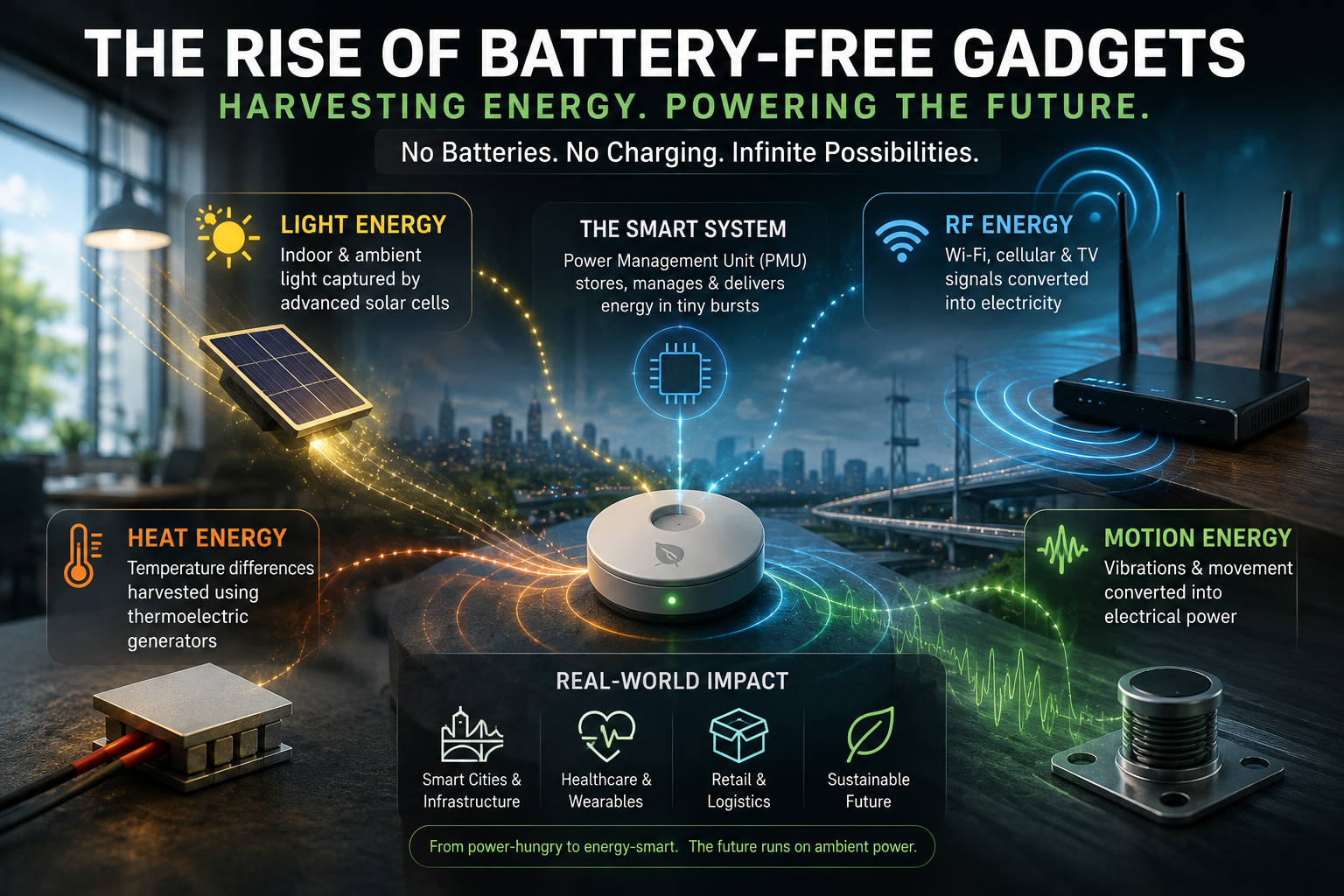
- Photovoltaic (Light): Far more advanced than standard solar panels, modern indoor photovoltaics can harvest energy from standard ambient LED and fluorescent lighting, not just direct sunlight.
- RF (Radio Frequency): This is perhaps the most futuristic method. Rectennas (rectifying antennas) can capture stray electromagnetic energy—specifically Wi-Fi signals, cellular signals, and TV broadcasts—and convert that wireless radiation into direct current (DC) electricity. Your router is literally broadcasting power, not just data.
- Thermoelectric (Heat): Utilizing the Seebeck effect, these generators create electricity from the temperature difference between two surfaces. For wearables, it’s the difference between your warm body and the cooler air.
- Piezoelectric (Motion/Vibration): Certain crystals generate a small electrical charge when physically deformed or vibrated. Sensors on machinery or even in shoe soles can harvest energy from everyday movement.
B. Power Management Units (PMUs): The Brains of the Operation
Ambient energy is rarely a steady stream; it comes in bursts. A passing cloud might dim the light, or a device might move out of a strong Wi-Fi zone. The Power Management Unit is the critical gatekeeper.
These ultra-low-power microchips act as a reservoir manager. They take the tiny, erratic trickle of energy coming from the harvester, store it temporarily in microscopic capacitors (not chemical batteries), and regulate the voltage. When enough energy has accumulated, the PMU releases a precise burst of power to wake up the main processor, perform a specific task (like taking a sensor reading and transmitting data), and then shut down completely, waiting for the next recharge cycle.
C. Ultra-Low-Power Electronics: Doing More with Less
None of this would be possible without massive advancements in semiconductor efficiency. Modern microcontrollers, radios (like Bluetooth Low Energy, LoRa, and Zigbee), and sensors consume exponentially less power than their counterparts from a decade ago.
Engineers design circuits that operate in sub-threshold voltage regions, meaning they function on just a few hundred millivolts. The communication protocols are designed to "burst" data transmission in milliseconds, spending the vast majority of their operational lifespan in a profound "deep sleep" state that consumes almost zero current.
3. Real-World Applications: Where Battery-Free is Already Here
While we aren't powering smartphones purely off Wi-Fi yet (the power demands are simply too high for current harvesting technology), the battery-free revolution is already transforming critical sectors.
Smart Cities and the Industrial Internet of Things (IIoT)
This is the largest immediate application. Deploying millions of sensors in remote locations—pipelines, forests, smart agricultural fields—becomes practically impossible if you have to visit every single one to change batteries every two years.
Battery-free sensors utilizing LoRa (Long Range) communication networks can wake up, measure temperature, humidity, or vibration, transmit that data miles away to a central gateway, and go back to sleep, all powered by a small solar cell or thermal gradient. This makes massive, truly "smart" infrastructure monitoring economically and environmentally viable.
Healthcare and Wearables
Implantable medical devices are a prime target for ambient power. Currently, pacemakers require invasive surgeries every few years just to replace the battery. Researchers are developing prototypes powered by the mechanical motion of the heart itself or by converting blood glucose into electricity, eliminating the need for replacement surgeries.
In consumer fitness, companies are already experimenting with smartwatches that utilize advanced solar charging and thermoelectric generation from body heat, theoretically offering infinite standby time under normal usage conditions.
Retail and Logistics (RFID 2.0)
Passive RFID tags have been around for decades—those stickers on clothing in stores that set off alarms. They work by harvesting the small amount of energy from the security gate's antenna to reflect a simple ID number back.
The next generation of this technology is far more advanced. Battery-free sensor tags can now monitor the temperature of perishable food shipments throughout the entire supply chain, logging data every minute. When the shipment arrives, a simple smartphone scan can verify that the cold chain was never broken, without the truck driver ever having to activate a logger.
4. The Challenges Ahead: Limitations of Ambient Power
Despite the immense promise, the widespread adoption of battery-free gadgets faces significant engineering and practical hurdles.
- Power Density: The fundamental limitation is physics. The amount of energy available in ambient sources is incredibly low. A square centimeter of indoor solar cell might generate microwatts, while a Wi-Fi harvester might manage nanowatts. This severely restricts what the device can do. Continuous high-definition video streaming or high-power computing is impossible with current harvesting tech.
- Reliability and Consistency: Ambient power is inherently intermittent. A sensor relying solely on solar power will fail at night. A device relying on Wi-Fi harvesting will die if the router is turned off. Designing systems that can gracefully handle "brownouts" (loss of power mid-operation) and store enough energy for critical "blackout" moments is complex.
- Infrastructure Dependence: RF harvesting requires a dense environment of existing signals (like Wi-Fi). In truly remote areas, this power source is unavailable, meaning the device must rely solely on light, heat, or vibration, which may also be inconsistent.
Conclusion: Redefining Our Relationship with Technology
The rise of battery-free gadgets represents far more than just a convenience upgrade; it signifies a crucial step toward sustainable, intelligent infrastructure. By breaking the dependency on chemical batteries, we eliminate toxic waste streams and reduce the colossal environmental footprint associated with manufacturing and disposing of billions of batteries annually.
We are moving toward a future where our electronics are truly integrated into the environment, operating silently and invisibly in the background, drawing sustenance directly from the world around them. The "low battery" warning may soon become a relic of the past, replaced by a new standard of electronics that simply—perpetually—works.