





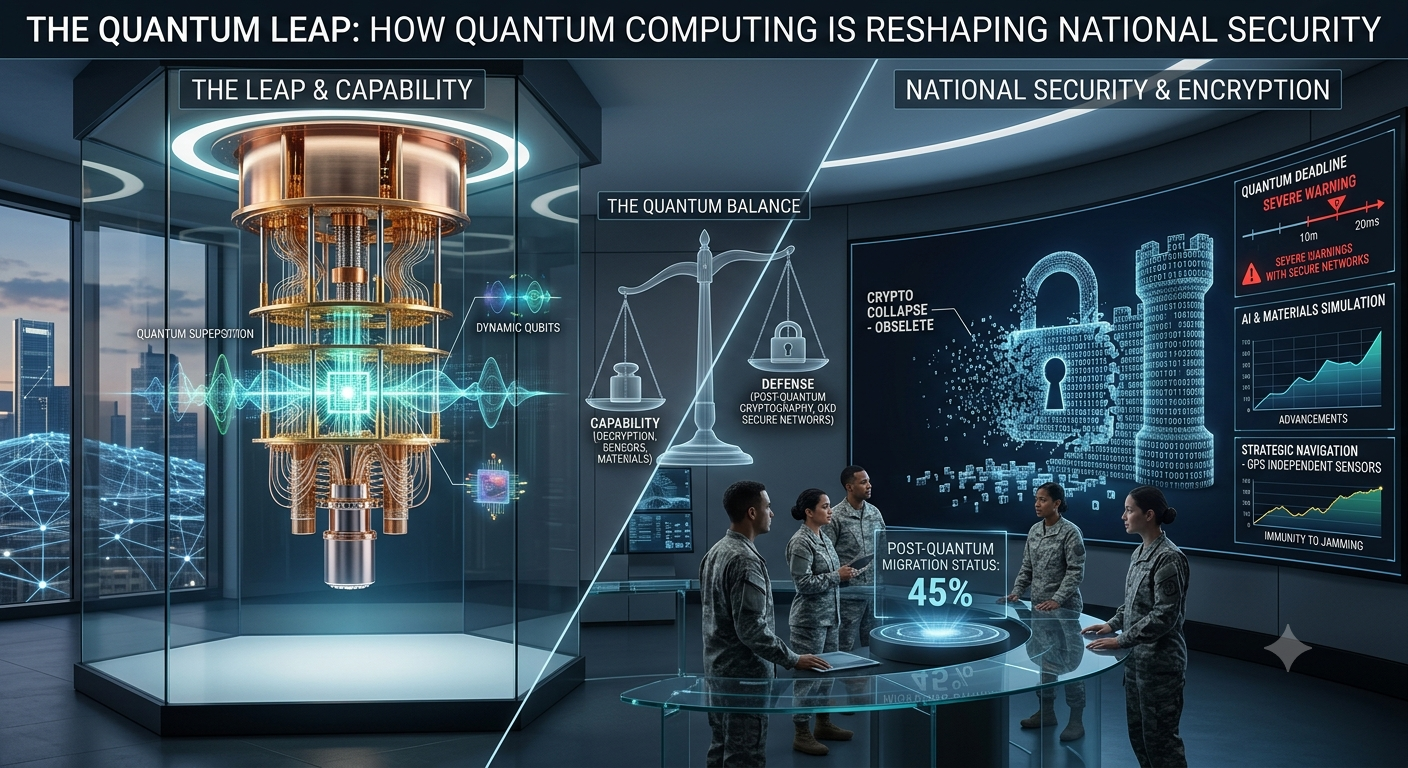
The Race for Quantum Supremacy A quiet but high-stakes technological arms race is taking place in advanced research laboratories worldwide. Quantum computing—once a theoretical concept confined to physics textbooks—is rapidly transitioning into a tangible reality. Unlike classical computers that process information using rigid bits (0s and 1s), quantum systems use qubits, which can exist in multiple states simultaneously due to the principles of superposition and entanglement.
This exponential leap in processing power promises to solve complex mathematical problems in minutes that would take today's fastest supercomputers millennia to compute. While the commercial benefits for medicine and logistics are massive, the immediate driving force behind global investments is national security.
The Great Encryption Threat The most urgent national security concern is the vulnerability of global encryption. Modern digital security—including banking networks, state communications, and corporate databases—relies on cryptographic algorithms like RSA. These systems are secure simply because factoring massive prime numbers takes a classical computer an impractical amount of time.
A sufficiently powerful quantum computer running Shor’s Algorithm can break these mathematical codes with ease. This looming reality has created a "Store Now, Decrypt Later" strategy, where adversaries actively intercept and harvest encrypted state and corporate data today, waiting for the day quantum technology allows them to unlock it.
The Shift to Post-Quantum Cryptography To combat this vulnerability, security agencies and standardization bodies worldwide are rushing to deploy Post-Quantum Cryptography (PQC). These are new, highly complex mathematical frameworks designed to withstand attacks from both classical and quantum computers.
Transitioning the global digital infrastructure to quantum-resistant standards is a monumental task. It requires completely overhauling the code running on billions of servers, smart devices, and legacy software systems. Organizations that delay this migration risk exposing their entire operational history to future decryption.
Beyond Cybersecurity: The Strategic Advantages The geopolitical impact of quantum supremacy extends far past data decryption:
Advanced Materials and Warfare: Quantum simulation allows scientists to design entirely new molecular structures. This could lead to the creation of ultra-light armor, high-efficiency stealth coatings, and next-generation battery tech for autonomous military fleets.
Breaking GPS Dependencies: Quantum sensors can measure minute changes in gravitational and magnetic fields. This enables hyper-precise navigation systems that do not rely on satellite signals, making them completely immune to traditional GPS jamming techniques.
Unbreakable Quantum Communication: Using Quantum Key Distribution (QKD), nations can build communication networks secured by the laws of physics. If an adversary attempts to intercept a quantum-secured transmission, the cryptographic key instantly changes state, alerting the senders to the intrusion.
The transition to the quantum era represents a massive shift in global power dynamics. True national sovereignty and corporate security will no longer depend solely on traditional defensive measures, but on how quickly organizations can adapt their digital infrastructure to survive in a post-quantum world.