



The consumer technology landscape has always been driven by a relentless cycle of reinvention. While global tech giants dominate headlines with incremental smartphone upgrades and massive cloud infrastructure, true cultural and functional disruption is almost always born in the garages, university labs, and nimble incubators of early-stage startups. These agile companies are not burdened by legacy product lines; instead, they build from a clean slate to solve friction points we have long accepted as part of daily life.
As we navigate through 2026, the startup ecosystem has shifted profoundly. The era of generic software wrappers is giving way to deep integrations of hardware, ambient AI, and bio-tech. From hyper-personalized wellness hardware to spatial social platforms and ambient home computing, these are the most innovative consumer tech startups to watch this year.
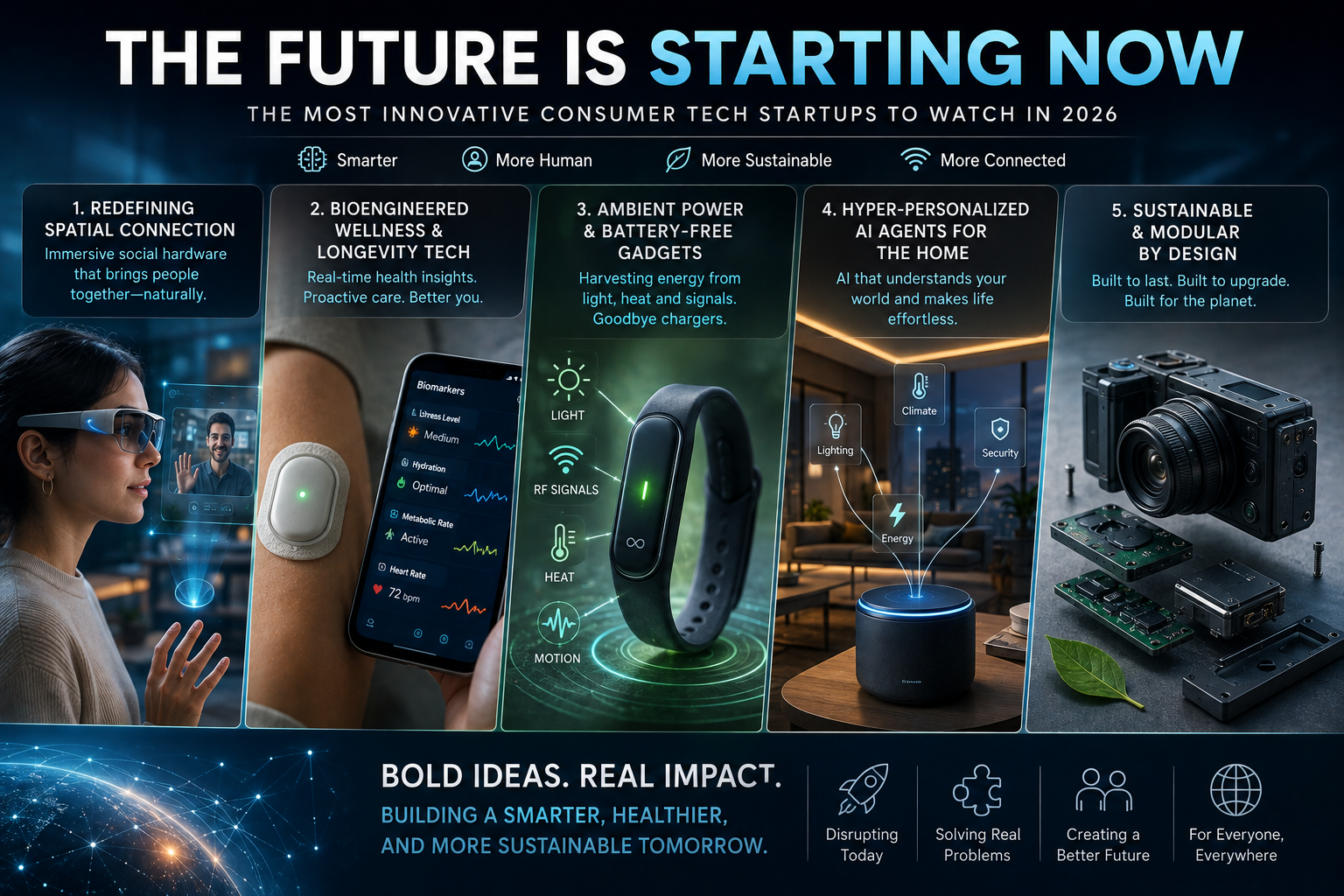
1. Redefining Spatial Connection: The Rise of Immersive Social Hardware
For over a decade, social networking has been trapped behind flat, rectangular glass screens. A wave of fresh consumer hardware startups is aggressively working to change how we interact remotely, moving past traditional video calls into rich, environmental presence.
Startups focusing on spatial 3D environments and ambient audio hardware are capturing major venture capital attention. By blending lightweight augmented reality optics with hyper-directional directional sound, these companies are building devices that make remote friends and family feel as though they are sitting right across the room. Rather than isolating users inside heavy, closed headsets, these new consumer form factors prioritize open-ear ergonomics, allowing digital interactions to weave seamlessly into physical living spaces without tearing our attention away from the real world.
2. Bioengineered Wellness & Longevity Tech
Preventative health and biological optimization have transitioned from elite athletic training regimens into mainstream consumer expectations. The boundary between consumer electronics and biotechnology is blurring faster than ever, spearheaded by brilliant early-stage innovators.
Companies specializing in non-invasive continuous biomarker tracking are moving far beyond simple step-counting and heart-rate monitoring. Utilizing advanced optical sensors and micro-fluidic skin patches, these startups provide real-time metabolic insights, cellular hydration tracking, and early stress indicators directly to your phone. Combined with local AI health agents that analyze data on-device to protect user privacy, this new generation of wellness tech acts as an active, preventative partner rather than a passive logbook.
3. Ambient Power and Battery-Free Personal Gadgets
One of the most persistent frustrations of modern consumer technology is the omnipresent charger. We carry cables, power banks, and charging docks everywhere we go, shackled to lithium-ion decay. Enter the sustainable hardware pioneers engineering the end of the charging cable.
Emerging energy-harvesting startups are introducing low-power consumer devices—ranging from smart home tags to minimalist fitness bands—that draw operational sustenance purely from indoor ambient light, Wi-Fi radio frequencies, and body heat. By pairing these advanced harvesters with ultra-low-power microprocessors, these companies are proving that everyday utility accessories can operate indefinitely without ever needing to be plugged into a wall socket.
4. Hyper-Personalized AI Agents for the Home
Smart home technology has historically suffered from fragmented ecosystems, clunky voice commands, and rigid automation rules that often feel more like chores than conveniences. A new breed of consumer robotics and ambient computing startups is rewriting the rules of domestic automation.
Powered by local Small Language Models (SLMs) running on dedicated home neural hubs, these new systems learn the behavioral patterns, comfort preferences, and daily routines of household members over time. Instead of barking precise trigger phrases at a stationary smart speaker, users interact with fluid, contextual agents that coordinate lighting, climate, security, and energy management proactively and quietly in the background.
5. Sustainable Consumer Electronics and Modular Design
The global electronic waste crisis is an environmental catastrophe that consumers are increasingly unwilling to support. In response, forward-thinking hardware startups are building entire business models around radical circularity and modular repairability.
These companies are designing consumer electronics—from modular cameras to customizable audio gear—with standardized, easily swappable components that users can upgrade themselves using simple tools. By combining durable, recycled chassis materials with transparent supply chain auditing via secure digital product passports, these startups are proving that high-end consumer desire and environmental stewardship can coexist profitably.
Conclusion: The Blueprint of Tomorrow
The consumer tech startups making waves in 2026 share a common philosophy: technology should adapt to human behavior, rather than forcing humans to adapt to clunky technology. By fusing advanced artificial intelligence, sustainable power systems, and thoughtful human-centric design, these visionary companies are laying down the foundational blueprint for how we will live, communicate, and care for ourselves in the decades to come. Keep a close eye on these disruptors—they are building the future right before our eyes.