




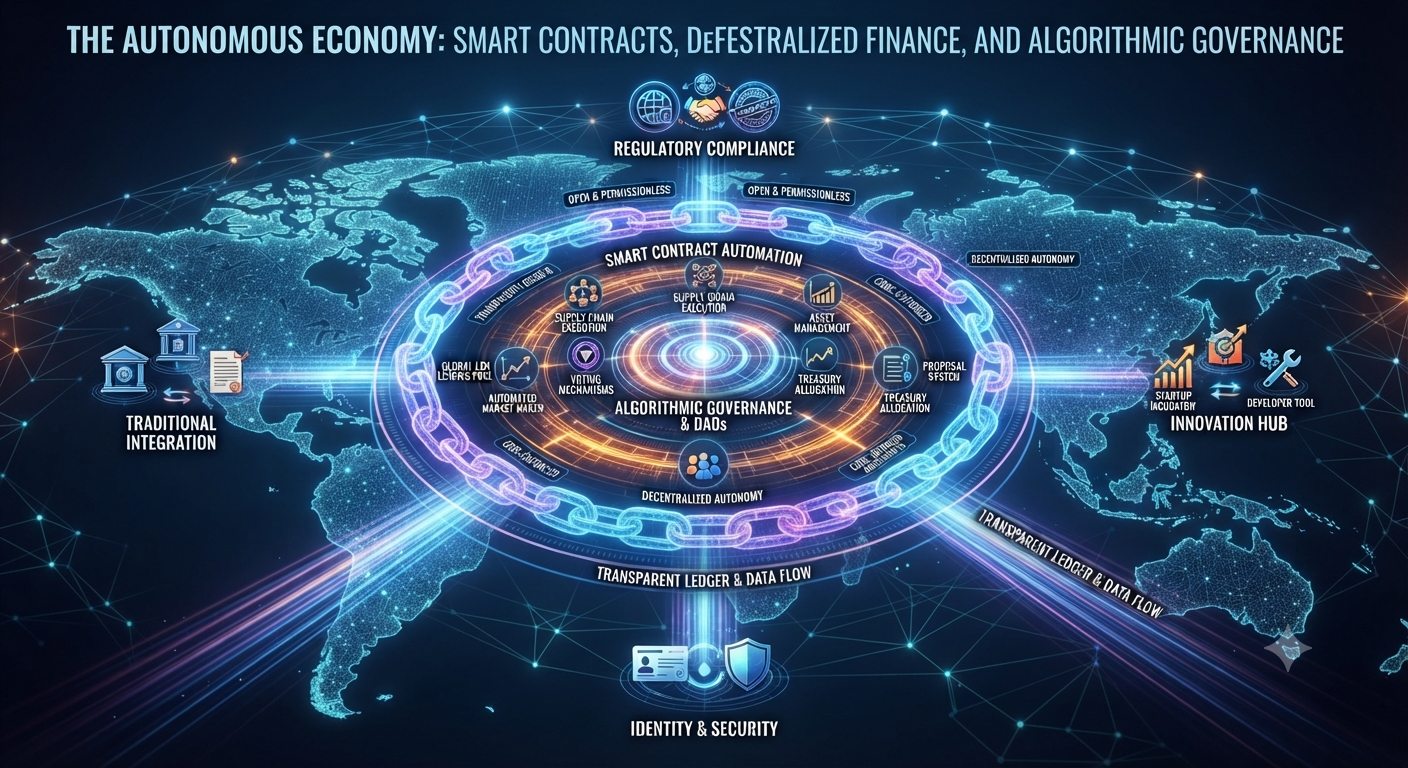
Smart Contracts: Code as the New Infrastructure of Trust
At the heart of the autonomous economy is the smart contract—a computer program stored on a blockchain that automatically executes specific actions when predetermined conditions are met.
By automating predefined processes, smart contracts can potentially reduce administrative costs, accelerate settlement times, and minimize certain forms of counterparty risk. Their applications extend far beyond cryptocurrency.
For example, a smart contract could automatically initiate a payment once a shipment is digitally verified as delivered. In insurance, programmable agreements could trigger predefined payouts when trusted external data confirms that specific conditions have occurred.
The fundamental shift is significant: agreements that once required multiple intermediaries and manual verification can increasingly be handled by transparent software rules.
However, smart contracts do not eliminate the need for human oversight. Their effectiveness depends on the accuracy of the code, the reliability of external data sources, and the legal frameworks surrounding their use.
Decentralized Finance and Open Liquidity
Complementing programmable contracts is the rapidly evolving world of Decentralized Finance, commonly known as DeFi.
DeFi seeks to recreate or redesign traditional financial services—including lending, borrowing, asset trading, and yield-generating applications—using blockchain networks and smart contracts rather than conventional financial intermediaries.
One of the sector's defining characteristics is its potential accessibility. Depending on local regulations and technical requirements, users can interact directly with financial applications through digital wallets without relying exclusively on traditional banking infrastructure.
DeFi also introduces a concept known as composability. Often described as "money legos," individual protocols can be connected and integrated to create new financial applications. Developers can combine different programmable components to build increasingly complex systems with greater speed and flexibility.
This innovation, however, comes with significant challenges. Smart-contract vulnerabilities, market volatility, regulatory uncertainty, and cybersecurity threats demonstrate that decentralization does not eliminate financial risk—it often redistributes it.
Algorithmic Governance and Decentralized Autonomy
As blockchain-based ecosystems grow, the concept of governance is evolving alongside them.
Decentralized Autonomous Organizations (DAOs) use blockchain technology, smart contracts, and community-based voting mechanisms to coordinate activities without relying entirely on traditional corporate hierarchies.
DAOs can be used to manage digital treasuries, vote on protocol upgrades, allocate community resources, and coordinate participants across geographic boundaries. In theory, this creates a more transparent organizational model in which rules and transactions can be publicly verified.
Yet decentralized governance remains an evolving experiment. Questions surrounding voting power, token concentration, participation, accountability, security, and legal recognition continue to shape the future of DAOs.
From Institutional Trust to Programmable Trust
The autonomous economy represents a fundamental shift in how societies coordinate value, trust, and resources.
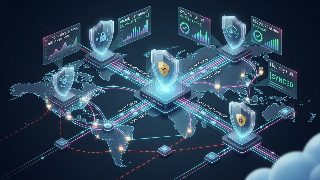
Blockchain networks can provide transparent records of transactions. Smart contracts can automate predefined agreements. DeFi protocols can create alternative financial infrastructure, while DAOs experiment with new models of organizational coordination.
Together, these technologies are challenging the traditional assumption that every economic interaction must depend on a central intermediary.
The transition, however, will not be without obstacles. Regulatory frameworks, cybersecurity, privacy, scalability, consumer protection, and the complexity of real-world contracts remain critical challenges. Not every agreement can be reduced to a set of programmable rules, and human judgment will remain essential when circumstances fall outside predefined conditions.
Pioneering a Transparent Financial Horizon
The future of the autonomous economy is unlikely to involve the complete disappearance of banks, corporations, or governments. Instead, the emerging model may be a hybrid financial ecosystem in which traditional institutions operate alongside decentralized networks and programmable digital infrastructure.
As blockchain technology matures, more economic processes could become automated, transparent, and independently verifiable. The result could be faster settlement, more efficient coordination, and new forms of global financial participation.
Ultimately, the most important transformation may be a shift from trusting institutions to verify every transaction toward using technology to make certain transactions independently verifiable.
By combining programmable infrastructure with responsible human oversight, the autonomous economy has the potential to reshape how the world coordinates value—creating a financial architecture that is more transparent, efficient, and adaptable to the digital age.