






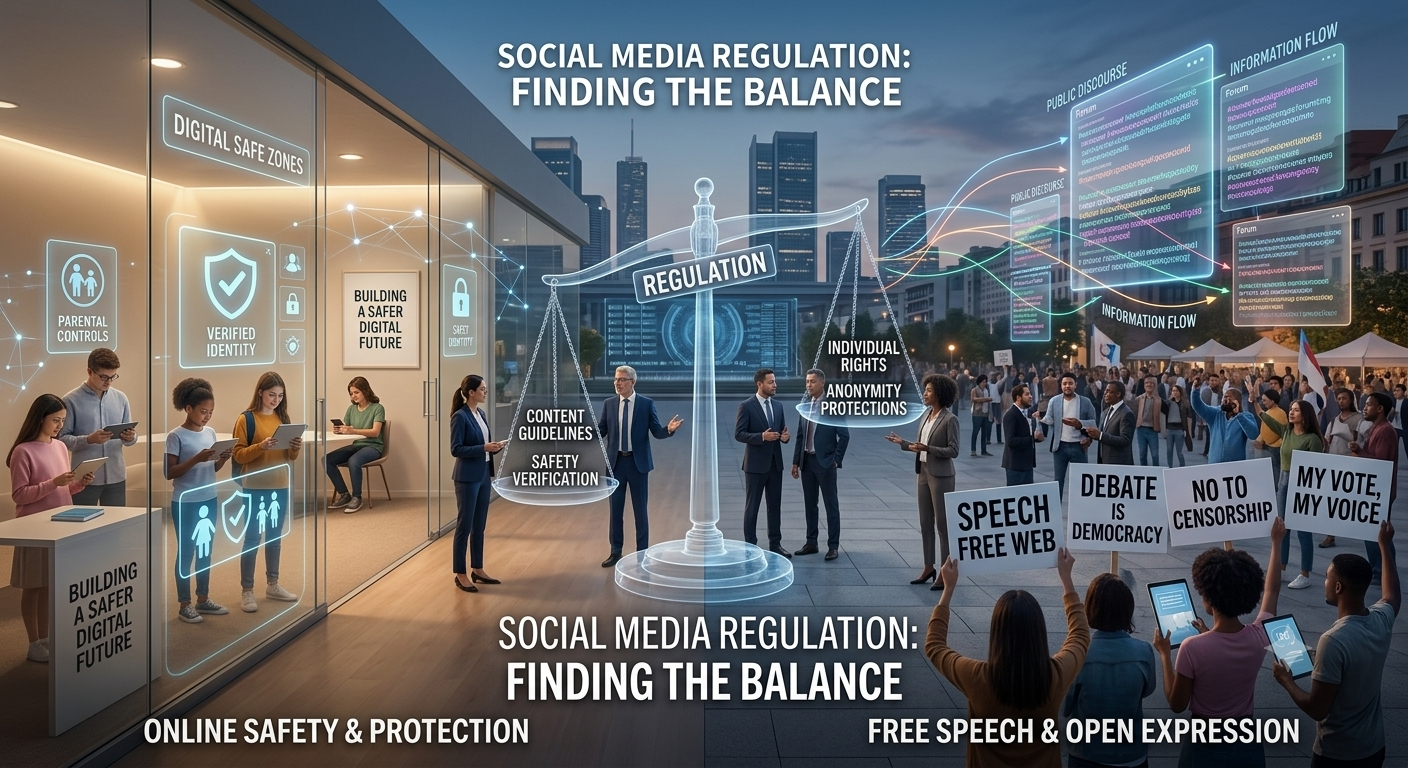
The digital world is entering a new era of regulation. For many years, social media platforms largely governed themselves by creating their own community guidelines and moderation policies. While this model enabled rapid innovation and global connectivity, it also raised concerns about misinformation, online abuse, privacy violations, and the spread of harmful content. Today, governments around the world are taking a far more active role in regulating digital platforms.
What began as isolated policy proposals has evolved into a coordinated international movement aimed at holding technology companies legally accountable for the content, services, and digital ecosystems they operate. Legislators are introducing comprehensive laws designed to protect users, strengthen online safety, safeguard personal data, and increase transparency in how platforms make decisions.
At the same time, this regulatory shift presents a difficult challenge. Policymakers must find a way to create safer online environments without undermining freedom of expression, limiting access to information, or enabling excessive government control over digital communication. Finding this balance has become one of the defining public policy issues of the digital age.
The Major Legislative Drivers
The current wave of digital regulation is being shaped by several major policy priorities that are influencing legislation across Europe, North America, Asia, and other regions.
Protecting Minors Online
One of the strongest areas of regulatory focus is the protection of children and teenagers on digital platforms. Governments are introducing stricter age requirements for accessing social media services, with several countries proposing or implementing minimum age limits of 15 or 16 years.
To enforce these rules, many regulations require platforms to introduce age-assurance technologies capable of verifying a user's age before granting access. These measures are intended to reduce children's exposure to harmful content, cyberbullying, online predators, and addictive platform designs while promoting healthier digital experiences for younger users.
Greater Platform Responsibility for Online Content
Governments are also expanding the legal responsibilities of technology companies regarding the content hosted on their platforms. Legislation such as the European Union's Digital Services Act (DSA) and the United Kingdom's Online Safety Act requires platforms to respond more quickly to illegal content, hate speech, terrorist material, child exploitation content, fraudulent activity, and harmful deepfakes.
Rather than treating platforms as passive intermediaries, these laws increasingly recognize them as active participants responsible for reducing online harms. Companies that fail to comply may face substantial financial penalties, regulatory investigations, and increased legal accountability.
Addressing AI-Generated Misinformation
The rapid growth of generative artificial intelligence has introduced entirely new regulatory challenges. AI systems can now create highly realistic images, videos, audio recordings, and written content that are often difficult to distinguish from authentic material.
In response, governments are developing regulations that require clear labeling of AI-generated content, increased transparency regarding synthetic media, and stronger legal penalties for malicious deepfakes, election interference, identity fraud, and non-consensual AI-generated content. These measures aim to preserve public trust while reducing the misuse of increasingly powerful AI technologies.
The Free Speech Dilemma
Although these regulations are designed to improve online safety, they have also generated significant debate among free speech advocates, journalists, academics, and civil liberties organizations.
One of the primary concerns is the risk of over-compliance. When technology companies face the possibility of multi-million or even multi-billion-dollar penalties for hosting prohibited content, they may choose to remove questionable material before fully evaluating whether it actually violates the law.
To minimize legal risk, many platforms rely heavily on automated AI moderation systems. While these systems can identify harmful material quickly, they are not always capable of understanding context, satire, journalism, artistic expression, or legitimate political debate. As a result, lawful content may be mistakenly removed, reducing opportunities for open discussion and democratic participation.
Another significant concern involves privacy. Age verification and identity confirmation often require users to submit government-issued identification documents, facial recognition scans, or other sensitive personal information. While these systems may improve child safety, they also increase the amount of personal data collected by digital platforms, raising important questions about surveillance, cybersecurity, and individual privacy rights.
Building a Balanced Digital Framework
Creating safer online environments should not require sacrificing the openness and freedom that have made the internet a powerful platform for communication and innovation. Instead of relying solely on broad content restrictions, many experts argue that future regulation should focus on improving platform transparency, accountability, and user empowerment.
Greater transparency regarding recommendation algorithms would allow researchers, regulators, and users to better understand how online content is promoted and distributed. Giving users more control over personalized feeds, recommendation systems, and content preferences would also reduce dependence on opaque algorithms that often prioritize engagement over user well-being.
Equally important is the creation of independent appeals processes that allow users to challenge moderation decisions fairly and transparently. Independent oversight can help ensure that content moderation remains consistent, proportionate, and respectful of fundamental rights.
Looking Ahead
The future of internet governance will depend on finding the right balance between safety, innovation, privacy, and freedom of expression. Governments have an important role in protecting citizens from genuine online harms, but effective regulation must also preserve the principles of openness, transparency, and democratic participation.
The most successful digital platforms of the future will be those that embrace accountability without compromising user rights. By combining responsible regulation with transparent algorithms, strong privacy protections, and fair moderation practices, societies can create an online environment that is both safer and more open for everyone.
Ultimately, the goal of digital oversight should not be to silence the internet—it should be to build a digital ecosystem where trust, transparency, innovation, and individual freedoms can coexist.