



For the past twenty years, if you wanted to see a digital twin in action, you had to step onto the heavily guarded floor of a high-tech manufacturing plant, tour a multi-billion-dollar aerospace laboratory, or examine complex offshore wind turbine farms. Originally pioneered by NASA and heavy industry, digital twins—live, virtual replicas of physical assets synchronized via real-time Internet of Things (IoT) sensors—served a singular purpose: keeping complex, expensive machinery from failing.
Today, that industrial technology is undergoing a massive cultural and commercial migration. Thanks to leaps in edge computing, miniaturized sensors, and artificial intelligence, the barrier to entry has evaporated. Digital twins are breaking out of the factory gates and stepping directly into our everyday lives. From personal health replicas and smart-home matrices to virtual avatars that optimize our routines, here is how digital twins are quietly transforming the consumer world.
1. What Is a Digital Twin? (A Quick Refresher)
Before exploring how this technology impacts our daily lives, it helps to understand what a digital twin actually is. Unlike a static 3D computer model or a CAD blueprint, a digital twin is a dynamic, living software counterpart.
Powered by continuous data streams, a digital twin mirrors its physical counterpart in real time. If the physical object changes temperature, experiences wear and tear, or alters its position, the digital twin registers that exact change instantly. More importantly, it allows systems to run complex simulations—testing "what-if" scenarios in a virtual space before applying the optimal solution back to the physical world. While enterprises used this to optimize jet engines, we are now using it to optimize our personal existence.
2. Smart Homes: Your Living Space Has a Digital Brain
The traditional concept of a "smart home" has often felt disjointed—a collection of independent apps controlling smart bulbs, thermostats, and robotic vacuums that rarely communicate fluidly with one another.
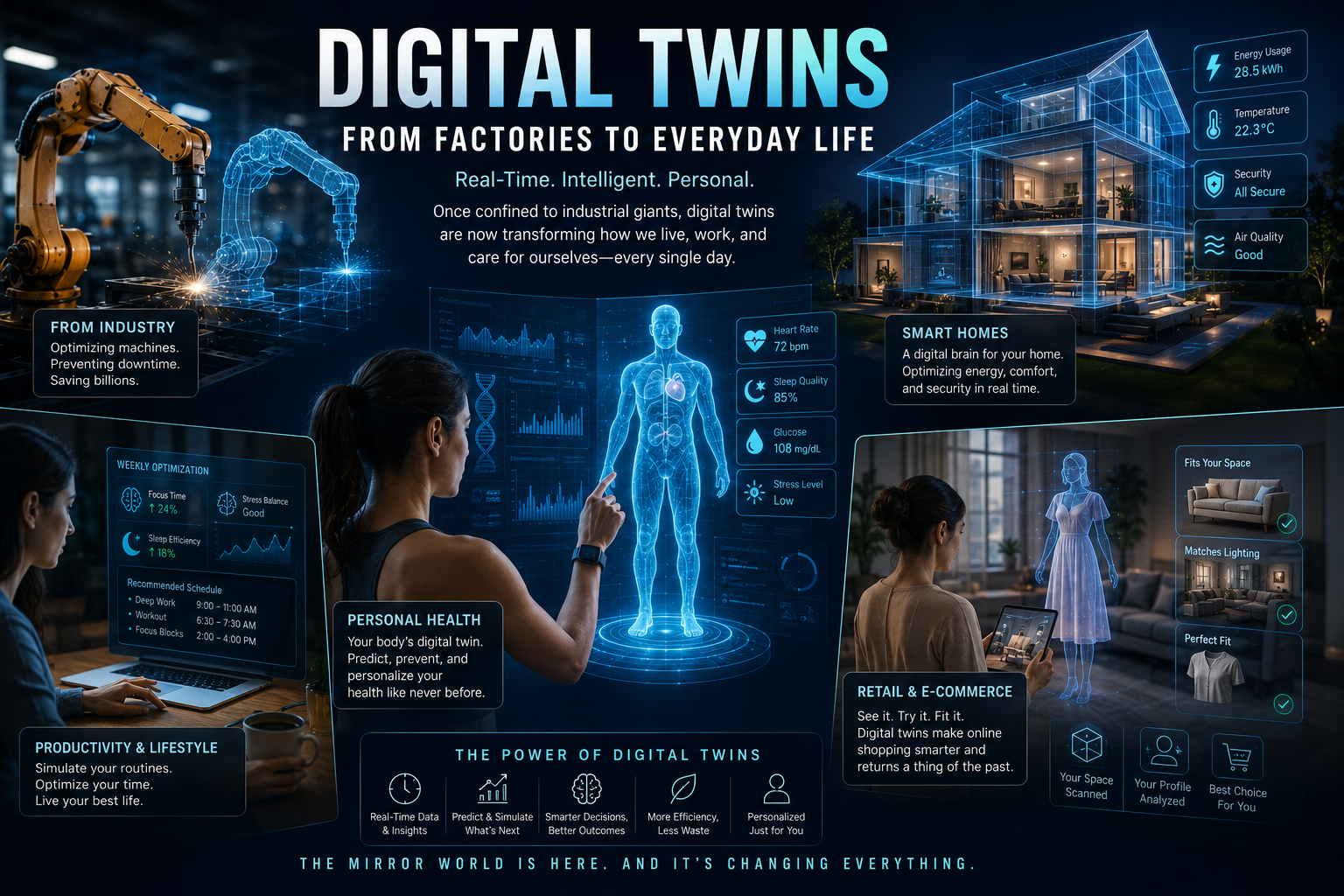
Consumer digital twins are changing this by creating a unified 3D virtual replica of your entire house. Ingesting live telemetry data from your smart meter, HVAC system, window sensors, and appliances, a home digital twin tracks energy flow, structural thermal retention, and appliance wear and tear in real-time. Instead of guessing why your electricity bill spiked last month, your home’s digital twin can run a diagnostic simulation, spot a micro-draft leaking through a poorly sealed window frame or an inefficient heat pump cycle, and automatically suggest or execute optimization fixes.
3. Personalized Healthcare and the "Body Twin"
Perhaps the most profound application of consumer-facing digital twins lies in the realm of health and wellness. Medicine is historically reactive: you feel sick, you go to a doctor, tests are run, and a generalized treatment is prescribed based on broad demographic averages.
Digital twins are accelerating the shift toward predictive, hyper-personalized medicine. Researchers and consumer health startups are building dynamic virtual models of human organs—and eventually, full physiological systems—fed continuously by smartwatches, continuous glucose monitors, and genetic profiles.
Imagine wanting to test a new fitness regimen, sleep schedule, or dietary supplement. Instead of experimenting blindly with your actual body, your digital health twin can simulate how your cardiovascular and metabolic systems will respond over a three-month period. Doctors can use these virtual replicas to simulate how a specific medication will interact with your unique genetic makeup before writing a single prescription, virtually eliminating trial-and-error healthcare.
4. Personal Productivity and Lifestyle Simulation
Our daily routines are complex webs of scheduling constraints, traffic variables, nutritional habits, and energy fluctuations. What if you could test-drive different versions of your weekly schedule to see which one maximizes productivity while minimizing burnout?
Emerging lifestyle platforms are beginning to utilize personal digital twins built from calendar patterns, wearable stress indicators, and sleep metrics. These behavioral models can simulate how shifting your morning workout, altering your deep-work blocks, or modifying your travel schedule will impact your cognitive performance throughout the week. It acts as an intelligent mirror for your habits, helping you navigate modern life with data-driven clarity.
5. Retail, E-Commerce, and Virtual Try-Ons
Shopping online has always carried an inherent friction: ordering clothes, furniture, or cosmetics without knowing how they will actually fit, look, or function in your unique physical space.
Retailers are increasingly adopting consumer digital twins to eliminate this barrier. By combining precise body-scanning technologies and millimeter-accurate 3D scans of your living room, e-commerce platforms generate personal digital twins of you and your home. When you browse furniture, your home twin instantly simulates whether a couch will fit through your doorway and match your room's exact lighting. When buying apparel, your body twin accurately simulates how different fabrics drape across your posture, effectively killing the era of endless return shipping hassles.
The Privacy and Ethical Considerations
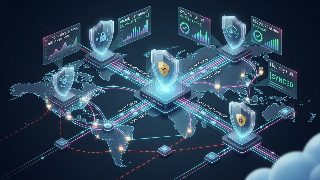
As intimate data flows from our bodies, homes, and daily habits into virtual replicas, profound questions surrounding data sovereignty inevitably arise. Who owns your health twin? Where is your home’s structural and behavioral data stored? Ensuring that consumer digital twins are protected by robust on-device encryption and strict edge-processing standards will be essential to preventing misuse.
Conclusion: The Mirror World Is Here
Digital twins have officially graduated from heavy industrial hardware to the fabric of everyday human experience. By bridging the gap between the physical and virtual worlds, they offer us unprecedented visibility into how our homes operate, how our bodies function, and how our choices shape our lives.
We are no longer just living in the physical world; we are learning to run simulations of it to live smarter, healthier, and more efficiently. The factory floor was only the beginning—the mirror world is now right at home.