






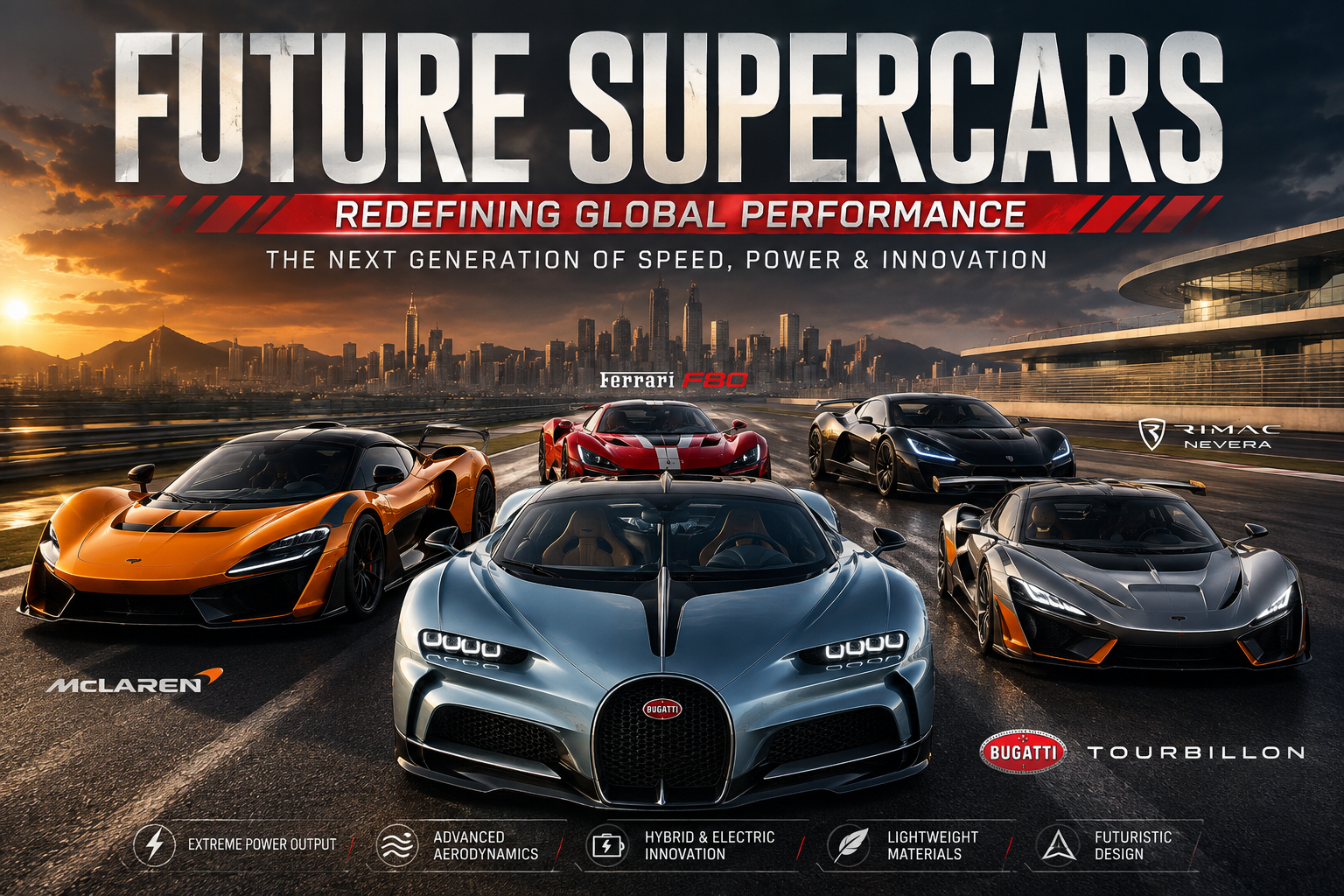
For over a century, the definition of a great supercar was straightforward: a screaming multi-cylinder internal combustion engine, a lightweight chassis, an aggressively sculpted aerodynamic shell, and enough raw horsepower to pin your organs to the back of your seat. We measured automotive evolution in fractions of seconds shaved off a 0-to-60 mph sprint and incremental top-speed records set on remote German test tracks.
Today, that traditional blueprint is undergoing a radical, once-in-a-generation metamorphosis. Driven by astonishing breakthroughs in aerospace materials, solid-state battery architecture, Formula 1-derived hybrid electrification, and intelligent vectoring software, the next generation of supercars is completely rewriting the laws of physics. These aren't just faster cars; they are technological marvels redefining what human beings can experience on four wheels. Here are the future supercars redefining global performance.
1. The Bugatti Tourbillon: The Symphony of Mechanical Mastery
When Volkswagen Group and Rimac joined forces to guide Bugatti into its next chapter, purists worried that the legendary W16 engine would be quietly retired in favor of a silent, heavy electric powertrain. Instead, Bugatti shocked the world with a masterpiece of internal engineering defiance: the Bugatti Tourbillon.
Abandoning turbochargers entirely, the Tourbillon features an 8.3-liter naturally aspirated V16 engine developed alongside Cosworth that spins effortlessly up to a screaming 9,000 RPM. To bridge the gap into modern performance, this mechanical monster is paired with a sophisticated three-motor electric system, delivering a combined output of 1,775 horsepower. Its interior looks like a Swiss mechanical wristwatch come to life, eschewing giant digital touchscreens for analog titanium gauges. It bridges old-world mechanical romance with staggering hypercar performance.
2. The McLaren W1: Formula 1 DNA for the Open Road
As the spiritual successor to the iconic McLaren F1 and the track-dominating P1, the McLaren W1 carries an impossibly heavy legacy on its carbon-fiber shoulders. Rather than chasing brute electric weight, McLaren focused intensely on weight optimization, aerodynamic downforce, and hybrid synergy.
At the heart of the W1 sits a brand-new 4.0-liter twin-turbocharged V8 engine mated to an advanced Formula 1-derived E-module, pumping out a collective 1,258 horsepower exclusively to the rear wheels. What truly sets the W1 apart is its active "Ground Effect" aerodynamic mode. The rear wing dynamically extends backward and shifts angles, transforming the car from a sleek street weapon into a track-devouring downforce monster capable of cornering speeds that defy belief.
3. The Ferrari F80: Endurance Racing Transferred to Asphalt
Ferrari’s halo hypercars—the GTO, F40, F50, Enzo, and LaFerrari—define the absolute pinnacle of their respective eras. The Ferrari F80 steps into this lineage by taking direct technology from Ferrari's Le Mans-winning 499P endurance racer and packing it into a carbon-fiber tub.
Moving away from V12 or V8 layouts for its core combustion element, the F80 utilizes a hyper-optimized 3.0-liter twin-turbo V6 coupled with three electric motors (two on the front axle, one at the rear) to deliver an all-wheel-drive total of 1,184 horsepower. The front electric axle enables sophisticated torque vectoring, pulling the car through apexes with supernatural agility and redefining how cornering dynamics behave in high-output exotics.
4. The All-Electric Revolution: Instant Torque and Vectoring Physics
While hybrid hypercars preserve the visceral roar of combustion, the pure electric vanguard is pushing performance metrics into uncharted territory. Machines like the Rimac Nevera and next-wave electric concepts utilize independent quad-motor setups that deliver upward of 1,900 horsepower with zero transmission lag.
Because each wheel is controlled by an independent computer processing traction data thousands of times per second, electric supercars can manipulate yaw and slip angles instantaneously. They corner with a level of lateral grip that makes traditional mechanical limited-slip differentials look primitive, achieving 0-to-60 mph times well under the 2-second threshold.
5. Advanced Materials and Active Aerodynamics
Performance isn't just about straight-line power; it is heavily dictated by how a car sheds weight and cuts through air. Future supercars are moving beyond standard carbon fiber into aerospace-grade titanium matrices and graphene-infused composites.
Active aerodynamics have evolved from simple pop-up spoilers into morphing body panels, active underbody tunnels, and real-time drag-reduction systems. These cars breathe with the air, opening cooling channels under heavy braking and closing completely smooth profiles on long straights to maximize top-end velocity.
Conclusion: The Golden Age of Automotive Engineering
There was a widespread fear that tightening global emissions regulations and the rise of electrification would sterilize the supercar market, turning future performance machines into quiet, characterless commuter appliances.
Instead, the exact opposite has happened. Spurred by engineering competition, brands are building the most extreme, mechanically complex, and breathtakingly fast vehicles in human history. Whether driven by a roaring 16-cylinder engine or instant-torque quad-motors, the future of the supercar is brighter, louder, and faster than ever before.