



Introduction
Elite sports have always been defined by incredibly small margins. At the highest level of competition, victory is rarely determined by obvious differences in strength, speed, or endurance. Championships are often won by fractions of a second, a perfectly timed decision, or a minor technical adjustment that goes unnoticed by spectators. As sports science has evolved over the past few decades, athletes have benefited from improved nutrition, advanced training techniques, cutting-edge equipment, and personalized recovery plans. These innovations have helped competitors reach levels of performance that once seemed impossible.
However, many experts now believe that traditional methods are approaching their limits. Athletes can only train so hard before the risk of injury increases. Muscles can only recover so quickly, and even the best coaches are limited by how much information they can observe and analyze during training or competition.
The next breakthrough in sports performance is no longer about simply lifting heavier weights or running more miles. It lies in understanding the enormous amount of biological data generated by every athlete every second they move. Every heartbeat, muscle contraction, stride, jump, change in direction, and breathing pattern creates valuable information that reveals how the body is functioning in real time.
This hidden layer of information has sparked one of the biggest technological revolutions in modern sports: the rise of Artificial Intelligence (AI) as a digital coach.
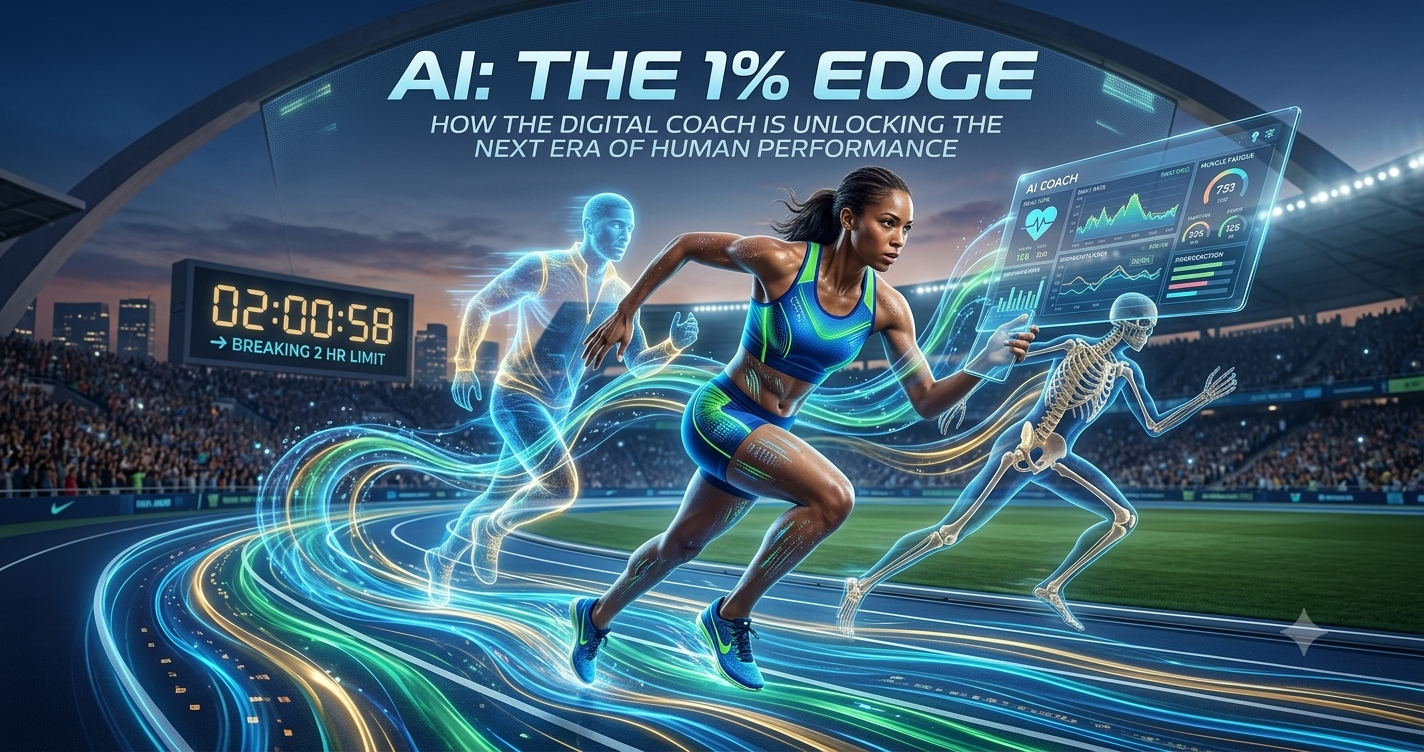
Unlike traditional coaching methods, which rely heavily on observation and experience, AI systems can collect and analyze millions of data points instantly. They identify patterns that are invisible to the human eye and provide coaches with insights that help athletes train smarter, recover faster, and reduce their risk of injury.
Rather than replacing human coaches, AI has become a powerful assistant capable of transforming raw biometric data into practical recommendations. As competition becomes more intense and the margin for victory becomes smaller, these tiny improvements can make the difference between winning a championship and missing the podium.
The Evolution of Sports Coaching
For centuries, coaching relied primarily on knowledge, observation, and experience. Coaches watched athletes train, identified weaknesses, and developed programs based on years of practical understanding.
The introduction of video analysis changed sports forever. Coaches could slow down movements frame by frame, allowing athletes to improve technique with much greater precision.
Soon after came wearable technology.
Heart rate monitors.
GPS tracking devices.
Power meters.
Motion sensors.
Sleep monitors.
Recovery trackers.
Each new technology generated more information than ever before. However, gathering data and understanding it are two completely different challenges.
An elite athlete now produces millions of pieces of information every week. No human coach can realistically analyze every heartbeat, every stride, every muscle contraction, and every recovery pattern simultaneously.
Artificial Intelligence fills this gap.
Instead of reviewing information after training has ended, AI continuously processes incoming data while the athlete is still moving. It recognizes patterns instantly, compares them with previous performances, and provides recommendations before problems even become visible.
This marks a major shift from reactive coaching to predictive coaching.
Real-Time Biometric Analysis
The foundation of AI coaching is real-time biometric monitoring.
Modern athletes wear sophisticated sensors capable of measuring far more than speed or distance. Today’s wearable technology continuously monitors numerous aspects of human performance, including:
- Heart rate
- Heart rate variability
- Blood oxygen levels
- Core body temperature
- Hydration status
- Muscle activity
- Running mechanics
- Joint movement
- Acceleration and deceleration
- Ground contact time
- Sleep quality
- Recovery readiness
- Respiratory efficiency
One of the most important technologies is electromyography (EMG).
EMG sensors measure the electrical signals produced when muscles contract. Instead of waiting until fatigue becomes visible, AI systems detect tiny changes in muscle activation that often occur long before athletes notice any discomfort.
Accelerometers provide another valuable source of information.
These tiny sensors measure movement in three dimensions and identify microscopic changes in posture, stride length, balance, and coordination.
Even the slightest variation in movement can indicate developing fatigue or the early stages of injury.
Researchers are also exploring biomarkers related to stress hormones, metabolic activity, and neurotransmitter depletion. Although many of these technologies are still developing, they may eventually allow AI systems to monitor both physical and mental fatigue simultaneously.
Rather than examining each measurement separately, Artificial Intelligence combines all of this information into a single, constantly evolving picture of an athlete’s condition.
Finding the Invisible One Percent
Elite athletes rarely improve by dramatic amounts.
Instead, success comes from accumulating many tiny improvements.
Artificial Intelligence specializes in discovering these hidden advantages.
Imagine a professional sprinter whose running technique changes very slightly after several weeks of intense training.
The difference is almost impossible to notice.
A human coach may never detect it.
An AI system immediately recognizes the subtle shift in movement mechanics. After comparing it with thousands of previous training sessions, it determines that the pattern resembles those commonly seen before hamstring injuries.
Instead of waiting until pain develops, coaches receive an early warning.
Training intensity can be adjusted.
Recovery sessions can be increased.
Strength exercises can be modified.
The injury may be prevented entirely.
Similarly, AI may detect that a cyclist’s pedaling efficiency decreases just enough to reduce power output by one percent.
That small change may not seem important.
At the Olympic level, however, one percent can determine whether an athlete wins a gold medal or finishes outside the medals altogether.
Personalized Training Through Artificial Intelligence
One of AI’s greatest strengths is personalization.
Traditional training programs often rely on averages.
Athletes of similar age, fitness level, and sporting discipline frequently receive comparable workouts.
However, every athlete responds differently to physical stress.
Some recover rapidly.
Others require additional recovery days.
Some perform best after high-volume training.
Others improve more through shorter, higher-intensity sessions.
Artificial Intelligence learns these individual differences over time.
Every workout becomes additional information that improves future recommendations.
Instead of relying on generalized assumptions, AI creates a unique physiological profile for each athlete.
It begins answering questions such as:
- How much recovery does this athlete require after sprint training?
- Which warm-up routine produces maximum explosive power?
- When does fatigue begin reducing technical accuracy?
- How much sleep is necessary before competition?
- How does hydration affect endurance in hot conditions?
Because recommendations become increasingly personalized, athletes train more efficiently while reducing unnecessary fatigue.
Injury Prevention Before Pain Appears
One of the most valuable applications of AI coaching is injury prevention.
Traditional sports medicine often reacts after symptoms appear.
By the time pain develops, tissue damage may already exist.
Artificial Intelligence attempts to identify injury risk before any symptoms occur.
Machine learning models analyze thousands of variables associated with previous injuries.
These include:
- Training volume
- Movement symmetry
- Muscle fatigue
- Recovery quality
- Sleep duration
- Previous injury history
- Joint loading
- Biomechanical efficiency
When AI recognizes combinations of variables associated with elevated injury risk, coaches receive immediate alerts.
Training loads can be adjusted.
Recovery can be extended.
Exercises can be modified.
Movement technique can be corrected.
Instead of treating injuries, teams increasingly focus on preventing them altogether.
Smarter Recovery Strategiesa
Recovery has become just as important as training itself.
Without proper recovery, muscles cannot repair efficiently, performance declines, and injury risk increases.
Artificial Intelligence evaluates how athletes respond to different recovery methods.
These may include:
- Cold water immersion
- Heat therapy
- Compression garments
- Massage
- Active recovery
- Sleep optimization
- Nutrition timing
- Hydration strategies
Rather than recommending identical recovery plans for everyone, AI identifies which methods work best for each individual athlete.
For example, one athlete may recover faster using cold therapy after endurance training, while another responds better to heat following strength sessions.
These personalized recommendations maximize recovery while minimizing unnecessary interventions.
Tactical Decision-Making During Competition
Artificial Intelligence is beginning to influence live competition as well.
Real-time biometric analysis allows coaches to make faster and more informed tactical decisions.
Imagine a soccer player whose movement efficiency, heart rate variability, and muscle fatigue indicate that performance will decline within the next few minutes.
Although the athlete still appears energetic, AI predicts that fatigue will soon reduce decision-making ability.
Rather than waiting until mistakes occur, coaches substitute the player before performance drops.
Similarly, basketball coaches can optimize player rotations, cycling teams can adjust pacing strategies, and marathon runners can receive personalized hydration recommendations based on changing environmental conditions.
These decisions improve both performance and athlete safety.
Breaking the Performance Plateau
Elite athletes often reach a point where improvement becomes extremely difficult.
Despite harder training, results remain almost unchanged.
Artificial Intelligence offers a different approach.
Rather than simply increasing workload, AI identifies dozens of tiny opportunities for improvement.
Perhaps stride length requires a slight adjustment.
Maybe nutrition timing needs refinement.
Recovery duration could be optimized.
Sleep quality may have a greater impact than expected.
Each improvement may only increase performance by a fraction of a percent.
Combined together, however, these small gains become significant.
This continuous optimization allows athletes to break through performance plateaus that traditional coaching methods sometimes struggle to overcome.
Human Coaches and AI: Working Together
Although AI is becoming increasingly sophisticated, it is unlikely to replace human coaches.
Successful coaching involves much more than analyzing numbers.
Coaches motivate athletes.
Build trust.
Provide emotional support.
Develop leadership.
Manage team dynamics.
Help athletes overcome setbacks.
These human qualities cannot easily be replicated by algorithms.
Instead, AI acts as a highly intelligent assistant.
It processes enormous amounts of information beyond human capability.
Human coaches interpret those insights, apply experience, and make final decisions based on context.
The strongest coaching environments will combine technological precision with human understanding.
Ethical Challenges
As AI becomes more common in sports, several ethical questions must be addressed.
Data Ownership
Athletes generate enormous amounts of biometric information.
Who owns that data?
The athlete?
The team?
The technology company?
If an athlete transfers to another team, should years of historical biometric data transfer as well?
These questions remain largely unresolved.
Algorithmic Bias
Artificial Intelligence learns from historical datasets.
If those datasets primarily represent certain body types, genders, or populations, prediction accuracy may decline for others.
Developing diverse and representative datasets is essential to ensure fairness.
Privacy
Continuous biometric monitoring raises concerns about personal privacy.
Many athletes now wear devices that collect data throughout the day, including sleep, recovery, stress, movement, and heart rate.
Clear policies are needed to protect athletes while still allowing technology to improve performance.
The Future of AI in Sports
Artificial Intelligence is advancing rapidly.
Future systems may include computer vision capable of analyzing entire teams, digital twins that simulate athlete physiology, virtual reality coaching environments, predictive nutrition planning, AI-assisted rehabilitation programs, and even genetic insights combined with performance analytics.
Eventually, athletes may have digital models that predict how they will respond to specific training sessions before those sessions even begin.
Training programs could be optimized weeks in advance based on predicted physiological responses.
Sports will increasingly combine physical excellence with computational intelligence.
Final Thoughts
Artificial Intelligence is transforming elite sports by revealing performance insights that were once impossible to detect. Through real-time biometric analysis, predictive modeling, personalized training, injury prevention, and optimized recovery, AI helps athletes perform at their highest potential while reducing unnecessary physical strain.
Yet technology alone cannot create champions. Dedication, discipline, resilience, teamwork, and mental strength remain deeply human qualities that no algorithm can replace. AI serves as a powerful tool that enhances these strengths rather than replacing them.
The future of sports will belong to athletes and coaches who successfully combine human expertise with artificial intelligence. Every heartbeat, every movement, every recovery session, and every decision will contribute to a constantly evolving digital understanding of performance.
The next generation of champions will not simply train harder—they will train smarter. In this new era, victory will increasingly be determined not only by physical ability but also by the intelligent systems capable of discovering the invisible details that unlock human potential. The future of elite sports is no longer just about stronger bodies—it is about smarter performance powered by data, science, and artificial intelligence.