





Introduction
The workplace is experiencing one of the most significant transformations in modern history. Artificial intelligence is no longer an experimental technology used by only large technology companies. In 2026, AI has become a core part of everyday business operations across industries including healthcare, finance, education, retail, manufacturing, marketing, logistics, and customer service.
While many people continue to worry that artificial intelligence will eliminate millions of jobs, the reality is far more complex. AI is certainly automating repetitive and routine tasks, but at the same time it is creating entirely new opportunities for professionals who can combine technological knowledge with uniquely human abilities.
The future of work is not a competition between humans and machines. Instead, it is a collaboration where each contributes its greatest strengths. AI excels at processing information, identifying patterns, performing repetitive work, and analyzing large amounts of data at incredible speed. Humans remain superior in creativity, emotional intelligence, ethical reasoning, leadership, innovation, strategic thinking, and relationship building.
This shift is changing how businesses recruit employees, design workflows, evaluate performance, and measure productivity. Organizations are moving away from traditional job structures toward AI-enabled workplaces where technology handles execution while people focus on decision-making and long-term strategy.
The companies that thrive in the coming years will not simply purchase AI software. They will redesign their operations, encourage collaboration between humans and intelligent systems, and build cultures that embrace continuous learning and innovation.
In this article, we explore how artificial intelligence is transforming work and business in 2026, the human skills that remain irreplaceable, and why collaboration between people and AI will become the most valuable competitive advantage of the next decade.
The Evolution of Work in the AI Era
For decades, professional success depended largely on the ability to execute tasks efficiently.
Employees were expected to process information, complete paperwork, prepare reports, answer customer inquiries, organize schedules, and perform repetitive administrative work.
Today, artificial intelligence performs many of these responsibilities faster, more accurately, and without interruption.
AI can summarize documents, generate reports, analyze customer behavior, organize emails, schedule meetings, prepare presentations, create marketing content, write computer code, monitor inventory, and provide customer support twenty-four hours a day.
This automation does not eliminate the importance of human workers.
Instead, it changes the nature of their work.
Professionals are increasingly responsible for directing AI systems, interpreting results, validating outputs, making strategic decisions, solving complex problems, and ensuring technology aligns with organizational goals.
Rather than completing every individual task themselves, employees increasingly supervise intelligent systems that perform much of the routine work automatically.
This transition marks one of the most important workplace changes of the twenty-first century.
From Task Execution to Strategic Oversight
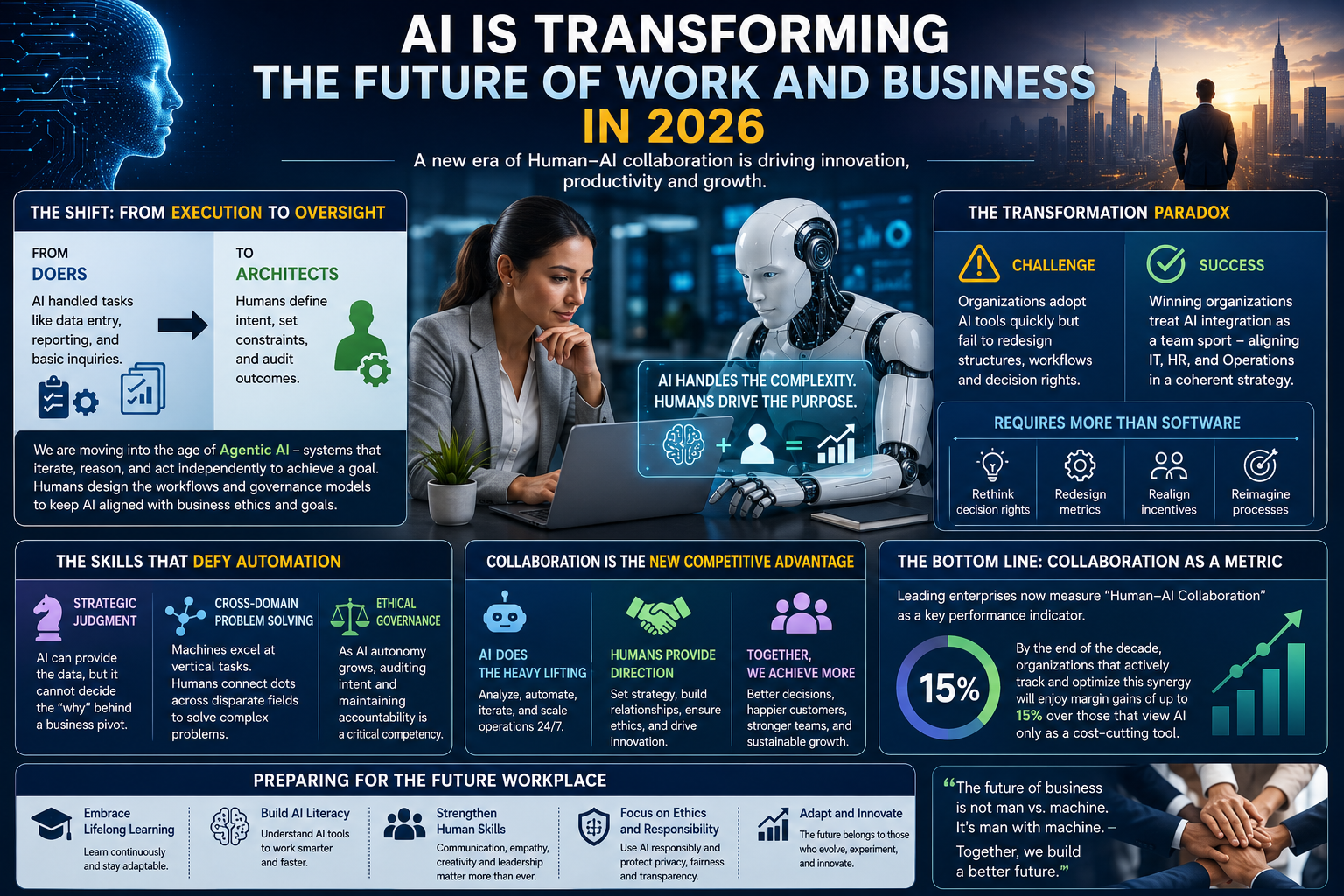
One of the defining characteristics of the modern workplace is the shift from execution toward oversight.
Traditional business roles focused heavily on completing assigned tasks.
Success was measured by speed, accuracy, and productivity.
Artificial intelligence now handles much of this operational workload.
The human role has therefore evolved.
Today’s professionals define objectives, establish quality standards, monitor AI performance, identify exceptions, and make final decisions.
Instead of writing every report manually, managers review AI-generated insights.
Instead of answering every customer inquiry, support teams resolve only complex situations requiring empathy and judgment.
Instead of manually analyzing thousands of data points, executives interpret AI-generated recommendations before determining organizational strategy.
Human expertise remains essential because AI lacks contextual understanding, organizational awareness, emotional intelligence, and ethical judgment.
Professionals have become architects of intelligent systems rather than simply operators of business processes.
This transformation increases productivity while allowing people to focus on work that creates greater value.
The Rise of Agentic Artificial Intelligence
Artificial intelligence is evolving beyond simple chatbots and automation tools.
A new generation known as Agentic AI is emerging.
Unlike earlier AI systems that waited for individual instructions, agentic AI can pursue broader objectives independently.
These systems plan workflows, complete multiple connected tasks, communicate with different software platforms, adapt to changing circumstances, and continuously improve outcomes.
For example, an AI agent may receive the objective of increasing customer satisfaction.
Instead of simply answering questions, it might analyze customer feedback, identify recurring complaints, generate improvement recommendations, coordinate marketing campaigns, schedule follow-up communications, and monitor future performance.
Businesses increasingly use AI agents to automate project management, financial analysis, marketing operations, software development, customer service, logistics, and administrative work.
Human responsibility shifts toward defining goals, establishing ethical boundaries, monitoring performance, and ensuring accountability.
Organizations that successfully implement agentic AI create highly efficient digital workforces while maintaining strong human oversight.
Human Skills That Artificial Intelligence Cannot Replace
Despite rapid technological progress, certain human abilities continue becoming more valuable.
As AI automates technical execution, demand grows for uniquely human capabilities.
These skills represent the greatest long-term career advantages.
Strategic Thinking
Artificial intelligence analyzes information quickly but cannot fully understand organizational purpose, long-term vision, or competitive positioning.
Business leaders determine strategic direction by considering market conditions, customer expectations, organizational culture, economic trends, and long-term objectives.
Strategic judgment requires experience, intuition, creativity, and understanding of complex business environments.
These qualities remain fundamentally human.
Creativity and Innovation
AI generates ideas by recognizing patterns from existing information.
Humans create entirely new concepts by combining imagination, emotion, curiosity, and personal experience.
Innovation depends upon challenging assumptions, exploring possibilities, and developing solutions that have never existed before.
Creative thinking continues driving product development, business models, marketing campaigns, scientific discoveries, and artistic expression.
Organizations increasingly value employees capable of original thinking rather than repetitive execution.
Emotional Intelligence
Successful businesses depend on trust, communication, collaboration, empathy, and leadership.
These qualities cannot be automated effectively.
Managers motivate employees.
Sales professionals build customer relationships.
Healthcare workers provide compassionate care.
Teachers inspire students.
Leaders navigate organizational change through understanding human emotions and motivations.
Emotional intelligence strengthens teamwork while improving customer experiences and workplace culture.
Complex Problem Solving
Many business challenges involve incomplete information, conflicting priorities, uncertain outcomes, and multiple stakeholders.
Artificial intelligence provides valuable analysis but often struggles with ambiguous situations requiring nuanced judgment.
Humans excel at balancing competing objectives while adapting creatively to unexpected circumstances.
Complex decision-making remains one of the most valuable professional capabilities.
Cross-Domain Thinking: A Unique Human Advantage
Modern organizations increasingly face interdisciplinary challenges.
Healthcare organizations combine medicine, technology, psychology, and economics.
Financial institutions integrate artificial intelligence, cybersecurity, customer behavior, and regulatory compliance.
Manufacturers combine engineering, sustainability, automation, and global logistics.
Artificial intelligence performs exceptionally well within clearly defined domains.
Humans, however, excel at connecting ideas across unrelated fields.
Cross-domain thinking enables professionals to identify innovative opportunities that purely technical analysis may overlook.
For example, combining behavioral science with healthcare data may improve patient treatment compliance.
Integrating environmental sustainability with manufacturing processes creates competitive advantages while reducing operational costs.
Connecting artificial intelligence with education transforms personalized learning experiences.
Businesses increasingly seek employees capable of interdisciplinary thinking because innovation often occurs where different fields intersect.
Ethical Leadership in the Age of AI
As artificial intelligence becomes more autonomous, ethical leadership grows increasingly important.
Organizations now face difficult questions regarding privacy, fairness, transparency, accountability, intellectual property, cybersecurity, and responsible automation.
Artificial intelligence influences hiring decisions, financial approvals, healthcare recommendations, educational systems, and criminal justice processes.
Without careful oversight, biased algorithms or poorly designed systems can produce unfair outcomes.
Business leaders therefore carry significant responsibility.
They establish governance frameworks ensuring AI remains aligned with organizational values and legal requirements.
Ethical leadership includes evaluating potential risks, protecting customer information, ensuring transparency, monitoring algorithmic fairness, and maintaining human accountability for important decisions.
Organizations that prioritize responsible AI strengthen public trust while reducing legal and reputational risks.
Ethics has become a strategic business advantage rather than simply a compliance requirement.
The Business Transformation Paradox
Although organizations are investing heavily in artificial intelligence, many fail to achieve expected results.
This challenge is often described as the Transformation Paradox.
Businesses purchase advanced software but continue operating with outdated processes.
Employees receive powerful AI tools while existing workflows remain unchanged.
Departments adopt independent technologies without organizational coordination.
As a result, productivity improvements remain limited.
Successful digital transformation requires much more than software implementation.
Organizations must redesign business processes, redefine employee responsibilities, establish new performance metrics, encourage cross-functional collaboration, and develop AI governance strategies.
Technology alone cannot transform organizations.
Real transformation occurs when leadership aligns people, processes, technology, and culture toward common objectives.
Companies recognizing this principle consistently outperform competitors focused solely on automation.
Building Human-AI Collaboration
The most successful organizations treat artificial intelligence as a collaborative partner rather than a replacement for employees.
Human-AI collaboration combines computational efficiency with human judgment.
Artificial intelligence performs repetitive analysis, identifies opportunities, generates recommendations, and automates routine work.
Humans evaluate strategic implications, communicate with stakeholders, exercise ethical judgment, solve complex challenges, and make final decisions.
This partnership creates significantly better outcomes than either humans or AI working independently.
Businesses increasingly encourage employees to develop AI literacy while strengthening uniquely human capabilities.
Training programs now focus equally on technology skills and leadership development.
The future workplace depends on effective collaboration rather than technological competition.
Measuring Human-AI Collaboration
Traditional business metrics focused primarily on productivity, revenue, operational efficiency, and cost reduction.
The next generation of organizations measures something different.
Human-AI collaboration has emerged as a strategic performance indicator.
Businesses increasingly evaluate how effectively employees use AI to improve quality, accelerate innovation, enhance customer experiences, and support better decision-making.
Performance measurement now includes factors such as AI adoption, workflow efficiency, employee satisfaction, innovation rates, customer outcomes, and organizational learning.
Rather than measuring automation alone, successful companies assess how technology strengthens overall business performance.
Research suggests organizations optimizing human-AI collaboration achieve stronger financial performance, greater innovation, improved customer loyalty, and higher employee engagement.
The future belongs to organizations that treat AI as an investment in people rather than simply a tool for reducing labor costs.
Preparing for the Future Workplace
Professionals seeking long-term career success should prepare for ongoing technological change.
Learning artificial intelligence fundamentals represents only one part of future readiness.
Equally important are communication skills, adaptability, leadership, creativity, emotional intelligence, ethical reasoning, analytical thinking, and continuous learning.
Workers who combine technical literacy with strong interpersonal abilities will remain highly valuable across industries.
Businesses increasingly support lifelong learning through online education, AI-powered coaching, professional certifications, and internal development programs.
Career success depends less on memorizing information and more on learning how to adapt as technology continues evolving.
Continuous improvement has become a professional necessity rather than an optional advantage.
Final Thoughts
Artificial intelligence is fundamentally transforming the workplace, but its greatest impact is not replacing people—it is redefining how people create value.
Routine execution is increasingly automated while human expertise shifts toward strategy, creativity, leadership, ethical governance, innovation, and collaboration.
The rise of agentic AI marks the beginning of a new era where intelligent systems perform complex operational tasks under thoughtful human supervision.
Organizations that successfully redesign workflows, encourage cross-functional collaboration, and prioritize responsible AI governance will achieve significant competitive advantages.
Likewise, professionals who embrace continuous learning while strengthening uniquely human capabilities will remain indispensable throughout the coming decade.
The future of work is neither human nor machine.
It is a powerful partnership where artificial intelligence expands what people can accomplish, and human judgment ensures technology serves meaningful business goals.
Businesses that embrace this collaborative future will not only improve productivity—they will build stronger organizations, create greater innovation, and unlock sustainable growth in an increasingly AI-driven world.