




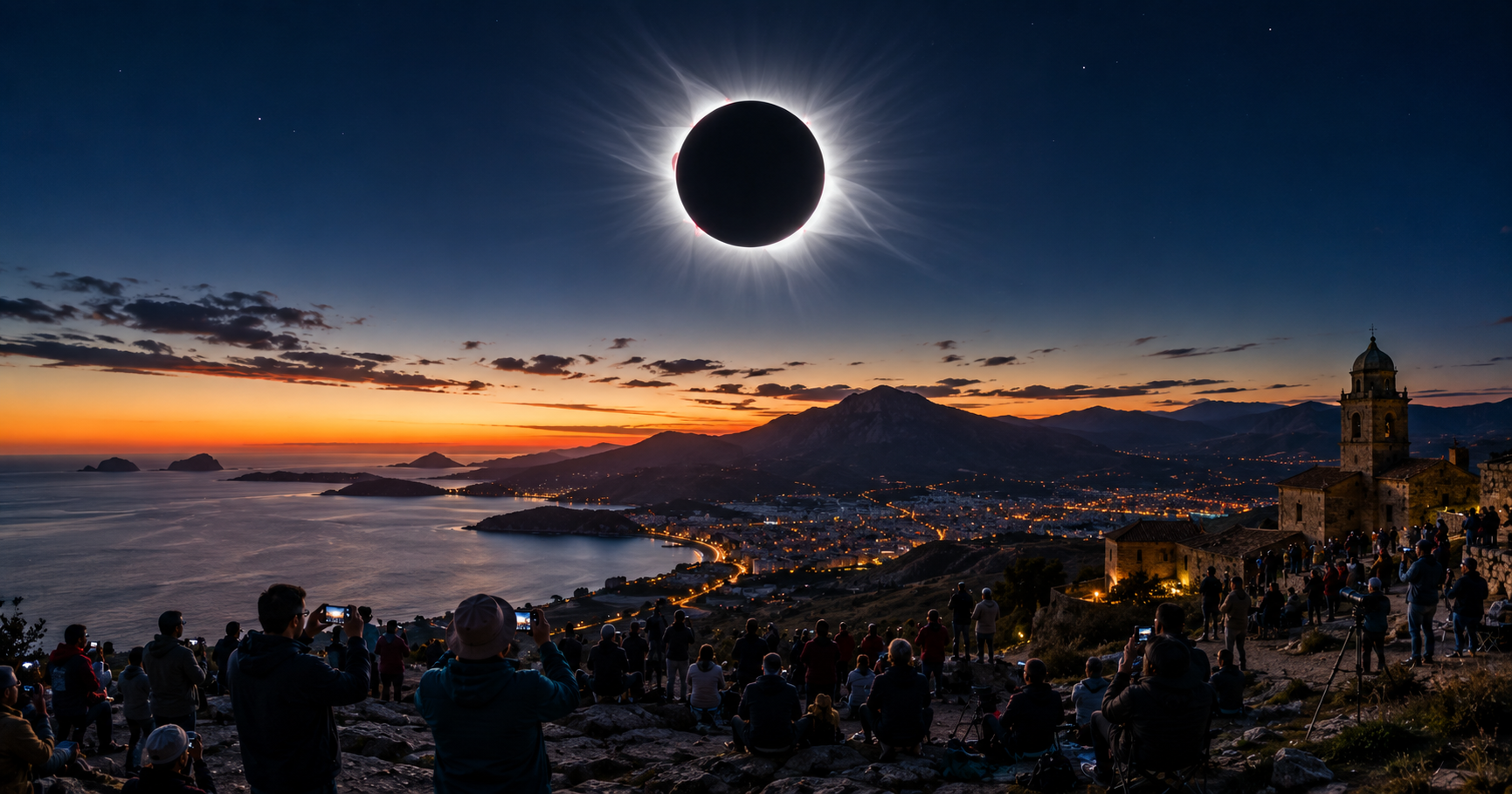
For a few extraordinary minutes on August 12, daylight will begin to disappear.
The temperature may drop.
The sky will darken.
Bright planets and stars may become visible.
And millions of people will look towards the Sun as the Moon moves directly between Earth and our star.
The total solar eclipse of August 12, 2026, is now only one month away.
NASA has released detailed maps of the eclipse path, travellers are booking trips to viewing destinations, and eclipse chasers are preparing cameras and protective equipment.
For most people on Earth, totality will not be visible.
But inside a narrow path crossing parts of the Northern Hemisphere, the Sun will completely disappear behind the Moon.
For less than three minutes, day will briefly become something that looks remarkably like night.
Why August 12 Is Becoming a Major Global Event
Total solar eclipses are among the most dramatic astronomical events visible without a telescope.
The Moon passes between Earth and the Sun.
From most locations, the Moon may cover only part of the solar surface.
Inside the path of totality, the alignment is different.
The Moon completely blocks the bright face of the Sun.
The solar corona becomes visible around the dark lunar silhouette.
This is the moment eclipse chasers travel across countries to experience.
NASA says the August 12 eclipse will bring totality to Greenland, Iceland, Spain, northern Russia and a small area of Portugal. A partial eclipse will be visible across a much larger region.
The Path of Totality Is Surprisingly Narrow
One of the biggest misunderstandings about a total solar eclipse is the idea that everyone under the eclipse sees the same event.
They do not.
Location matters enormously.
The Moon's darkest shadow creates a narrow path across Earth's surface.
People inside that path can experience totality.
Someone outside it may see a dramatic partial eclipse but never experience the moment when the Sun becomes completely covered.
Even a very deep partial eclipse is not the same as totality.
This is why travellers carefully study eclipse maps.
A relatively small difference in location can completely change the experience.
Spain Is Preparing for an Historic Moment
Spain is expected to become one of the most important viewing destinations.
The eclipse will cross northern parts of the country and continue towards the Mediterranean.
NASA's path information places parts of Spain directly within totality.
The event is particularly significant because mainland Spain has not experienced a total solar eclipse for more than 120 years, according to travel data published by Amadeus.
Cities and regions near the path are preparing for increased visitor numbers.
Hotels, airlines and tourism businesses have already seen growing eclipse-related demand.
For many residents, this may be the only total solar eclipse they ever experience from their home region.
Iceland Could Offer One of the Most Dramatic Views
Iceland is another major destination for eclipse travellers.
The combination of volcanic landscapes, mountains and the North Atlantic has made the country particularly attractive to photographers.
The eclipse path crosses part of Iceland.
NASA's detailed eclipse information shows that the greatest duration of totality across the overall path reaches roughly two minutes and 18 seconds.
Weather remains the major uncertainty.
Clouds can hide the Sun at exactly the wrong moment.
Experienced eclipse chasers often monitor forecasts and remain willing to move between viewing locations.
The astronomical event is predictable.
The clouds are not.
Travel Demand Is Already Rising
The eclipse is not only an astronomy story.
It is becoming a major travel event.
Amadeus reported a 25% year-on-year rise in travel demand connected with destinations along the eclipse path in Spain and Iceland.
Hotel occupancy and accommodation pricing have also faced increased pressure around the event.
This demonstrates the economic power of rare astronomical events.
People plan holidays around eclipses.
They book flights.
They reserve hotels.
They hire cars.
Some travellers cross continents for less than two minutes of totality.
To someone who has never experienced a total eclipse, that may sound extreme.
Eclipse chasers often say the experience is difficult to explain until it has been seen in person.
What Actually Happens When Totality Begins?
The transformation does not happen instantly.
The Moon gradually begins covering the Sun.
At first, the change may be difficult to notice without eclipse glasses.
As more of the solar surface disappears, the environment begins to change.
Sunlight can develop an unusual quality.
Shadows may appear sharper.
The temperature can fall.
Animals may react to the changing light.
Then the final bright portion of the Sun disappears.
Totality begins.
The solar corona becomes visible.
The horizon may show unusual colours.
The sky darkens dramatically.
For a short period, observers are standing inside the Moon's shadow.
Then sunlight returns.
The entire experience can feel much shorter than expected.
Why the Sun and Moon Appear Almost the Same Size
The visual perfection of a total solar eclipse comes from an extraordinary coincidence.
The Sun is vastly larger than the Moon.
But the Sun is also much farther away from Earth.
From our perspective, the two objects appear roughly similar in size in the sky.
This allows the Moon to cover the bright solar disk.
If the Moon appears slightly too small, an annular eclipse can occur instead.
A bright ring of sunlight remains visible around the Moon.
During a total eclipse, the apparent size and alignment allow the Sun's surface to become completely hidden.
That alignment creates one of nature's most spectacular visual events.
The Corona Is Usually Hidden From Human Eyes
The Sun's outer atmosphere is called the corona.
It extends millions of kilometres into space.
Under normal conditions, the bright solar surface overwhelms our view of it.
During totality, the Moon blocks the brightest part of the Sun.
The corona can suddenly become visible.
It appears as a glowing structure surrounding the black silhouette of the Moon.
Scientists can study the corona using specialised instruments at other times.
But a total eclipse gives ordinary observers a rare opportunity to see it directly.
This is one reason totality looks so different from a partial eclipse.
NASA Scientists Are Also Preparing to Study the Event
The eclipse is not only a spectacle for tourists.
Scientists use total solar eclipses as research opportunities.
Nearly 40 NASA scientists are expected to take part in an Iceland research campaign connected with the August event, according to reporting on the planned mission.
Eclipses can provide opportunities to study the solar atmosphere and how changes in sunlight affect Earth's environment.
Modern satellites observe the Sun continuously.
However, a total eclipse still creates unusual conditions for ground-based measurements.
The Moon effectively acts as a natural solar blocker.
Scientists are ready to take advantage of that brief window.
Do Not Look at the Sun Without Proper Protection
The excitement around the eclipse creates a serious safety issue.
Looking directly at the Sun can damage the eyes.
Ordinary sunglasses are not sufficient protection.
NASA advises viewers to use safe solar viewing glasses or appropriate handheld solar viewers during the partial phases of a solar eclipse.
Regular cameras, binoculars and telescopes also require suitable solar filters.
Viewing the Sun through an optical device without the correct protection can cause serious injury.
During totality, when the bright face of the Sun is completely covered, direct viewing rules are different.
But totality is brief.
The moment bright sunlight begins returning, eye protection must be used again.
NASA's official eclipse safety guidance explains the viewing precautions and eclipse stages.
Your Phone Camera Also Needs Care
Millions of people will try to photograph the eclipse.
A smartphone may capture the changing light and surrounding atmosphere.
However, pointing camera equipment directly at the Sun can create risks for imaging sensors and the person framing the shot.
Specialised solar filters are important for detailed solar photography.
People using larger cameras or telescopes should prepare equipment before eclipse day.
Totality lasts only a short time.
Trying to understand unfamiliar camera settings while the Sun is disappearing can mean missing the entire experience.
Many experienced eclipse observers recommend spending at least part of totality simply watching.
Not every moment needs to become a video.
A Partial Eclipse Will Be Visible Across a Much Larger Area
People outside the path of totality may still see an impressive event.
NASA says the partial eclipse will be visible across much of Europe, parts of Africa and North America, and broad areas of the Atlantic, Arctic and Pacific regions.
The percentage of the Sun covered will depend on location.
Some places will experience a deep partial eclipse.
Others will see a smaller portion of the solar disk covered.
Safe viewing equipment remains essential.
A partial eclipse can still damage the eyes if someone looks directly at the Sun without proper protection.
Social Media Will Probably Fill With Eclipse Misinformation
Major astronomical events often attract false claims.
The August eclipse has already been connected with viral conspiracy theories about gravity and catastrophic events.
There is no scientific basis for claims that Earth will suddenly lose gravity because of the eclipse.
A solar eclipse is a predictable orbital alignment.
Scientists can calculate eclipse paths years in advance.
The event is extraordinary to witness.
It does not require invented disasters to make it interesting.
Users should be cautious when dramatic videos make unsupported claims about what will happen on August 12.
Astronomy is already providing the real spectacle.
This Could Be One of the Most Photographed Events of 2026
The 2024 total solar eclipse produced extraordinary images across North America.
The 2026 event is likely to create another global wave of eclipse photography.
Iceland offers dramatic landscapes.
Spain provides historic cities and Mediterranean environments.
Aircraft and ships may also position themselves around the eclipse path.
Professional photographers will use specialised equipment.
Ordinary spectators will raise millions of smartphones.
Within minutes, images of the darkened Sun will begin appearing online.
The eclipse itself lasts briefly.
Its digital life will continue for years.
One Month Remains
August 12 is approaching quickly.
For people planning to travel into the path of totality, the remaining weeks are becoming increasingly important.
Accommodation may be limited.
Transport routes could become busy.
Weather forecasts will become more useful closer to the event.
Viewing equipment should be obtained from reliable sources.
And anyone hoping to photograph the eclipse should practise before the day arrives.
The Moon will not wait while someone searches for a camera setting.
For a Few Minutes, Millions Will Look Up Together
Modern life rarely stops.
Phones vibrate.
Messages arrive.
Work continues.
The internet constantly demands attention.
A total solar eclipse creates a strange interruption.
People step outside.
Crowds become quiet.
The light disappears.
And for a few minutes, millions of people look at the same object in the sky.
On August 12, the Moon's shadow will cross part of Earth again.
Most people will experience only a partial eclipse.
A smaller number will stand directly inside the path of totality.
For them, the Sun will disappear.
And after months of planning, thousands of kilometres of travel and years of anticipation, the entire event may be over in less than two minutes.