






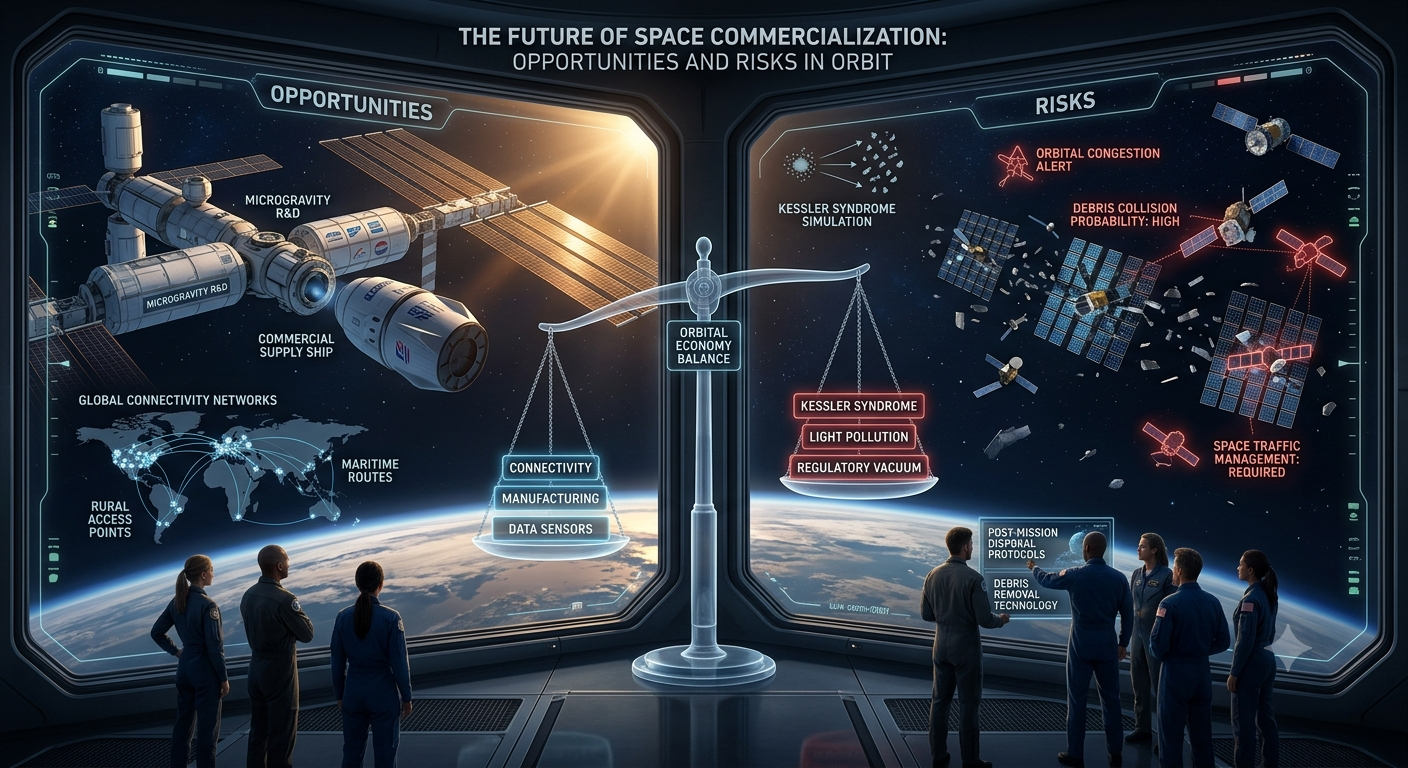
The Democratization of Low Earth Orbit For decades, space exploration was exclusively the domain of heavily funded state agencies. Today, a profound shift is underway. The arrival of reusable rocket technology has dropped launch costs by over 90%, opening up the space economy to a wave of private enterprises, startups, and international commercial consortia.
Low Earth orbit (LEO) is no longer just a destination for specialized research; it has quickly become a thriving economic zone. This rapid commercial expansion promises to revolutionize global telecommunications, environmental monitoring, and materials manufacturing, but it also introduces complex geopolitical and environmental risks.
The Pillars of the Orbital Economy The modern commercial space sector relies on three fast-growing industries:
Mega-Constellations and Connectivity: Private operators are launching thousands of small satellites into LEO to build global internet grids. These networks provide high-speed, low-latency connectivity to remote rural areas, maritime shipping fleets, and aviation routes, completely bypassing the need for vulnerable ground-based fiber cables.
Orbital Manufacturing and R&D: The microgravity environment of space allows companies to manufacture pristine materials that are impossible to produce on Earth. Industries are actively testing the production of perfect semiconductor crystals, advanced fiber-optic cables, and bio-printed human tissues without the distorting effects of Earth's gravity.
Real-Time Earth Observation: High-resolution satellite arrays provide a constant stream of planetary data. Commercial sectors use this information to track supply chains in real time, monitor agricultural crop health, detect illegal logging, and accurately evaluate climate change patterns.
The Rising Risks of a Crowded Sky This rapid growth comes with severe logistical and environmental challenges. The most pressing concern is orbital congestion. With tens of thousands of satellites scheduled for launch over the next decade, the risk of catastrophic collisions has escalated dramatically.
A single collision between two satellites can generate thousands of pieces of fast-moving space debris. This creates a potential chain reaction known as the Kessler Syndrome, where a growing field of untrackable debris repeatedly strikes other objects, eventually rendering specific orbital paths entirely unusable for generations. Furthermore, astronomers warn that the sheer volume of bright satellite fleets is creating severe light pollution, significantly hindering ground-based scientific observation.
Establishing Rules for the High Frontier The legal framework governing space remains dangerously outdated, relying largely on treaties written before the internet era. Navigating the future of space commercialization requires building updated, enforceable international agreements.
Nations and private operators must agree on strict space traffic management protocols, mandatory post-mission satellite disposal timelines, and active debris-removal missions. Space security is no longer just about preventing international conflict; it depends entirely on keeping our shared orbital lanes clear, sustainable, and open for the next generation of global innovators.