





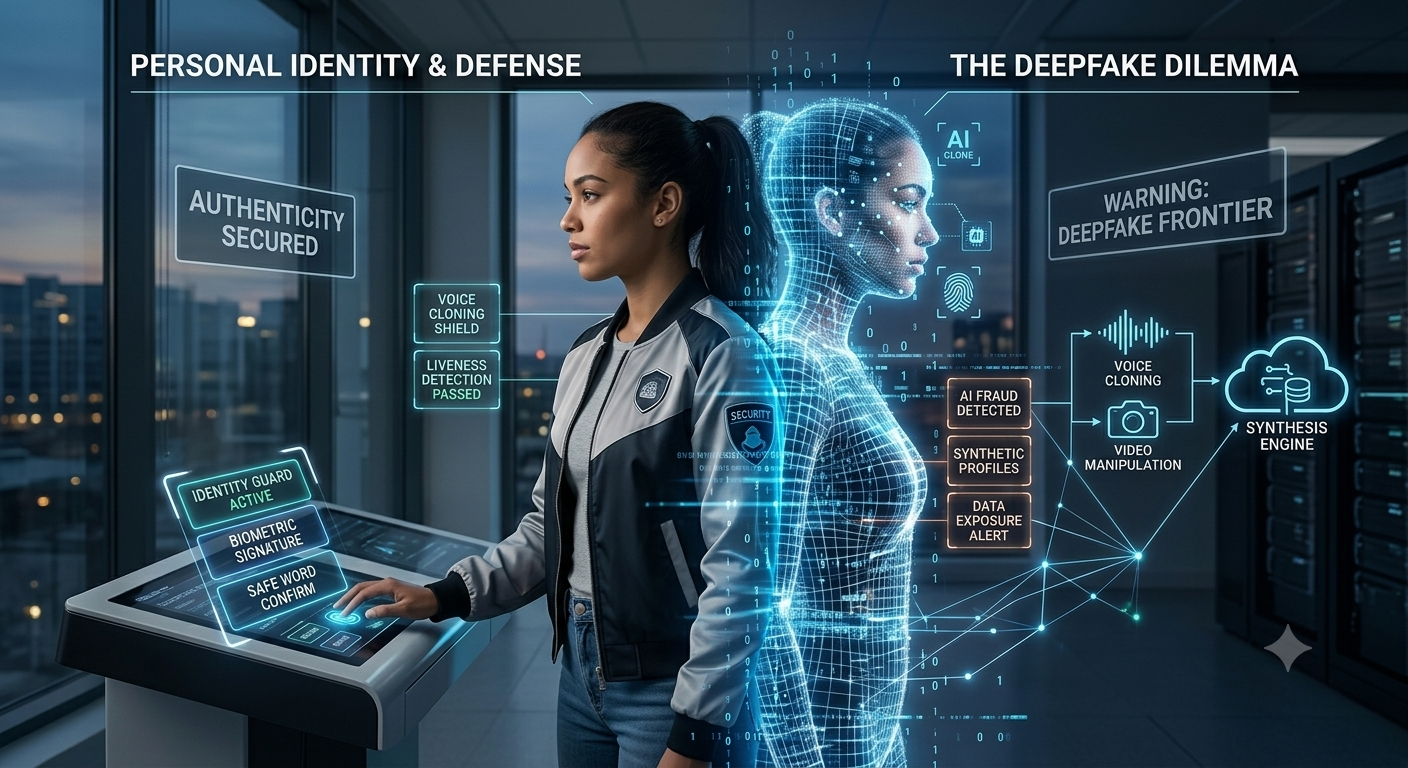
Artificial intelligence has transformed countless industries by improving productivity, automation, and digital experiences. However, the same technologies driving innovation are also empowering cybercriminals with increasingly sophisticated tools for deception. One of the most alarming developments is the rapid rise of AI-generated identity fraud, where realistic voices, faces, and digital identities can be created within minutes.
Only a few years ago, producing a convincing deepfake required advanced technical expertise, powerful computing resources, and significant time. Today, publicly available AI tools allow almost anyone to generate realistic voice clones, synthetic videos, and digitally altered images with minimal effort. As a result, deepfake technology has evolved from a niche experiment into a mainstream weapon used for financial fraud, identity theft, corporate espionage, and social engineering attacks.
Recent cybersecurity reports indicate that a growing number of organizations worldwide have already experienced attempted deepfake attacks. This shift highlights a critical reality: visual appearance and familiar voices can no longer be considered reliable proof of identity on their own. In the age of AI, trust must be supported by stronger verification systems rather than human perception alone.
The Evolution of AI-Powered Identity Fraud
Cybercriminals are rapidly moving beyond traditional phishing emails toward highly personalized attacks that exploit artificial intelligence to impersonate trusted individuals with remarkable accuracy.
Voice Cloning and AI-Powered Vishing
Modern AI systems can recreate a person's voice using only a short audio sample collected from social media videos, podcasts, interviews, or public recordings. Once trained, these systems generate speech that closely matches the individual's tone, pronunciation, and speaking style.
Criminals use these cloned voices to contact family members, employees, executives, or financial departments while creating a false sense of urgency. Victims may be pressured into transferring money, revealing confidential information, or authorizing sensitive transactions because they genuinely believe they are speaking to someone they know and trust.
Biometric Verification Bypass
Many financial institutions and online services rely on facial recognition as part of their Know Your Customer (KYC) verification process. However, AI-generated videos and sophisticated injection attacks now allow fraudsters to manipulate these verification systems by feeding realistic synthetic video streams directly into authentication software.
Without advanced security measures, conventional facial verification alone may no longer provide sufficient protection against increasingly realistic digital impersonation.
Synthetic Digital Identities
Artificial intelligence has also made it possible to create entirely fictional identities that appear authentic. Criminals combine stolen personal information with AI-generated profile photographs, fabricated employment histories, and realistic online activity to construct convincing synthetic personas.
These fabricated identities can be used to open financial accounts, apply for loans, obtain credit, bypass hiring procedures, or conduct large-scale financial fraud while making investigations significantly more difficult for law enforcement and financial institutions.
Why Traditional Trust No Longer Works
Historically, people relied on visual recognition and familiar voices to confirm someone's identity. Today, that assumption is becoming increasingly unreliable.
Modern deepfakes contain far fewer visual and audio imperfections than earlier generations of AI-generated media. Improvements in machine learning have significantly reduced many of the obvious signs that previously exposed manipulated videos and cloned voices. As a result, even experienced professionals may struggle to distinguish authentic communications from AI-generated imitations.
This changing threat landscape requires organizations and individuals to adopt a zero-trust mindset, where every high-risk request is verified using multiple independent methods rather than relying solely on what is seen or heard.
Building Stronger Defenses Against Digital Cloning
Protecting against AI-powered identity fraud requires a combination of technological safeguards, organizational policies, and personal awareness.
Always Verify Through Independent Channels
Unexpected requests involving financial transfers, confidential information, or urgent business decisions should never be accepted based solely on a phone call, voice message, or video communication. Instead, individuals should independently verify the request using a previously established communication channel, such as calling a known phone number or contacting the individual through a trusted messaging platform.
Create Private Verification Codes
Families, executive teams, and organizations can significantly strengthen security by establishing confidential verification phrases or code words that are never shared publicly. During emergencies or unexpected requests, the inability to provide the agreed verification code should immediately raise suspicion and trigger additional identity checks.
Limit Public Exposure of Biometric Data
Every publicly available video, interview, livestream, or voice recording provides additional training material for AI systems capable of cloning identities. While maintaining an online presence is often necessary, limiting the publication of long, high-quality audio and video recordings can reduce opportunities for criminals to create highly accurate digital replicas.
Adopt Advanced Authentication Technologies
Organizations should strengthen identity verification by moving beyond static photographs and basic facial recognition. Modern security systems increasingly combine multiple layers of authentication, including liveness detection, behavioral analysis, cryptographic verification, device authentication, and anomaly detection. These technologies make it significantly more difficult for synthetic media to bypass security controls.
Looking Ahead
Artificial intelligence will continue to improve, making digital impersonation increasingly realistic and more difficult to detect through human observation alone. As deepfake technology becomes faster, cheaper, and more accessible, identity verification must evolve accordingly.
The future of cybersecurity will depend less on recognizing fake media and more on implementing secure authentication frameworks that continuously verify identity through multiple independent signals. Organizations that invest in modern verification systems, employee awareness training, and layered security controls will be far better prepared to defend against the next generation of AI-powered cyber threats.
Ultimately, the defining principle of the modern digital world is simple: seeing is no longer believing. Protecting personal identities, financial assets, and organizational data requires a zero-trust approach where every important interaction is verified—not assumed.