




When we picture a master chef or a brilliant food scientist at work, we usually imagine a pristine, highly organized kitchen filled with precise measurements, calibrated timers, decades of culinary training, and meticulous planning. We assume that every iconic snack, decadent dessert, and refreshing beverage we enjoy today was engineered through years of deliberate trial and error.
Yet, culinary history is wonderfully chaotic. Some of the most beloved, globally consumed foods in human history were never planned at all. They were born out of kitchen laziness, absent-minded mistakes, forgotten leftovers, explosive chemical reactions, and sheer dumb luck. Here is a delicious look at some of the world's most famous foods that were invented completely by accident.
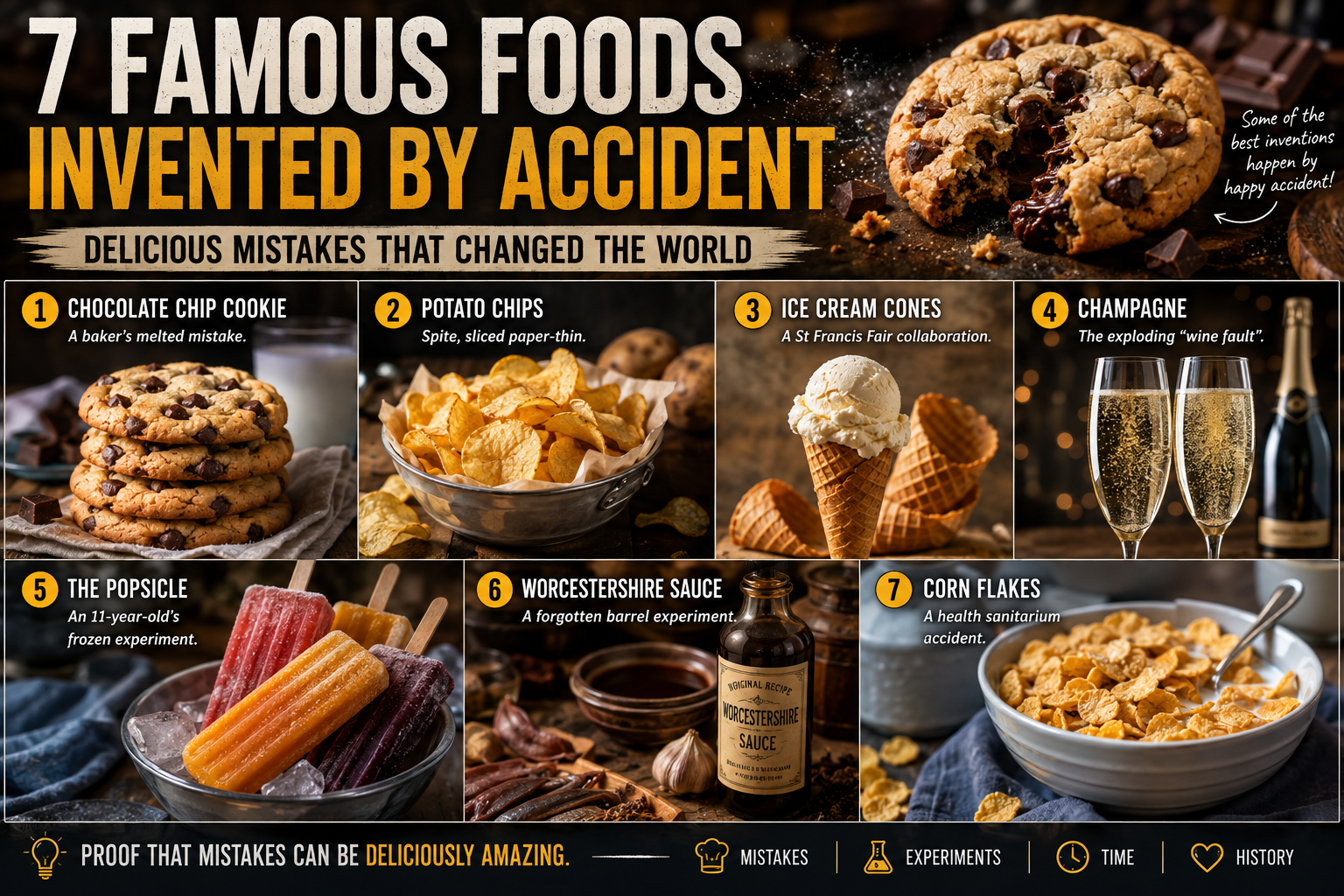
1. The Chocolate Chip Cookie: A Baker’s Melted Mistake
It is difficult to imagine modern comfort food without the legendary chocolate chip cookie. It is a staple of bake sales, midnight snacks, and glass-of-milk pairings across the globe. Yet, this sweet masterpiece came to life because a chef simply ran out of regular ingredients and tried to improvise.
In 1938, Ruth Wakefield and her husband ran the Toll House Inn in Whitman, Massachusetts. While baking a batch of butter-drop do cookies, Wakefield realized she was completely out of baker's chocolate. Hoping for the best, she chopped up a block of semi-sweet Nestlé chocolate bar into small bits, expecting the chocolate chunks to melt completely into the dough during baking, creating a uniform chocolate cookie.
To her surprise—and the eternal gratitude of humanity—the chocolate pieces retained their individual shapes while softening into pockets of gooey goodness. When the recipe was published in a Boston newspaper, the chocolate chip cookie exploded in popularity, changing baking history forever.
2. Potato Chips: Spite, Sliced Paper-Thin
If you have ever mindlessly eaten an entire bag of potato chips while watching a movie, you can thank a very angry chef and a notoriously difficult customer.
The year was 1853 at Moon’s Lake House in Saratoga Springs, New York. A notoriously picky diner—widely reported to be shipping tycoon Cornelius Vanderbilt—complained bitterly that his fried French fries were cut too thick and were far too soggy. Annoyed by the customer's attitude, Chef George Crum decided to teach the diner a sarcastic lesson.
Crum sliced a batch of potatoes as thin as humanly possible, fried them in boiling oil until they were completely crisp, and salted them heavily, expecting them to be impossible to eat with a fork. To Crum's absolute shock, the customer loved them, and "Saratoga Chips" instantly became the hottest menu item in America.
3. Ice Cream Cones: A St Francis Fair Collaboration
Eating ice cream out of a crisp, edible waffle cone feels so natural that it’s hard to believe ice cream was once served exclusively in glass dishes or small ceramic bowls. The invention of the cone was a textbook case of entrepreneurial adaptation under pressure.
At the 1904 World’s Fair in St. Louis, Missouri, an ice cream vendor experienced overwhelming crowds and quickly ran out of clean glass dishes to serve his frozen treats. Desperate for a solution, he looked around and noticed a neighboring Middle Eastern vendor selling zalabia—a thin, crisp, waffle-like pastry.
The ice cream vendor teamed up with the pastry maker, rolled the warm, pliable waffle flatbread into a cone shape, and let it cool into a crisp holder. The handheld ice cream cone was born, instantly becoming the undisputed star of the world's fair.
4. Champagne: The Exploding "Wine Fault"
Celebrations, weddings, New Year’s Eve, and championship sports victories all share one universal liquid symbol of luxury: sparkling champagne. However, for centuries, bubbles in wine were viewed by winemakers not as a luxury, but as a catastrophic manufacturing flaw.
In the chilly Champagne region of France, cold winters frequently halted the fermentation process before yeast could consume all the sugar in the wine. When spring arrived and temperatures warmed up, the dormant yeast woke back up and resumed fermenting inside sealed glass bottles, releasing carbon dioxide gas. The pressure often caused weak glass bottles to explode violently in wine cellars, creating a chain reaction that destroyed entire inventories. Winemakers called it "the devil's wine." It took decades of experimentation by innovators like Dom Pérignon to tame the fizz and turn an explosive wine fault into a multi-billion-dollar luxury industry.
5. The Popsicle: An 11-Year-Old’s Frozen Experiment
Every summer afternoon, children across the world enjoy fruit-flavored popsicles to beat the heat. This iconic frozen treat was invented by an 11-year-old boy who simply forgot to clean up before bedtime.
In 1905, an Oakland, California boy named Frank Epperson mixed a powdered soda flavoring and water with a wooden stirring stick on his porch. He got distracted by play and accidentally left the glass outside overnight. During the night, temperatures plummeted below freezing. When Epperson woke up the next morning and pulled on the wooden stick, out slid a solid cylinder of flavored ice. He originally called it the "Epsicle," but his children later convinced him to rebrand it as the Popsicle.
6. Worcestershire Sauce: A Forgotten Barrel Experiment
That savory, umami-rich dash of Worcestershire sauce adds depth to everything from Caesar salads to Bloody Mary cocktails. Its origin story reads like a forgotten medieval mystery.
In the early 1830s, Lord Sandys returned to Worcestershire, England, after serving as a colonial governor in Bengal, India. He hired local chemists John Wheeley Lea and William Perrins to replicate a specific Indian sauce recipe he had grown to love. When the chemists mixed the pungent ingredients—anchovies, vinegar, molasses, tamarind, garlic, and assorted spices—the resulting flavor was so overwhelmingly harsh and unpalatable that they abandoned the barrel in a cellar and forgot about it entirely.
Years later, while cleaning out the cellar storage, they rediscovered the dusty wooden barrel. Before throwing it out, they decided to taste it again. Time had allowed the ingredients to ferment and mellow into a rich, complex masterpiece.
7. Corn Flakes: A Health Sanitarium Accident
The world’s most popular breakfast cereal was never intended to be a fun, sugary morning treat. It was born out of strict dietary experiments at a Michigan health sanitarium.
In the late 19th century, Dr. John Harvey Kellogg and his brother Will Keith Kellogg ran the Battle Creek Sanitarium in Michigan, focusing heavily on vegetarianism, strict morals, and bland diets. While attempting to boil wheat to make a wholesome grain dish, the brothers got distracted by administrative hospital duties and left the boiled wheat cooking for far too long.
When they finally ran the overcooked, stale dough through heavy rollers, instead of forming long sheets of bread dough, the wheat broke apart into thin individual flakes. They toasted the flakes anyway, and patients went wild for the crispy texture. They later experimented with corn, launching a global breakfast empire.
Conclusion: Embrace the Happy Accidents
These seven culinary tales prove that perfection is vastly overrated. Some of humanity’s greatest cultural achievements didn't come from rigid blueprints or sterile laboratories; they came from distracted chefs, angry customers, forgotten cellar barrels, and late-night experiments.
The next time you make a mistake in your own kitchen, don't throw it in the trash too quickly. You just might be one happy accident away from inventing the next great global food sensation.