





SpaceX made landing rockets look like science fiction becoming reality.
China has now taken a very different approach.
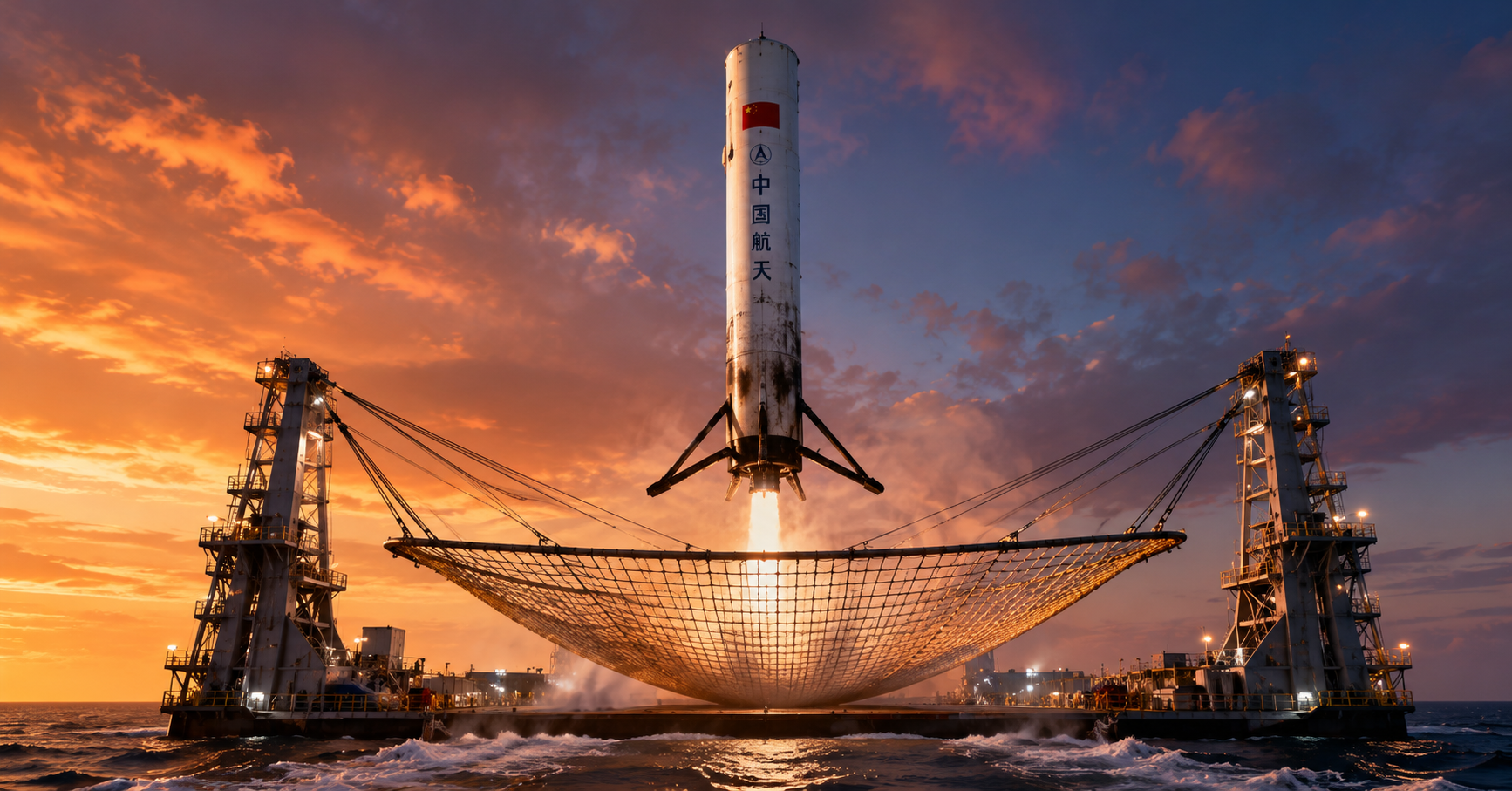
Instead of relying on a booster to land vertically on its own legs, China has successfully tested a system designed to catch a returning rocket stage using a giant net on an offshore platform.
The unusual recovery method was demonstrated following the launch of the Long March 10B rocket from Hainan on July 10, 2026.
Around six minutes after launch, the booster stage was successfully retrieved at sea.
It is a significant technological milestone for China's rapidly expanding space programme and another sign that reusable rocket competition is becoming much more serious.
A Rocket Recovery Method That Looks Almost Impossible
Recovering a rocket after launch is one of the most difficult challenges in modern spaceflight.
Traditional rockets discard major stages after they have completed their job. Those components may fall into the ocean or become unusable.
That means a large and expensive piece of hardware has to be built again for another mission.
Reusable systems attempt to change that model.
China's latest test used an offshore platform and a net-based recovery mechanism to capture the returning booster.
The concept sounds simple when described in a sentence.
In reality, a rocket stage returning towards Earth is moving through an extreme environment and must reach a carefully controlled recovery area.
Timing, guidance and structural engineering all become critical.
Missing the recovery zone by a relatively small distance can mean losing the booster entirely.
Why China Is Not Simply Copying SpaceX
SpaceX's Falcon 9 has become famous for vertical booster landings.
The returning first stage performs controlled manoeuvres before descending onto landing legs on land or an autonomous drone ship.
China's net system follows a different engineering philosophy.
According to reporting on the test, the approach is intended to reduce rocket weight by avoiding some of the hardware associated with traditional landing systems.
Weight is one of the most important factors in rocket design.
Every additional component carried by a launch vehicle affects performance.
Reducing recovery hardware could potentially allow more capacity to be dedicated to payload or other mission requirements.
The net may also provide flexibility when dealing with changing conditions around a recovery area.
China is therefore not only trying to build a reusable booster.
It is experimenting with a different answer to the same fundamental problem.
The Long March 10B Is an Important Part of the Story
The rocket involved in the test was the Long March 10B.
The launch vehicle can carry at least 16 metric tons to low-Earth orbit, according to Reuters.
During the July mission, the rocket launched from the Hainan commercial space launch site and successfully deployed a satellite into orbit.
The booster recovery was therefore not the only objective.
The mission also demonstrated that the vehicle could complete its launch role before the recovery system was tested.
This distinction is important.
A reusable rocket system must do more than survive a dramatic landing or capture.
Its primary responsibility is still to deliver a payload successfully.
Recovery only becomes commercially valuable when it can be integrated into reliable launch operations.
Reusability Could Reduce the Cost of Reaching Orbit
Rocket launches are expensive partly because launch vehicles have historically been treated as disposable machines.
Imagine building an aircraft for a single flight and abandoning it after reaching its destination.
That comparison is not technically perfect, but it helps explain why reusable rockets are so attractive.
If major rocket components can be safely recovered, inspected and flown again, launch providers may be able to reduce manufacturing pressure and lower mission costs over time.
The key phrase is "over time."
Recovering a booster does not automatically make a launch system cheap.
Engineers still have to inspect the rocket, repair damaged components and prove that the hardware can safely fly again.
The real test of a reusable programme is repeated operation.
China's successful capture is therefore an important first step rather than the end of the engineering challenge.
A New Challenge to American Launch Dominance
The modern commercial launch market has been heavily influenced by SpaceX.
Frequent Falcon 9 missions and successful booster recoveries have changed expectations around launch schedules and rocket reuse.
Other countries and private companies have been forced to reconsider their own launch strategies.
China has spent years developing reusable rocket technology.
The successful sea-based recovery test shows that those efforts are beginning to produce significant results.
This could become increasingly important as China expands its satellite programmes and pursues larger ambitions beyond Earth orbit.
A stronger reusable launch capability may allow the country to conduct missions more frequently while developing experience with recovered flight hardware.
The space race is no longer only about reaching a destination first.
Launch frequency, cost and infrastructure now matter just as much.
Lunar Ambitions Make the Timing Significant
China has major ambitions for lunar exploration.
Future Moon missions require an enormous amount of engineering capability, launch infrastructure and long-term investment.
Reusable technology can play a wider role in building a more mature space ecosystem.
It may support satellite deployment, technology testing and the development of launch expertise needed for increasingly complex missions.
The Long March family is already central to China's space programme.
Advances in recovery technology could make future versions of the country's launch vehicles even more strategically important.
The successful booster capture therefore matters beyond one mission.
It demonstrates progress in an area that could influence China's space capabilities for years.
Giant Nets Could Offer an Alternative Path to Reusable Rockets
Vertical landings are visually spectacular.
They are also technically demanding.
A booster must control its descent, manage engine burns and arrive at a landing target with extraordinary precision.
A capture system could potentially shift some parts of the recovery challenge towards infrastructure on the ground or at sea.
However, catching a rocket with a net introduces its own engineering problems.
The capture structure must handle enormous forces.
The booster must enter the correct recovery area.
Weather and sea conditions may affect operations.
The rocket's structure must also survive the capture process if engineers intend to reuse it.
There is no easy method for recovering orbital-class rocket hardware.
China's test is interesting precisely because it explores another possible solution.
The Real Test Comes When the Booster Flies Again
Successful recovery creates headlines.
Successful reuse creates a launch system.
Engineers will now need to study the recovered booster carefully.
They can inspect structural components, propulsion systems and other hardware to understand how the rocket responded to launch, atmospheric return and capture.
The condition of the booster will provide valuable information.
If recovered stages can eventually be refurbished efficiently and launched again, the technology may become operationally significant.
Repeated success will matter more than a single demonstration.
That is the same challenge every reusable rocket programme faces.
A system must become predictable.
Another Launch Is Already Expected
Reuters reports that another Long March 10B launch is planned before the end of 2026.
That means China's reusable rocket development could move quickly.
Future missions may provide more evidence about the reliability of the net-based recovery approach and how the system performs under different conditions.
The global space industry will be watching closely.
Government agencies, launch companies and aerospace engineers are all searching for ways to make access to orbit more efficient.
China's giant net may look unconventional.
But many of today's normal space technologies once looked unconventional too.
The question now is not whether China can catch a booster.
It has demonstrated that capability.
The bigger question is whether it can turn the catch into a reliable cycle of launch, recovery and reuse.
That could have a much larger impact on the global space race.