




Best Phone for Content Creators: vivo X300 Ultra vs. iPhone 17 Pro Max Showdown

Comparing the ultimate mobile filmmaking beasts—the vivo X300 Ultra with its dual 200MP Zeiss optics and the Apple iPhone 17 Pro Max. Find out which powerhouse reigns supreme for mobile content creators.

Best Phone for Content Creators: vivo X300 Ultra vs. iPhone 17 Pro Max Showdown

The landscape of media production has undergone a permanent, revolutionary decentralization. You no longer need a bulky broadcast camera rig, a dedicated sound engineer, and a post-production studio to build a massive digital audience. Today, some of the most influential filmmakers, travel vloggers, TikTok creators, and commercial photographers shoot, edit, and publish cinematic masterpieces straight from a device that slips right into their back pocket.

For modern content creators, choosing the right smartphone isn't just about taking nice vacation snapshots—it is a critical business investment. At the very summit of mobile imaging stand two titans: the newly unleashed vivo X300 Ultra, co-engineered with Zeiss, and Apple’s heavyweight champion, the iPhone 17 Pro Max. Which of these powerhouse devices deserves a permanent spot in your creator kit? Let’s break down the ultimate smartphone creator showdown.

1. The Camera Philosophy: Focal Lengths and Sensor Mechanics

When evaluating tools for professional content creation, lens versatility and sensor architecture dictate what kind of stories you can tell.

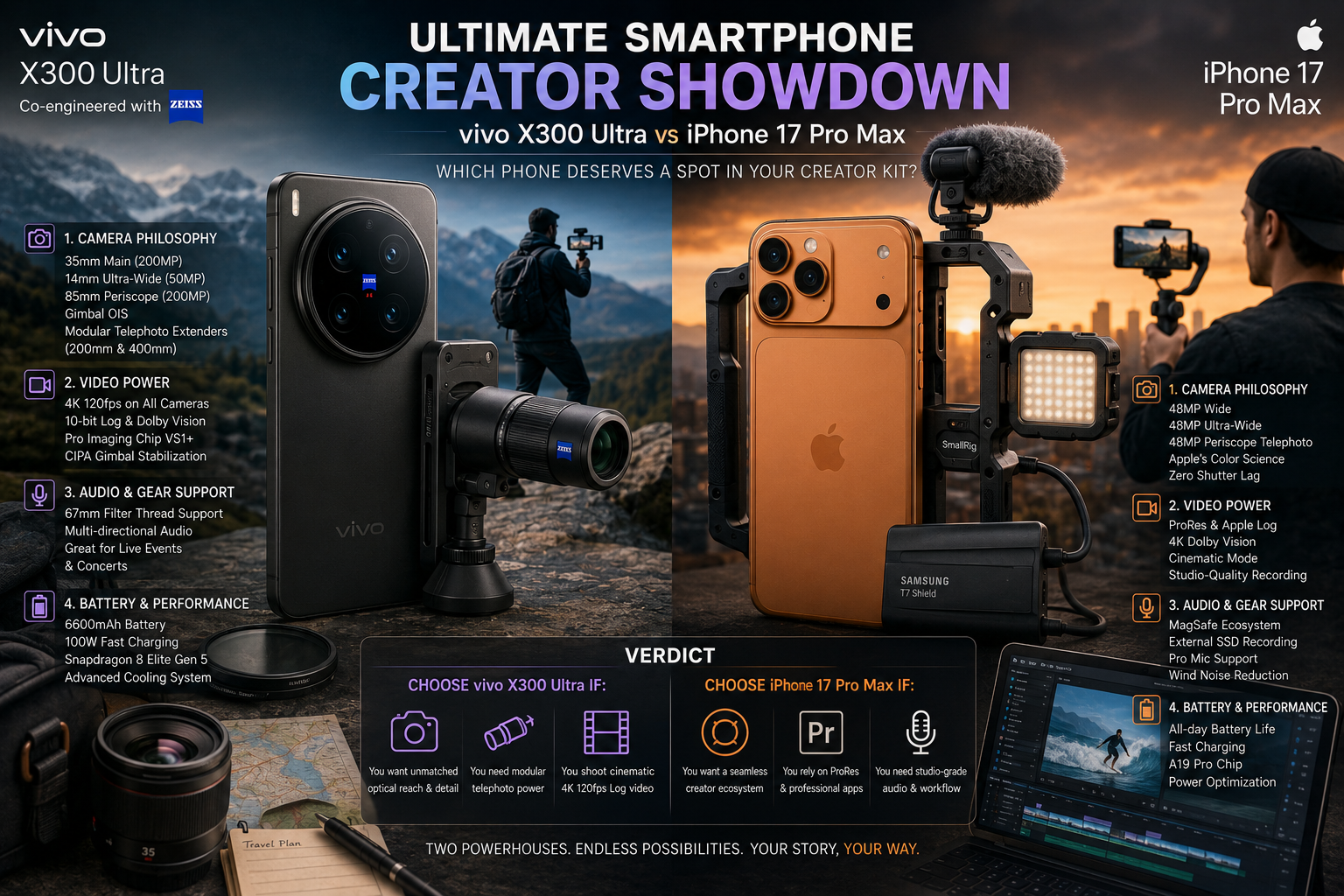
The vivo X300 Ultra completely rewrites the mobile camera playbook by throwing out traditional smartphone focal length formulas. Instead of a standard 24mm wide lens, vivo opts for a professional-grade 35mm main documentary camera driven by a massive 200MP Sony LYT-901 sensor (1/1.12-inch). It is paired with a 50MP 14mm ultra-wide lens and an astonishing 200MP 85mm periscope telephoto lens featuring gimbal-grade optical image stabilization. Furthermore, vivo offers modular telephoto extenders (200mm and 400mm equivalents) that turn the device into a modular photography rig.

The iPhone 17 Pro Max sticks closer to Apple’s reliable, heavily optimized formula, featuring a trio of 48MP sensors covering wide, ultra-wide, and a high-zoom periscope lens. Apple's strength lies in zero-shutter-lag consistency, instantaneous skin-tone rendering, and seamless switching between focal lengths during live recording without micro-stutters or color shifts.

2. Video Power and Cinematic Codecs

For video creators, frame rates, color profiles, and stabilization are the ultimate metrics of success.

The vivo X300 Ultra is an absolute video beast. It supports 4K video recording up to an incredible 120fps across all its rear cameras, alongside professional 10-bit Log recording and Dolby Vision. Combined with vivo's Pro Imaging Chip VS1+ handling heavy computational noise reduction and dynamic range, the footage straight out of the camera possesses a natural, organic roll-off that mimics traditional cinema glass. Its CIPA-rated gimbal stabilization makes walking shots look like they were captured on a motorized steadicam gimbal.

The iPhone 17 Pro Max remains the undisputed gold standard for mobile workflow integration. Apple’s ProRes and Apple Log codecs integrate seamlessly with professional non-linear editing software like Final Cut Pro and DaVinci Resolve. The iPhone's audio array features studio-grade directional mic capabilities with wind-noise reduction, making it a complete all-in-one mobile broadcasting studio right out of the box.

3. Audio Recording and External Gear Support

Great video is only half the battle; professional content creation demands pristine audio quality.

The vivo X300 Ultra steps up its creator appeal by supporting hardware accessories like 67mm filter thread adapters directly onto its camera housing, making it effortless to mount neutral density (ND) filters for cinematic shutter speeds in bright daylight. Its multi-directional audio capture handles loud music venues and concert environments remarkably well.

Meanwhile, the iPhone 17 Pro Max benefits from the massive, sprawling ecosystem of MagSafe accessories, custom cages, external SSD recording options (allowing direct ProRes 4K recording to a pocket-sized solid-state drive), and flawless USB-C peripheral integration with professional wireless lavalier microphone systems.

4. Battery Endurance and Processing Under Heavy Loads

Rendering 4K video files, exporting timelines, and shooting high-framerate clips drains batteries faster than almost any other mobile task.

The vivo X300 Ultra packs a massive 6600 mAh battery supported by blazing-fast 100W wired charging. If you run low on power between shoots, you can juice back up to a full charge in mere minutes. It handles the Qualcomm Snapdragon 8 Elite Gen 5 processor with advanced thermal cooling plates designed for long recording sessions.

The iPhone 17 Pro Max relies on Apple's hyper-efficient custom silicon. While its battery capacity is physically smaller than vivo's behemoth cell, its power optimization yields phenomenal all-day endurance during continuous social media streaming, live broadcasting, and video editing tasks.

Verdict: Which Creator Tool Wins?

  • Choose the vivo X300 Ultra if: You are a hardcore visual storyteller, photographer, or documentary creator who wants unmatched optical reach, a native 35mm documentary lens, modular telephoto extenders, and stunning 4K 120fps Log footage.
  • Choose the iPhone 17 Pro Max if: You rely on a frictionless ecosystem, demand seamless integration with professional editing apps like Final Cut Pro, and want industry-standard ProRes external SSD workflows for commercial social media content.

Both devices prove that smartphone content creation has officially surpassed traditional entry-level mirrorless cameras in convenience and computational power. Whichever tool you choose, your creative output is limited only by your imagination.

Give me pic related to this for article
Quick Summary

Comparing the ultimate mobile filmmaking beasts—the vivo X300 Ultra with its dual 200MP Zeiss optics and the Apple iPhone 17 Pro Max. Find out which powerhouse reigns supreme for mobile content creators.

Key Takeaways

  • Choose the vivo X300 Ultra if: You are a hardcore visual storyteller, photographer, or documentary creator who wants unmatched optical reach, a native 35mm documentary lens, modular telephoto extenders, and stunning 4K 120fps Log footage.
  • Choose the iPhone 17 Pro Max if: You rely on a frictionless ecosystem, demand seamless integration with professional editing apps like Final Cut Pro, and want industry-standard ProRes external SSD workflows for commercial social media content.

Quick Facts

Category: Technology
Published: August 2, 2026
Updated: October 8, 2026
Reading time: 5 min
65 views
Updated Oct 8, 2026 5 min read

Related Articles

View all
The 2026 Smartphone Divide: iPhone vs. Android Technology
Article Technology

The 2026 Smartphone Divide: iPhone vs. Android

As we move through 2026, the long-standing rivalry between iOS and Android has evolved. While both platforms are more capable and secure than ever, they serve fundamentally different philosophies: Apple’s curated ecosystem versus Android’s open-source flexibility.

Orwell, George 9 min 293

Mixed Content

Technology
Article Technology

The Post-Automation Economy: Architecting Human Skill Premiums in the Age of Autonomy

The rapid proliferation of agentic workflows and large action models is structurally inverting the traditional corporate skill pyramid. While routine analytical processes and information retrieval tasks are being automated into low-cost utility, uncommoditizable human traits—emotional intelligence, strategic ambiguity management, and ethical governance—are commanding an unprecedented value premium. Succeeding in the post-automation enterprise requires re-engineering workforce development to focu

Mutwassim 3 min 72
The Decline of Friction: Inside the FinTech Revolution in Cross-Border Settlement and Digital Identity Technology
Article Technology

The Decline of Friction: Inside the FinTech Revolution in Cross-Border Settlement and Digital Identity

The traditional plumbing of global finance—characterized by multi-day delays, hidden fees, and fragmented identity silo—is undergoing a profound transformation. A new generation of FinTech architectures, combining distributed ledger technology (DLT), synchronized liquidity pools, and decentralized digital passports, is enabling cross-border instant payments with near-zero friction.

Mutwassim 1 min 44
The City as a Switch: Architecting IoT Logistics for the Post-Congestion Urban Era Technology
Article Technology

The City as a Switch: Architecting IoT Logistics for the Post-Congestion Urban Era

The traditional model of urban delivery—reliant on high-emission diesel vans navigating static street grids—is creating unsustainable levels of congestion and pollution in global metros. To reclaim urban space, cities are transitioning to IoT-orchestrated logistics. This data-driven framework utilizes autonomous delivery swarms, automated micro-fulfillment centers, and dynamic digital kerb-side management to route goods with the efficiency of internet packets, transforming static streets into fl

Mutwassim 4 min 71
Beyond the Coffee Shop: How Cross-Border Employment and Sovereign Visas Are Institutionalizing Remote Work Technology
Article Technology

Beyond the Coffee Shop: How Cross-Border Employment and Sovereign Visas Are Institutionalizing Remote Work

Remote work is transitioning from an informal perk into an institutionalized pillar of international commerce. Over 60 nations have launched dedicated digital nomad visa regimes, while multi-jurisdictional compliance platforms and Employer of Record (EOR) frameworks dismantle traditional geographic barriers. As knowledge workers disperse globally, enterprises and municipal governments are formalizing policies around tax residency, permanent establishment risk, and asynchronous operational workfl

Mutwassim 3 min 71
The Death of Syntax: Inside the Shift to Intent-Driven Software Engineering Technology
Article Technology

The Death of Syntax: Inside the Shift to Intent-Driven Software Engineering

The day-to-day discipline of software engineering is undergoing its most radical abstraction leap since the transition from assembly language to high-level compilers. Generative code synthesis and deterministic reasoning engines are automating boilerplate syntax, turning software developers into systems architects. Survival in this new paradigm demands mastering intent formalization, specification design, and continuous verification.

Mutwassim 3 min 71
The Post-Visual Threat: Architecting Zero-Trust Defense Against Weaponized Deepfakes Technology
Article Technology

The Post-Visual Threat: Architecting Zero-Trust Defense Against Weaponized Deepfakes

The rapid weaponization of real-time voice cloning and synthetic video generation has transformed social engineering from opportunistic phishing into targeted executive identity emulation. High-profile incidents involving multi-million-dollar wire transfers authorized via synthetic video calls prove that sight and sound can no longer authenticate authorization. Securing modern enterprises requires an uncompromising zero-trust identity layer capable of neutralizing synthetic deception.

Mutwassim 3 min 139
Beyond the Battery: How Electric Mobility Is Forcing a Overhaul of the Global Power Grid Technology
Article Technology

Beyond the Battery: How Electric Mobility Is Forcing a Overhaul of the Global Power Grid

The global transition toward electric vehicles is no longer constrained primarily by battery chemistry or vehicle range. Instead, the real bottleneck has shifted directly to the electrical grid. As commercial fleets and passenger cars electrify at scale, utilities and city planners are racing to deploy vehicle-to-grid (V2G) bidirectional systems, AI-driven dynamic load balancers, and decentralized microgrid storage to avoid grid failure.

Mutwassim 3 min 58
Cloud 3.0: The Shift Toward Sovereign Data Architectures and Edge Computing Technology
Article Technology

Cloud 3.0: The Shift Toward Sovereign Data Architectures and Edge Computing

The architectural assumption that enterprise compute and storage should reside in a handful of centralized hyperscaler data centers is fracturing. Driven by strict cross-border data sovereignty regulations and the demand for millisecond-latency AI inference, global IT leaders are pivoting to Cloud 3.0—a model centered on distributed, locally governed, and hybrid sovereign architectures.

Mutwassim 3 min 61