





Grok 4.5 vs. GPT-5.5 vs. Claude Opus 4.8: How xAI's New Coding-Focused AI Model Actually Compares

xAI's Grok 4.5 launched with a specific pitch: near Opus-level intelligence at a fraction of the cost. Here's what that means in practice for developers choosing between today's top AI models.

Grok 4.5 vs. GPT-5.5 vs. Claude Opus 4.8: How xAI's New Coding-Focused AI Model Actually Compares

Quick Summary

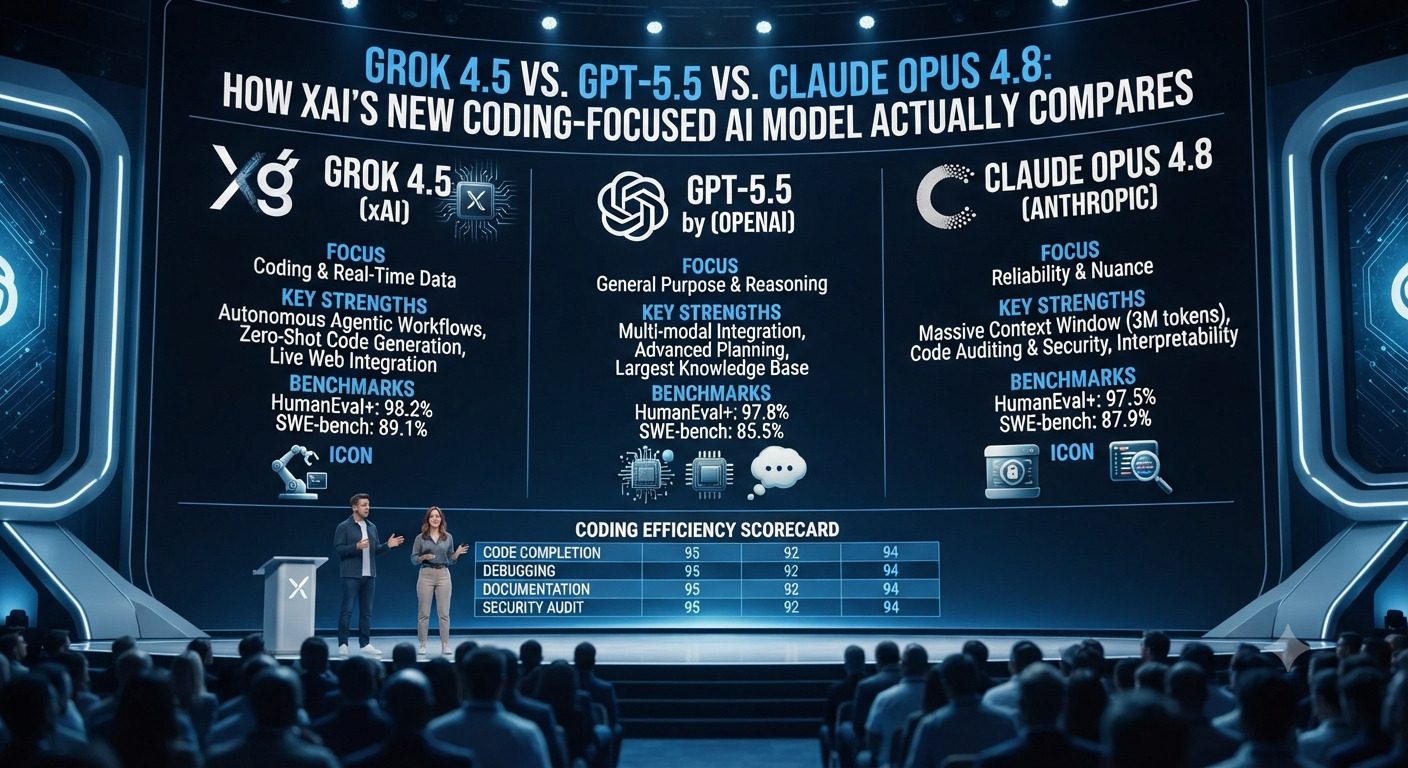
xAI released Grok 4.5 on July 8, 2026, positioning it as a coding- and agent-focused model trained partly on real developer session data from Cursor. Early benchmarks place it fourth on the Artificial Analysis Intelligence Index, ahead of every Gemini and open-weight model, while pricing it more than 60% below Claude Opus 4.8 and GPT-5.5 — a combination that has made it one of the most closely watched AI releases of the summer among developers deciding which model to build with.

Key Takeaways

  • Grok 4.5 launched July 8, 2026, built on a 1.5-trillion-parameter foundation model
  • It ranks fourth on the Artificial Analysis Intelligence Index, ahead of all Gemini and open-weight models
  • Pricing is $2 per million input tokens and $6 per million output tokens — over 60% cheaper than Opus 4.8 or GPT-5.5
  • It is notably more token-efficient, using a fraction of the output tokens Opus 4.8 needs for comparable tasks

A Model Built Specifically for Developers

Grok started out as a conversational chatbot built around real-time access to X. Grok 4.5 marks a clear pivot away from that framing. xAI trained it using real developer session data supplied through its partnership with Cursor, the AI code editor, and designed its benchmarks around what a model can actually accomplish inside a real, long-running codebase rather than isolated coding puzzles. That's a meaningfully different design goal than a general-purpose assistant, and it shows in how the model is being marketed — not as a smarter chatbot, but as infrastructure for coding tools and agent workflows.

What Elon Musk Actually Claimed

In his launch posts, Musk described Grok 4.5 as "roughly comparable to Opus 4.7, but much faster," and separately called it "more token-efficient and lower cost" — framing it as a direct alternative to Anthropic's Claude models for teams building AI-powered products. It's worth noting these were self-reported comparisons at launch, later supported by independent third-party benchmarking from Artificial Analysis, which placed Grok 4.5 fourth on its Intelligence Index — a meaningful, though not top-tier, result.

The Benchmarks in Context

According to Artificial Analysis's testing, Grok 4.5 scored ahead of every Gemini model and every open-weight model currently available, though it did not surpass the very top frontier models on the index. For coding-specific benchmarks, independent testing put it roughly on par with GPT-5.5 in Codex-style evaluations — at approximately half the per-task cost.

Also Read: Agentic AI, Explained: What It Actually Does Differently From ChatGPT and Older AI Assistants

Token efficiency is where the gap becomes most visible. Grok 4.5 reportedly uses around 14,000 output tokens to complete a typical Intelligence Index task, compared to roughly 67,020 tokens for Claude Opus 4.8 on the same class of task — a difference that directly affects both response speed and the real-world cost of running the model at scale.

Pricing Breakdown

Grok 4.5 is priced at $2 per million input tokens and $6 per million output tokens through its API — positioning it as a notably cheaper option than both Claude Opus 4.8 and GPT-5.5, which xAI states are priced more than 60% higher for comparable usage. For teams running high-volume coding agents or automated workflows, that pricing gap compounds quickly across millions of tokens processed daily.

Where This Fits in a Fast-Moving Market

Grok 4.5's launch landed in an unusually crowded week for frontier AI releases — the same period saw OpenAI pushing GPT-5.6 toward general availability and Anthropic dealing with an unrelated trademark dispute, underscoring just how quickly competing labs are now shipping updates. It's also worth noting that Grok 4.5 arrived through a joint effort with Cursor, which itself was acquired by SpaceX for a reported $60 billion just weeks later — tying the model, the compute powering it, and one of the most widely used AI coding tools under increasingly related ownership.

Also Read: What is "agentic AI" and how is it different from the AI assistants we already use, like ChatGPT or Google Assistant?

Should Developers Actually Switch?

For teams currently using Claude or GPT for coding tasks, Grok 4.5 is worth testing primarily on cost-sensitive, high-volume workloads — background agents, automated code review, or large-scale refactoring tasks where token efficiency directly affects your bill. For tasks requiring the highest achievable reasoning quality regardless of cost, the top-ranked frontier models still hold an edge based on current independent benchmarks. The most practical approach many developers are taking is running Grok 4.5 alongside their existing model rather than replacing it outright, given how quickly rankings in this space continue to shift.

FAQ

Q: When was Grok 4.5 released?
xAI released Grok 4.5 to the public on July 8, 2026.

Q: How much does Grok 4.5 cost compared to Claude Opus 4.8?
Grok 4.5 is priced at $2/$6 per million input/output tokens, reportedly more than 60% cheaper than Claude Opus 4.8 for comparable usage.

Q: Is Grok 4.5 better than GPT-5.5 for coding?
Independent benchmarks put Grok 4.5 roughly on par with GPT-5.5 on Codex-style coding evaluations, at approximately half the per-task cost.

Q: What data was Grok 4.5 trained on?
Grok 4.5 was built on xAI's 1.5-trillion-parameter V9 foundation model, with supplemental training on real developer session data provided through its partnership with Cursor.
Quick Summary

xAI's Grok 4.5 launched with a specific pitch: near Opus-level intelligence at a fraction of the cost. Here's what that means in practice for developers choosing between today's top AI models.

Key Takeaways

  • Grok 4.5 launched July 8, 2026, built on a 1.5-trillion-parameter foundation model
  • It ranks fourth on the Artificial Analysis Intelligence Index, ahead of all Gemini and open-weight models
  • Pricing is $2 per million input tokens and $6 per million output tokens — over 60% cheaper than Opus 4.8 or GPT-5.5
  • It is notably more token-efficient, using a fraction of the output tokens Opus 4.8 needs for comparable tasks

Quick Facts

Category: Technology
Published: July 26, 2026
Updated: September 4, 2026
Reading time: 5 min
132 views
Updated Sep 4, 2026 5 min read

Related Articles

View all
The 2026 Smartphone Divide: iPhone vs. Android Technology
Article Technology

The 2026 Smartphone Divide: iPhone vs. Android

As we move through 2026, the long-standing rivalry between iOS and Android has evolved. While both platforms are more capable and secure than ever, they serve fundamentally different philosophies: Apple’s curated ecosystem versus Android’s open-source flexibility.

Orwell, George 9 min 260

Mixed Content

The Post-Visual Threat: Architecting Zero-Trust Defense Against Weaponized Deepfakes Technology
Article Technology

The Post-Visual Threat: Architecting Zero-Trust Defense Against Weaponized Deepfakes

The rapid weaponization of real-time voice cloning and synthetic video generation has transformed social engineering from opportunistic phishing into targeted executive identity emulation. High-profile incidents involving multi-million-dollar wire transfers authorized via synthetic video calls prove that sight and sound can no longer authenticate authorization. Securing modern enterprises requires an uncompromising zero-trust identity layer capable of neutralizing synthetic deception.

Mutwassim 3 min 8
Beyond the Battery: How Electric Mobility Is Forcing a Overhaul of the Global Power Grid Technology
Article Technology

Beyond the Battery: How Electric Mobility Is Forcing a Overhaul of the Global Power Grid

The global transition toward electric vehicles is no longer constrained primarily by battery chemistry or vehicle range. Instead, the real bottleneck has shifted directly to the electrical grid. As commercial fleets and passenger cars electrify at scale, utilities and city planners are racing to deploy vehicle-to-grid (V2G) bidirectional systems, AI-driven dynamic load balancers, and decentralized microgrid storage to avoid grid failure.

Mutwassim 3 min 11
Cloud 3.0: The Shift Toward Sovereign Data Architectures and Edge Computing Technology
Article Technology

Cloud 3.0: The Shift Toward Sovereign Data Architectures and Edge Computing

The architectural assumption that enterprise compute and storage should reside in a handful of centralized hyperscaler data centers is fracturing. Driven by strict cross-border data sovereignty regulations and the demand for millisecond-latency AI inference, global IT leaders are pivoting to Cloud 3.0—a model centered on distributed, locally governed, and hybrid sovereign architectures.

Mutwassim 3 min 9
Beyond Offshoring: The Strategic Pivot to Multi-Hub Sourcing and Nearshore Resilience Technology
Article Technology

Beyond Offshoring: The Strategic Pivot to Multi-Hub Sourcing and Nearshore Resilience

The era of hyper-optimized, single-country manufacturing has come to an end. Faced with regulatory friction, geopolitical realignment, and maritime chokepoint vulnerabilities, global corporations are trading the narrow margins of ultra-lean offshoring for redundant, regionalized production networks. This strategic decoupling is fundamentally rewriting global trade routes and capital expenditure priorities.

Mutwassim 3 min 10
The Rise of Autonomous Agentic Workflows: How Multi-Agent Systems Are Redefining Enterprise Operations Technology
Article Technology

The Rise of Autonomous Agentic Workflows: How Multi-Agent Systems Are Redefining Enterprise Operations

The generative AI paradigm is shifting from conversational assistants to goal-driven multi-agent architectures. Rather than waiting for manual inputs at every stage, autonomous agentic workflows now orchestrate complex reasoning, call external APIs, self-correct errors, and execute end-to-end tasks across distributed software ecosystems.

Mutwassim 3 min 12
Technology
Article Technology

The Edge Energy Revolution: How Silicon-Level Power Optimization and Next-Gen Battery Chemistries Are Redefining Modern Mobility and Connected Devices

Compute power has scaled dramatically over the last decade, but battery capacity and thermal limits have struggled to keep up. Now, a combined wave of high-density solid-state batteries, intelligent silicon power management, and local edge efficiency is closing the gap for electric vehicles, smartphones, and industrial sensors.

Mutwassim 9 min 24
The Quantum Infiltration Defense: Why Post-Quantum Cryptography (PQC) and Cryptographic Agility Are the Defining Cyber Battleground Technology
Article Technology

The Quantum Infiltration Defense: Why Post-Quantum Cryptography (PQC) and Cryptographic Agility Are the Defining Cyber Battleground

Public-key infrastructure is undergoing its most significant structural replacement in modern computing history. With NIST post-quantum standards finalized and adversaries executing large-scale data harvesting campaigns, global enterprises are transitioning from theoretical quantum awareness to full-scale post-quantum cryptographic migrations.

Mutwassim 9 min 21