




For decades, enterprise security protocols operated on an implicit psychological assumption: human senses are the ultimate fallback for identity verification. When an automated flag was raised or an unusual transfer requested, security teams relied on direct contact—a phone call to verify voice timbre or a video conference to confirm the executive's physical presence.
That foundational premise is obsolete.
Advances in generative latent diffusion architectures and few-shot voice synthesis have industrialized weaponized deepfakes. Cybercriminals no longer need vast supercomputing clusters to mimic C-suite personnel; 30 seconds of scraped audio from an earnings call and a handful of high-resolution conference photos are sufficient to construct convincing, real-time synthetic avatars.
The battlefield has shifted from endpoint malware protection to an asymmetric war over cognitive trust.
The Anatomy of Modern Identity Emulation
The modern deepfake attack vector diverges sharply from crude consumer face-swapping tools. Today's enterprise incidents leverage real-time multimodal synthesis:
Synthetic Video Infiltration: Attackers stage multi-participant video conference rooms where all attendees—save for the target employee—are AI-rendered models mimicking corporate officers, directly pressuring finance personnel to authorize urgent, confidential capital transfers.
Acoustic Impersonation via Few-Shot Voice Cloning: Threat actors execute vishing (voice phishing) campaigns using neural text-to-speech engines that adapt instantly to cadence, ambient microphone noise, and linguistic mannerisms, effectively bypassing traditional human voice verification.
Contextual Phishing Orchestration: Attackers harvest organizational charts, internal corporate language, and vendor payment schedules via prior supply chain breaches to deploy deepfake communications at peak moments of corporate friction, such as quarterly reporting windows or active M&A transactions.
The Failure of Human Intuition
Relying on staff to "spot the artifact" is an ineffective security policy. While early synthetic media exhibited unnatural eye blinking, blurry edge artifacts, and lighting mismatches, current temporal attention layers and neural rendering engines render artifacts indistinguishable to the human eye—especially through compressed video call streams.
Human detection rates for cutting-edge synthetic media hover barely above pure chance. Treating human perception as a security firewall guarantees breach failure.
The Three Pillars of Deepfake-Resilient Architecture
To defend corporate infrastructure against synthetic identity emulation, Chief Information Security Officers (CISOs) are migrating to a structural Zero-Trust Identity framework:
Deterministic Out-of-Band Verification:
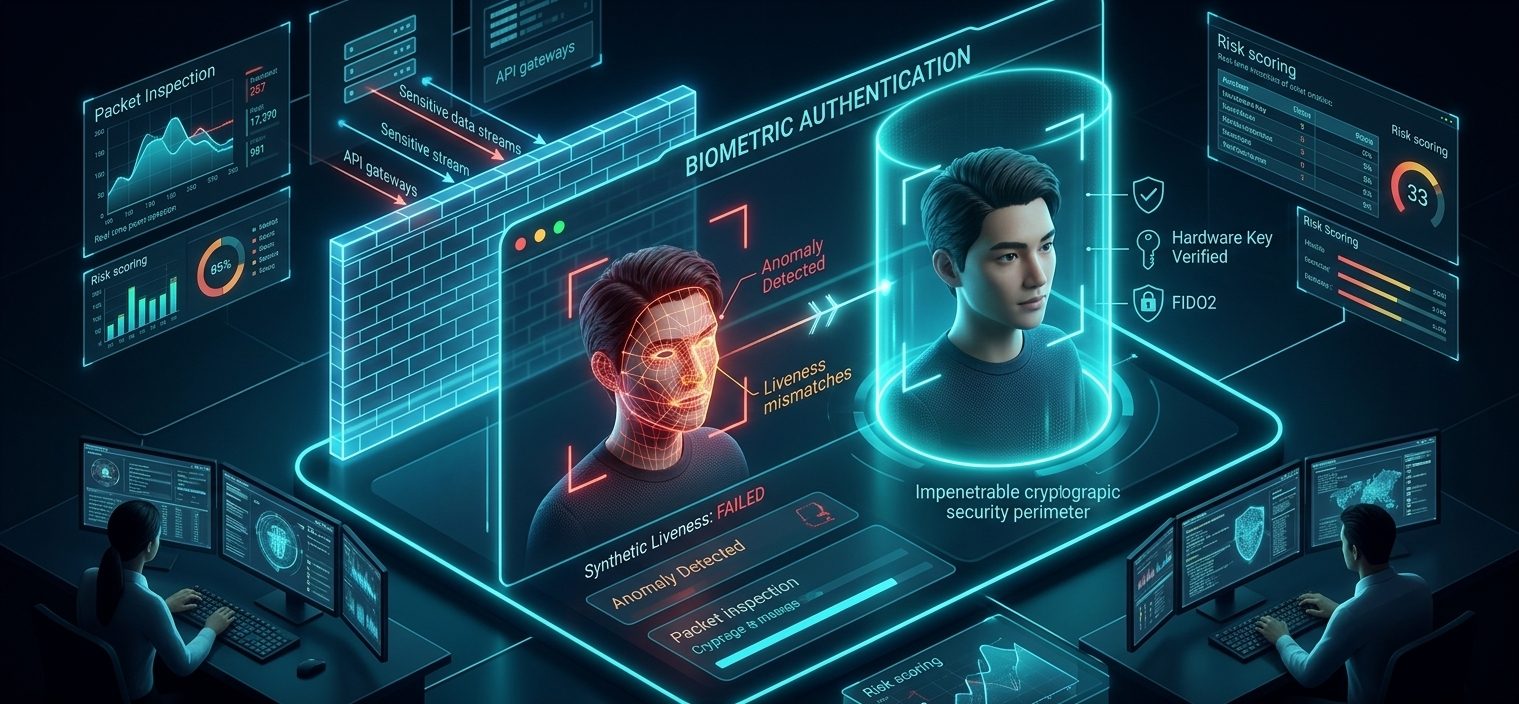
High-risk actions—such as treasury transfers, master database access, or vendor routing updates—must require cryptographic verification independent of voice or video confirmation. Requests initiated over conference calls must be validated through multi-party approval systems, hardware security keys (FIDO2/WebAuthn), and asynchronous challenge-response protocols that do not rely on audio-visual cues.
Multimodal Synthetic Media Detection Engines:
Security teams are deploying defensive machine learning models integrated directly into corporate communication gateways (Zoom, Microsoft Teams, Slack). These systems analyze audio-video streams at the packet and sensor level, detecting:
Micro-vascular blood flow fluctuations (photoplethysmography) that are absent in synthetic faces.
Frame-by-frame temporal jitter and voice acoustic spectral anomalies invisible to human observers.
Lighting inconsistencies between the participant’s face geometry and ambient background bounce.
Duress Protocols and Ephemeral Shared Secrets:
Corporations are institutionalizing shared, offline authentication keys for senior executives and authorized treasury teams. Rotating cryptographic passphrases and strict duress signaling allow employees under suspected deepfake coercion to verify identity without alerting the attacker.
The weaponization of generative media does not represent an isolated cybercrime tactic; it marks the death of passive digital trust. Organizations that survive this transition will be those that treat human sight and sound not as undeniable proof of identity, but as untrusted data streams requiring independent cryptographic verification.