





The concept of the open-world game has undergone a staggering evolution. What once began as simple grids of interconnected screens and text prompts has transformed into sprawling, breathing digital ecosystems where players can spend hundreds of hours losing themselves in alternative realities. An exceptional open-world game does not merely offer a large map; it offers agency, environmental storytelling, and a sense of genuine discovery that makes every player's journey entirely unique.
Across decades of hardware innovation, certain titles have transcended their contemporaries to become timeless milestones. These are the games that changed how developers design virtual spaces and how players interact with them. In this exhaustive retrospective, we examine the greatest open-world games ever created, analyzing the secret sauce behind their enduring legacies.
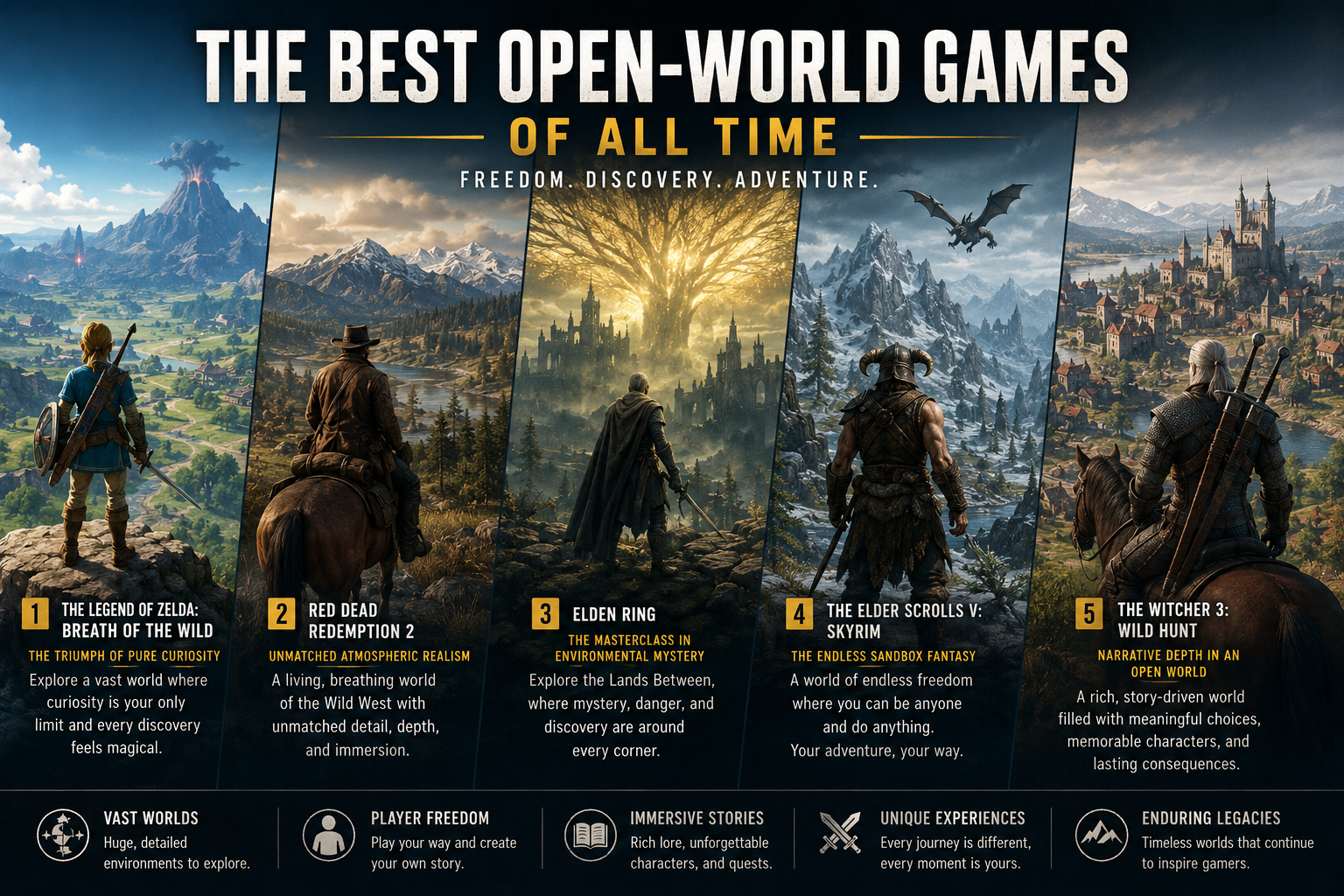
1. The Legend of Zelda: Breath of the Wild — The Triumph of Pure Curiosity
When Nintendo released The Legend of Zelda: Breath of the Wild, it didn't just redefine a legendary franchise; it completely flipped the modern open-world genre on its head. For years, open-world design had relied heavily on "ubiquitous map clutter"—mini-maps overflowing with icon markers, checklist objectives, and mandatory waypoint following.
Breath of the Wild replaced that formula with a single guiding principle: if you can see it, you can reach it. By utilizing a chemistry-and-physics-based engine where fire burns grass, metal attracts lightning, and wind carries objects, Nintendo created a playground of emergent gameplay. Climbing up a massive mountain peak wasn’t restricted by invisible walls or arbitrary skill trees; it was gated only by your stamina and resource management. It captured the genuine, unadulterated thrill of childhood exploration, proving that a quiet, ruined landscape could feel infinitely more alive than a crowded checklist.
2. Red Dead Redemption 2 — Unmatched Atmospheric Realism
Rockstar Games has long been a master of open-world architecture, but Red Dead Redemption 2 represents their crowning achievement in crafting living, breathing environments. Set in 1899 during the twilight of the American Wild West, the game immerses players in a world of staggering fidelity and granular detail.
What makes Red Dead Redemption 2 unforgettable is not just its cinematic storytelling or the tragic arc of Arthur Morgan, but the sheer depth of its simulation. Wildlife ecosystems interact naturally, NPCs remember your actions and treat you accordingly based on your honor level, and weather systems dynamically alter the terrain. Riding your horse across the snow-swept Grizzlies down into the muddy streets of Saint Denis feels like stepping into a living historical simulation. It stands as a monument to what cinematic storytelling and open-world immersion can achieve together.
3. Elden Ring — The Masterclass in Environmental Mystery
FromSoftware took the punishing, intricate world design of their dark fantasy RPGs and scaled it up into a vast, seamless open world with Elden Ring. The Lands Between is a terrifying, gorgeous, and deeply melancholy landscape that respects the player's intelligence by refusing to hold their hand.
The brilliance of Elden Ring lies in its navigation design. Instead of following quest markers on a HUD, players must read the topography, follow glowing trails of grace, and heed visual landmarks on the horizon—like the towering Erdtree casting a golden glow over the entire continent. When you spot a distant ruined castle or a mysterious crater in the earth, traveling there always yields a genuine sense of discovery, danger, and reward. It redefined how modern RPGs handle exploration without sacrificing challenge.
4. The Elder Scrolls V: Skyrim — The Endless Sandbox Fantasy
More than a decade after its initial release, The Elder Scrolls V: Skyrim remains a towering pillar of open-world design. Bethesda Game Studios captured lightning in a bottle by creating a sandbox where players could truly roleplay any fantasy they desired—whether that meant becoming a stealthy thief, a master destruction mage, or an armor-clad warrior shouting dragons out of the sky.
Skyrim's enduring appeal stems from its absolute freedom. You can completely ignore the main questline to wander through snowy pine forests, explore ancient Nordic tombs, join rival factions, or construct a homestead. Coupled with one of the most dedicated modding communities in gaming history, Skyrim transformed from a single-player roleplaying game into an eternal digital canvas.
5. The Witcher 3: Wild Hunt — Narrative Depth in an Open World
For a long time, there was an accepted compromise in game development: an open world meant sacrificing tight, compelling narrative pacing, while linear games offered great stories at the cost of freedom. The Witcher 3: Wild Hunt shattered that dichotomy.
CD Projekt Red populated the war-torn realms of Velen, the grand city of Novigrad, and the majestic islands of Skellige with writing of unprecedented quality. Crucially, even the smallest side quests—often categorized as menial "fetch quests" in other games—were elevated into mini-masterpieces with complex moral choices, memorable characters, and unexpected twists. Geralt of Rivia's hunt for Ciri proved that an open world could tell a deeply emotional, mature, and reactive story.
The Evolution of Freedom
The best open-world games ever made share a common DNA: they respect the player's autonomy. Whether you are scaling a remote cliff in Hyrule, tracking a bounty across the American frontier, uncovering secrets in the Lands Between, shouting down dragons in Skyrim, or tracking monsters across the Northern realms, these virtual worlds endure because they offer something rare—the freedom to carve out your own unique adventure.
Which open-world game holds a special place in your heart? Let us know your all-time favorite virtual world in the comments below!