






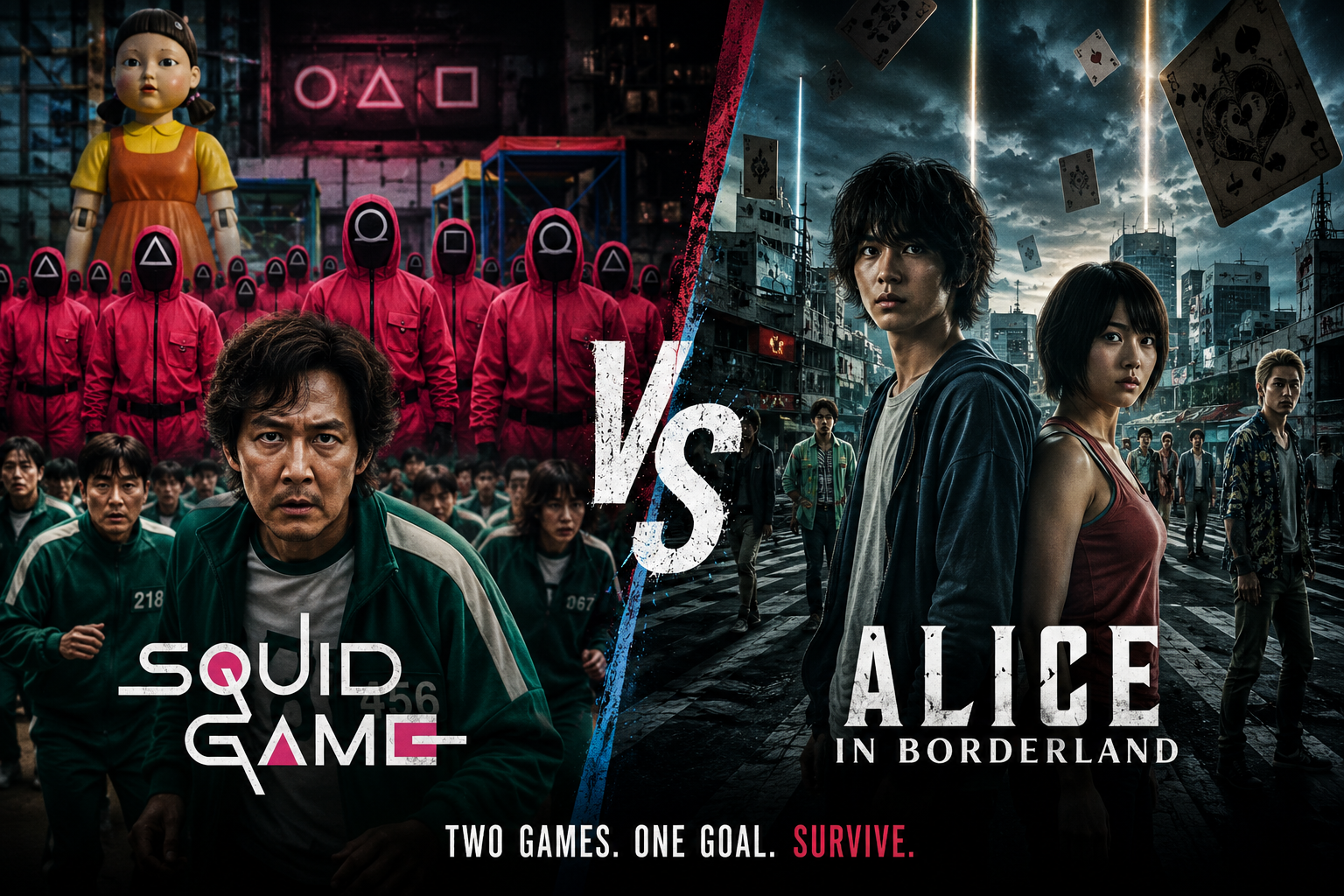
Squid Game vs. Alice in Borderland: The Ultimate Survival Showdown
Over the past few years, streaming television has undergone a seismic shift, largely driven by a dark, high-stakes subgenre that captures our collective anxieties: the death game thriller. At the forefront of this global phenomenon stand two titans from East Asia—Netflix’s South Korean cultural phenomenon Squid Game and its Japanese sci-fi counterpart, Alice in Borderland. While both series plunge desperate participants into deadly, high-stakes arenas where failure means immediate execution, they approach their premise through radically different philosophical, narrative, and aesthetic lenses. This comprehensive deep-dive explores how these two masterpieces stack up against one another across world-building, character depth, game design, and psychological impact.
1. The Premise and World-Building: Capitalism vs. Existential Limbo
The core engine of any death game narrative is the why. Why are these people here, and what rules govern their torment?
- Squid Game: Grounded firmly in raw socio-economic realism, Squid Game hooks viewers by using the harsh realities of late-stage capitalism. The contestants aren't chosen at random; they are crushed by insurmountable debt, predatory loans, and societal neglect. The arena itself is a surreal, pastel-colored labyrinth managed by a cold, corporate elite known as the VIPs, turning human desperation into a spectator sport for the ultra-wealthy.
- Alice in Borderland: Leans heavily into speculative science fiction and supernatural mystery. Arisu and his friends are suddenly transported into a parallel, eerily deserted Tokyo where they are forced to clear playing cards through deadly games to extend their "visas." The world is an existential puzzle box, blending urban decay with mysterious laser beams and hidden masterminds, creating a grander cosmic mystery.
2. Game Design and Strategic Depth: Nostalgia vs. Intellectual Warfare
The heart-pounding tension of these shows relies entirely on the creativity and deadliness of the games themselves.
Squid Game weaponizes childhood nostalgia. By taking innocent playground games like "Red Light, Green Light," Tug of War, and Marbles and adding fatal consequences, the show creates a chilling juxtaposition. The horror comes from watching adults murder each other over games they once played with carefree innocence. However, the physical rules are relatively straightforward, meaning the tension is driven almost entirely by interpersonal betrayal and emotional weight rather than complex puzzles.
Conversely, Alice in Borderland approaches games through an intellectual and psychological framework categorized by the suits of playing cards—Spades (physical endurance), Hearts (psychological betrayal), Clubs (teamwork), and Diamonds (intelligence). The games in Borderland demand intricate logic, riddles, math, and ruthless tactical choices. Characters frequently have to outsmart game designers who hold all the cards, making every victory feel like a hard-fought intellectual triumph.
3. Character Development and Emotional Core
A death game is only as good as the people playing it; if we don't care who survives, the stakes evaporate.
Squid Game excels at building raw, gut-wrenching human empathy. Seong Gi-hun’s journey from a down-on-his-luck gambler to a man scarred by trauma anchors the entire narrative. Relationships formed under pressure—such as the tragic bond between Gi-hun and Ali, or the intense rivalry and history between Gi-hun and Sang-woo—deliver devastating emotional payloads that linger long after the credits roll.
Alice in Borderland focuses heavily on character growth through trauma and existential realization. Arisu begins as an aimless, video-game-obsessed drifter who finds his sense of purpose only when forced to fight for his friends' lives. Alongside phenomenal supporting figures like Usagi, Chishiya, and Kuina, the series explores deep themes of the will to live, self-forgiveness, and finding meaning in a meaningless universe.
4. Pacing, Action, and Visual Direction
Visually and stylistically, both series offer top-tier cinematic production value, but their execution differs greatly.
Squid Game is a masterclass in controlled, symbolic art direction. The stark contrast between the vibrant, geometric playground sets and the brutal, crimson-suited guards creates a signature aesthetic that became a global pop-culture footprint. Its pacing is methodical, prioritizing character drama and slow-burn dread before erupting into violence.
Alice in Borderland functions as a high-octane blockbuster action thriller. From explosive car chases through Shibuya Crossing to brutal physical trials in massive industrial complexes, the cinematography is relentless, flashy, and adrenaline-fueled. It treats its dystopian landscape like an open-world survival video game brought to vivid life.
The Verdict: Which One Reigns Supreme?
Declaring a definitive winner between Squid Game and Alice in Borderland depends entirely on what you crave from a thriller. If you want a deeply human, socially poignant drama that uses high-stakes games as a mirror for the cruelty of modern economic inequality, Squid Game takes the crown. However, if your appetite leans toward mind-bending puzzles, sprawling world mysteries, relentless action, and high-stakes survival strategy, Alice in Borderland stands unmatched.
Ultimately, television fans win the most: both series have permanently raised the bar for global dystopian storytelling, proving that gripping, high-concept survival thrillers transcend language and cultural borders.