





PUBG vs Call of Duty: Warzone: The Battle Royale Titan Clash

We dive deep into the ultimate showdown of BR giants. Compare PUBG's tactical realism with Warzone's fast-paced action to decide which reigns supreme in 2026.

PUBG vs Call of Duty: Warzone: The Battle Royale Titan Clash

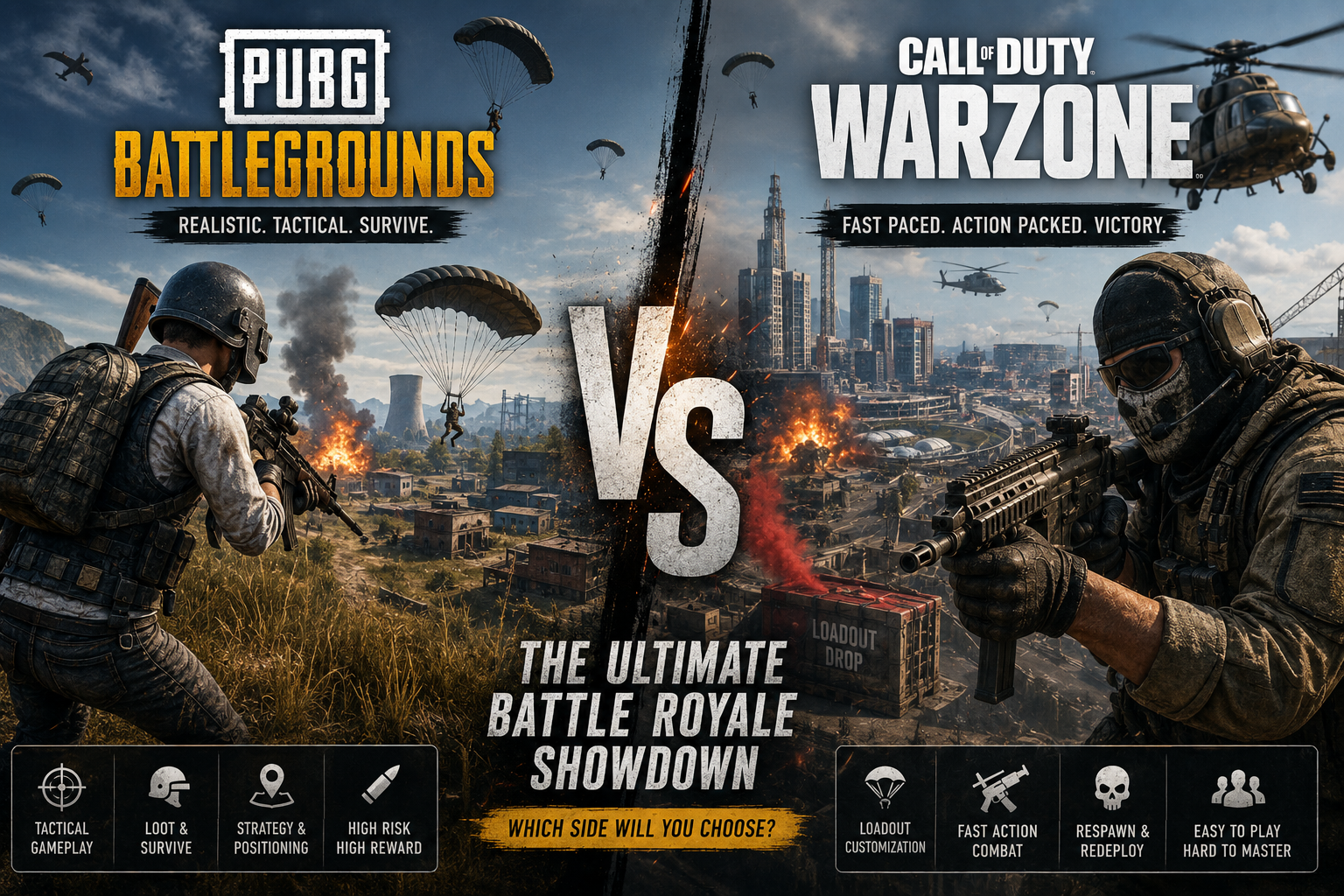
The battle royale genre, once a chaotic frontier, has matured into a highly competitive arena dominated by a few monolithic titles. For years, the conversation has been defined by an enduring rivalry: PUBG: Battlegrounds versus Call of Duty: Warzone. While both fall under the same umbrella, they represent two fundamentally different philosophies of what a massive multiplayer shooter should be. PUBG is the gritty, slow-burn progenitor that demands patience and tactical precision. Warzone is the explosive, high-octane evolution that prioritizes speed, loadouts, and constant engagement.

As we look at the landscape in 2026, both games have evolved significantly through countless updates, map changes, and feature additions. The question for new and returning players remains: Which titan deserves your time? In this exhaustive 1500-word analysis, we will deconstruct every critical aspect of PUBG and Warzone to help you declare a winner in this ultimate battle royale clash.

1. Gameplay Philosophy: Realism vs. Arcade Action

The core difference lies in their DNA. PUBG was built as a military simulation-lite, while Warzone is a direct descendant of the arcade-like Call of Duty multiplayer experience.

PUBG: Battlegrounds leans heavily into simulation. Movement is deliberately weighty, and gun recoil is significant, requiring players to master complex spray patterns and tap-firing. The "time-to-kill" (TTK) can be punishingly fast, turning a simple mistake into an immediate trip back to the lobby. The game's pacing is slow and methodical, focusing on looting, careful positioning, circle management, and gathering information. Every gunshot has consequences, and stealth is often as valuable as aggression.

Call of Duty: Warzone is all about controlled chaos. Movement is fluid, fast, and features mechanics like slide-canceling and tactical sprinting that allow for aggressive plays. The gunplay is snappy, with very manageable recoil across most weapons, making it accessible for players of all skill levels. The TTK is generally slower than PUBG, allowing for gunfights to be more about reaction time and accuracy during movement. Warzone constantly funnels players into engagements, with mechanics like the Gulag (a 1v1 respawn arena) and frequent public events keeping the action frantic from start to finish.

2. Gunplay and Gunsmith: Mastering the Arsenal

How you interact with weapons defines the combat loop, and both games offer distinct experiences.

PUBG: Battlegrounds features a unique, steep learning curve for its weapons. Each gun feels distinct, with significant horizontal and vertical recoil that takes dozens, sometimes hundreds, of hours to master. There are no pre-set loadouts; players must scavenge attachments (grips, scopes, magazines) from the world, making each match a new puzzle. The satisfaction of landing a long-range Kar98k shot on a moving target is unparalleled, but getting there requires dedication.

Call of Duty: Warzone utilizes the expansive Gunsmith system, allowing players to fine-tune weapons with dozens of attachments to alter recoil, range, bullet velocity, and handling. While weapons have recoil, it is generally predictable and can be heavily mitigated. The ability to call in a custom loadout creates a consistent and personalized gameplay experience, where players can always rely on their favorite, perfectly tuned weapon. This removes some of the RNG of looting but arguably reduces weapon variety in the late game, as everyone gravitates toward a few "meta" builds.

3. Graphics, Audio, and Technical Performance

The presentation and technical backbone significantly impact immersion and competitive integrity.

PUBG: Battlegrounds, despite improvements over the years, shows its age. The graphics, while serviceable and realistic in tone, lack the polish and fidelity of modern AAA titles. Textures can be muddy, and animations can feel stiff. However, its audio design is legendary for directional sound. Mastering the precise crack of a distant sniper shot or the crunch of footsteps in a nearby building is a core skill. Performance on PC and console has stabilized, but it can still be demanding.

Call of Duty: Warzone benefits from the cutting-edge IW engine, delivering stunning visual fidelity with photorealistic textures, detailed environments, and fluid animations. Weapons look and sound incredible, with a punchy, satisfying audio mix. However, the visual clutter can sometimes make it difficult to spot enemies, and the sheer scale of the game often leads to performance dips, pop-in, and occasional bugs. The audio, while cinematic, can sometimes be inconsistent in vertical situations (e.g., determining if an enemy is above or below you).

4. Live-Service Support and Community Evolution

A modern live-service game must continuously evolve to keep players engaged.

PUBG: Battlegrounds has pivoted successfully to a free-to-play model, injecting new life into its community. It continues to receive regular updates, introducing new maps (like the recent, sprawling Deston), new weapons, and significant gameplay rebalances. It has also collaborated on major crossover events. However, its core gameplay loop remains largely unchanged, which can feel stagnant to players seeking constant innovation.

Call of Duty: Warzone is a content behemoth. Integrated deeply with the mainline Call of Duty titles, it receives massive seasonal updates that bring new maps, weapons, operators, and limited-time modes. The integration of new mechanics (like underwater combat and swimming) keeps the gameplay fresh. However, this rapid pace can also introduce balance issues, with new "meta" weapons dominating the game until the next patch, leading to player frustration.

5. Player Base and Accessibility

Who is the game for, and who is playing it?

PUBG: Battlegrounds has a dedicated, hardcore player base, particularly in Asia. It has a steeper learning curve, which can be intimidating for newcomers. Its slower pace appeals to players who value strategy, realism, and high-stakes survival over twitch reflexes.

Call of Duty: Warzone boasts a massive, casual-friendly audience. Its fast-paced, action-packed gameplay and familiar Call of Duty mechanics make it easy for anyone to pick up and play. It has a low barrier to entry, making it the go-to choice for quick, adrenaline-fueled matches.

Final Verdict

There is no single "best" battle royale, as the choice depends entirely on personal preference.

  • Choose PUBG: Battlegrounds if you are a patient, methodical player who values tactical realism, deep gunplay mastery, high-stakes tension, and earning every victory through strategy and skill.
  • Choose Call of Duty: Warzone if you crave fast, arcade-style action, enjoy customizing weapons through the deep Gunsmith system, love the constant engagement of respawn mechanics, and prefer a lower barrier to entry for quick, explosive matches.

Which side of the battlefield do you stand on in 2026? Let us know your pick in the comments below!
Quick Summary

We dive deep into the ultimate showdown of BR giants. Compare PUBG's tactical realism with Warzone's fast-paced action to decide which reigns supreme in 2026.

Key Takeaways

  • Choose PUBG: Battlegrounds if you are a patient, methodical player who values tactical realism, deep gunplay mastery, high-stakes tension, and earning every victory through strategy and skill.
  • Choose Call of Duty: Warzone if you crave fast, arcade-style action, enjoy customizing weapons through the deep Gunsmith system, love the constant engagement of respawn mechanics, and prefer a lower barrier to entry for quick, explosive matches.

Quick Facts

Category: Entertainment
Published: July 26, 2026
Updated: October 5, 2026
Reading time: 6 min
20 views
Updated Oct 5, 2026 6 min read

Related Articles

View all
The 2026 Gaming Horizon: The Best Mobile Titles You Need to Play Now Entertainment
Article Entertainment

The 2026 Gaming Horizon: The Best Mobile Titles You Need to Play Now

Mobile gaming in 2026 has reached a new zenith. The platform is no longer just a secondary destination for "time-killer" apps; it is now a powerhouse for high-fidelity open worlds, console-quality ports, and innovative indie experiences. Whether you are looking for deep RPG narratives or fast-paced action, here are the mobile games defining the summer of 2026.

Bisma 9 min 65
Viral Internet Trends Everyone Is Talking About: The Cultural Shifts Shaping 2026 Entertainment
Article Entertainment

Viral Internet Trends Everyone Is Talking About: The Cultural Shifts Shaping 2026

The internet moves fast, but the digital landscape of 2026 has evolved past simple viral dance challenges and fleeting memes. Today’s biggest online phenomena are driven by a collective craving for unpolished authenticity, seamless social commerce, and deep community connection. From "yapping" long-form video revivals to the death of traditional hashtags, here are the viral trends dominating feeds right now.

Bisma 7 min 55
Binge-Worthy 2026: The Must-Watch Netflix Series of the Year Entertainment
Article Entertainment

Binge-Worthy 2026: The Must-Watch Netflix Series of the Year

From gripping true-crime adaptations and high-stakes thrillers to the return of beloved franchises, 2026 has been a landmark year for Netflix originals. Whether you're in the mood for an adrenaline-fueled mystery or a deep dive into historical drama, here are the series that have defined the streaming landscape so far.

Quinn, Kate 9 min 53

Popular

View all

Mixed Content

Entertainment
Article Entertainment

The Post-Automation Economy: Architecting Human Skill Premiums in the Age of Autonomy

The rapid proliferation of agentic workflows and large action models is structurally inverting the traditional corporate skill pyramid. While routine analytical processes and information retrieval tasks are being automated into low-cost utility, uncommoditizable human traits—emotional intelligence, strategic ambiguity management, and ethical governance—are commanding an unprecedented value premium. Succeeding in the post-automation enterprise requires re-engineering workforce development to focu

Mutwassim 3 min 72
The Decline of Friction: Inside the FinTech Revolution in Cross-Border Settlement and Digital Identity Entertainment
Article Entertainment

The Decline of Friction: Inside the FinTech Revolution in Cross-Border Settlement and Digital Identity

The traditional plumbing of global finance—characterized by multi-day delays, hidden fees, and fragmented identity silo—is undergoing a profound transformation. A new generation of FinTech architectures, combining distributed ledger technology (DLT), synchronized liquidity pools, and decentralized digital passports, is enabling cross-border instant payments with near-zero friction.

Mutwassim 1 min 44
The City as a Switch: Architecting IoT Logistics for the Post-Congestion Urban Era Entertainment
Article Entertainment

The City as a Switch: Architecting IoT Logistics for the Post-Congestion Urban Era

The traditional model of urban delivery—reliant on high-emission diesel vans navigating static street grids—is creating unsustainable levels of congestion and pollution in global metros. To reclaim urban space, cities are transitioning to IoT-orchestrated logistics. This data-driven framework utilizes autonomous delivery swarms, automated micro-fulfillment centers, and dynamic digital kerb-side management to route goods with the efficiency of internet packets, transforming static streets into fl

Mutwassim 4 min 71
Beyond the Coffee Shop: How Cross-Border Employment and Sovereign Visas Are Institutionalizing Remote Work Entertainment
Article Entertainment

Beyond the Coffee Shop: How Cross-Border Employment and Sovereign Visas Are Institutionalizing Remote Work

Remote work is transitioning from an informal perk into an institutionalized pillar of international commerce. Over 60 nations have launched dedicated digital nomad visa regimes, while multi-jurisdictional compliance platforms and Employer of Record (EOR) frameworks dismantle traditional geographic barriers. As knowledge workers disperse globally, enterprises and municipal governments are formalizing policies around tax residency, permanent establishment risk, and asynchronous operational workfl

Mutwassim 3 min 71
The Death of Syntax: Inside the Shift to Intent-Driven Software Engineering Entertainment
Article Entertainment

The Death of Syntax: Inside the Shift to Intent-Driven Software Engineering

The day-to-day discipline of software engineering is undergoing its most radical abstraction leap since the transition from assembly language to high-level compilers. Generative code synthesis and deterministic reasoning engines are automating boilerplate syntax, turning software developers into systems architects. Survival in this new paradigm demands mastering intent formalization, specification design, and continuous verification.

Mutwassim 3 min 71
The Post-Visual Threat: Architecting Zero-Trust Defense Against Weaponized Deepfakes Entertainment
Article Entertainment

The Post-Visual Threat: Architecting Zero-Trust Defense Against Weaponized Deepfakes

The rapid weaponization of real-time voice cloning and synthetic video generation has transformed social engineering from opportunistic phishing into targeted executive identity emulation. High-profile incidents involving multi-million-dollar wire transfers authorized via synthetic video calls prove that sight and sound can no longer authenticate authorization. Securing modern enterprises requires an uncompromising zero-trust identity layer capable of neutralizing synthetic deception.

Mutwassim 3 min 137
Beyond the Battery: How Electric Mobility Is Forcing a Overhaul of the Global Power Grid Entertainment
Article Entertainment

Beyond the Battery: How Electric Mobility Is Forcing a Overhaul of the Global Power Grid

The global transition toward electric vehicles is no longer constrained primarily by battery chemistry or vehicle range. Instead, the real bottleneck has shifted directly to the electrical grid. As commercial fleets and passenger cars electrify at scale, utilities and city planners are racing to deploy vehicle-to-grid (V2G) bidirectional systems, AI-driven dynamic load balancers, and decentralized microgrid storage to avoid grid failure.

Mutwassim 3 min 58
Cloud 3.0: The Shift Toward Sovereign Data Architectures and Edge Computing Entertainment
Article Entertainment

Cloud 3.0: The Shift Toward Sovereign Data Architectures and Edge Computing

The architectural assumption that enterprise compute and storage should reside in a handful of centralized hyperscaler data centers is fracturing. Driven by strict cross-border data sovereignty regulations and the demand for millisecond-latency AI inference, global IT leaders are pivoting to Cloud 3.0—a model centered on distributed, locally governed, and hybrid sovereign architectures.

Mutwassim 3 min 61