




Best Phone for Travelers: Pixel 10 Pro vs. iPhone 17 Pro Ultimate Showdown

Planning your next global adventure? Compare two of the world's finest mobile powerhouses—the Google Pixel 10 Pro and the Apple iPhone 17 Pro—to see which device reigns supreme for photography, navigation, connectivity, and durability on the road.

Best Phone for Travelers: Pixel 10 Pro vs. iPhone 17 Pro Ultimate Showdown

Choosing a travel companion used to mean picking the right backpack, durable walking shoes, or a reliable power adapter. Today, your most critical piece of travel gear fits squarely into your pocket. Whether you are navigating the winding medieval alleyways of Prague, translating a handwritten menu in a Tokyo side-street noodle shop, or capturing sweeping mountain vistas in Patagonia, your smartphone acts as your tour guide, translator, camera, map, and lifeline all at once.

When looking at the pinnacle of mobile engineering, two devices stand head and shoulders above the rest for globetrotters: the Google Pixel 10 Pro and the Apple iPhone 17 Pro. Both devices bring cutting-edge hardware, phenomenal computational photography, and advanced satellite connectivity to the table. But which one truly earns the crown as the ultimate phone for travelers? Let us put them through a rigorous, real-world travel gauntlet.

1. Design, Build Quality, and Portability

When you are traveling, every ounce in your daypack matters, and durability is non-negotiable. You need a device that can survive sudden downpours, dusty hikes, and accidental drops on cobblestone streets.

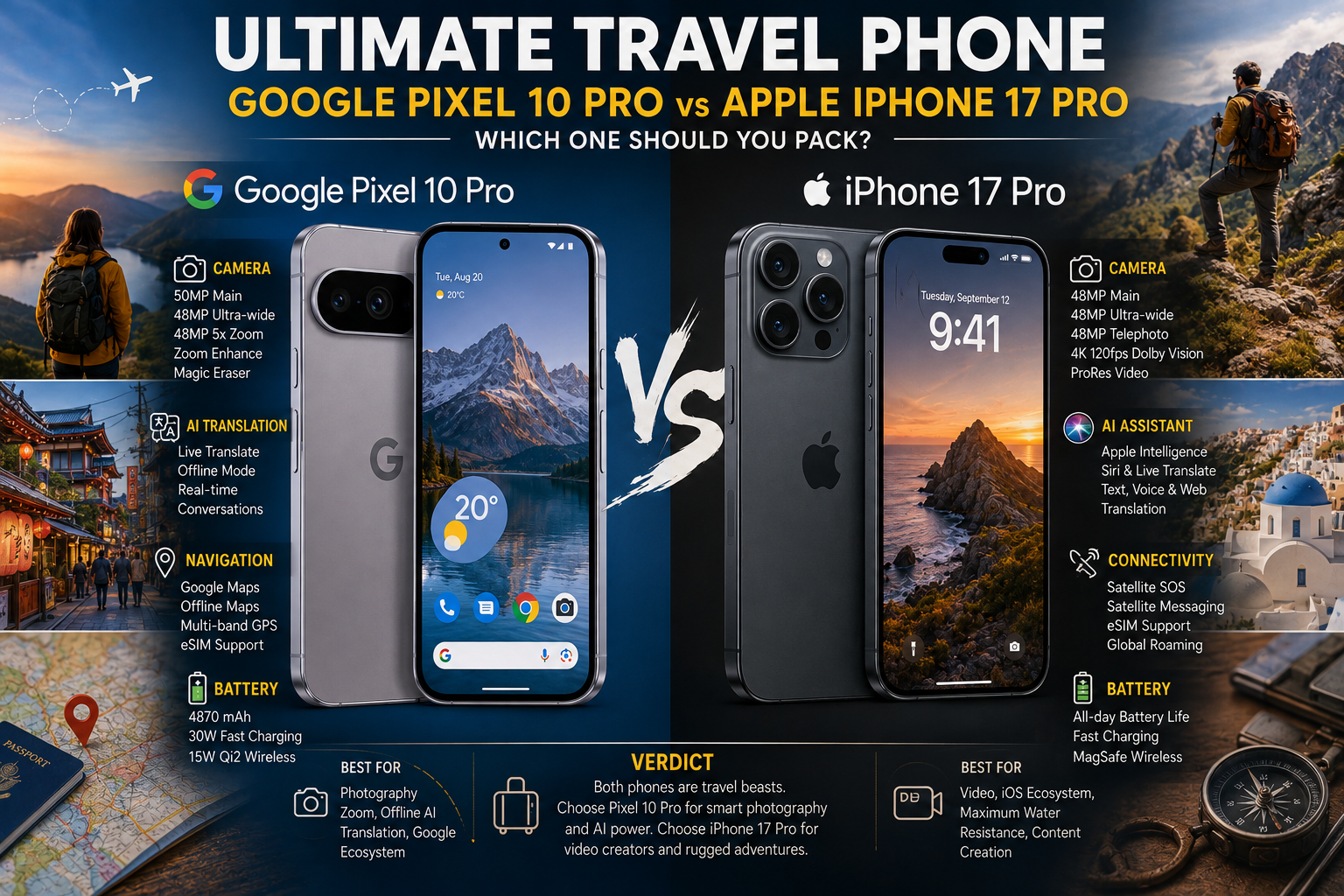
The Google Pixel 10 Pro features a sleek 6.3-inch form factor protected by Corning Gorilla Glass Victus 2 on both the front and back, anchored by a solid aluminum frame. It holds an IP68 dust and water-resistance rating, meaning it can withstand accidental submersions up to 1.5 meters.

On the other side, the Apple iPhone 17 Pro also sports a 6.3-inch display, utilizing advanced Ceramic Shield 2 protection and an aerospace-grade frame. Impressively, the iPhone 17 Pro boasts superior water resistance, rated for depths up to 6 meters for 30 minutes. Both phones are wonderfully pocketable and ergonomic, but the iPhone's rugged water sealing gives it a slight edge for aquatic adventures and beach trips.

2. Camera Performance: Capturing Memories on the Move

For most travelers, the smartphone has entirely replaced dedicated digital cameras. You want to capture breathtaking sunsets, sharp street portraits, and distant architectural details without carrying heavy glass lenses.

The Pixel 10 Pro is equipped with a versatile triple-lens setup: a 50MP main wide sensor, a 48MP ultra-wide lens, and a 48MP periscope telephoto lens offering 5x optical zoom. Google’s legendary computational photography pipeline shines brilliantly when traveling. Features like Zoom Enhance, Magic Eraser, and exceptional low-light Night Sight make it effortless to pull incredible details out of dark museums or moonlit landscapes. Furthermore, the 5x telephoto lens now includes tele-macro capability, letting you capture stunning close-ups of exotic flowers and local market textures.

The iPhone 17 Pro counters with a powerhouse camera system featuring a 48MP main sensor, a 48MP ultra-wide camera, and a 48MP telephoto lens. Apple excels exceptionally in video recording stability and cinematic quality. With support for 4K video at high frame rates, Dolby Vision HDR, and ProRes workflows, the iPhone 17 Pro is the undisputed king for travel vloggers and mobile filmmakers.

3. Language Translation and AI Travel Assistant

Language barriers can turn a simple restaurant order into a stressful puzzle. This is where software intelligence becomes your greatest travel asset.

The Pixel 10 Pro leverages Google’s deep suite of artificial intelligence tools powered by Gemini Nano. Live Translate operates locally on the device, allowing you to hold real-time bilingual voice conversations or translate foreign text through your camera viewfinder instantly—even without an active cellular data connection. It feels like having a personal local interpreter living inside your phone.

The iPhone 17 Pro responds with Apple Intelligence integrated seamlessly across iOS. Siri and system-wide translation tools handle text, voice, and web pages smoothly. While Apple's ecosystem privacy focus is stellar, Google's historical dominance in mapping, translation, and contextual search gives the Pixel 10 Pro a slight advantage for deep cultural immersion.

4. Navigation, Connectivity, and Global Roaming

Getting lost can be an adventure, but getting stranded without a map or signal in an unfamiliar city is a traveler’s worst nightmare.

Both phones embrace the modern eSIM standard, making it seamless to download local carrier data profiles before boarding your flight, avoiding exorbitant physical roaming fees. Both the Pixel 10 Pro and iPhone 17 Pro also feature satellite SOS and messaging capabilities, ensuring you can call for emergency help even when trekking through remote mountain ranges or deep national parks far outside cellular tower reach.

For general GPS accuracy, both utilize multi-band GNSS (GPS, GLONASS, Galileo, BeiDou) which locks onto coordinates rapidly through dense urban skyscrapers or narrow historic alleys.

5. Battery Life and Charging on the Road

Long travel days often mean 14 hours away from a wall outlet—navigating train timetables, translating languages, snapping photos, and checking maps.

The Pixel 10 Pro packs a robust 4870 mAh battery supporting 30W wired fast charging and 15W Qi2 magnetic wireless charging. It easily pushes through a full day of heavy sightseeing.

The iPhone 17 Pro offers stellar power efficiency paired with its custom A19 Pro chip, delivering exceptional active-use battery endurance scores and fast wired/MagSafe wireless charging speeds. In real-world travel tests, both devices will comfortably get you from sunrise monument tours to late-night dinner searches.

Verdict: Which One Should You Pack?

Choosing between the Google Pixel 10 Pro and the Apple iPhone 17 Pro for your travels ultimately comes down to your personal travel style:

  • Choose the Google Pixel 10 Pro if: You prioritize still photography, exceptional 5x optical zoom, and real-time offline AI translation tools that help you navigate language barriers effortlessly in foreign countries.
  • Choose the Apple iPhone 17 Pro if: You are a content creator who shoots extensive video blogs, prefers the iOS ecosystem, and values maximum water resistance for rugged outdoor and beach expeditions.

Whichever device you slip into your travel bag, both smartphones represent the absolute pinnacle of modern technology, ensuring you stay connected, safe, and inspired wherever your passport takes you next.

Quick Summary

Planning your next global adventure? Compare two of the world's finest mobile powerhouses—the Google Pixel 10 Pro and the Apple iPhone 17 Pro—to see which device reigns supreme for photography, navigation, connectivity, and durability on the road.

Key Takeaways

  • Choose the Google Pixel 10 Pro if: You prioritize still photography, exceptional 5x optical zoom, and real-time offline AI translation tools that help you navigate language barriers effortlessly in foreign countries.
  • Choose the Apple iPhone 17 Pro if: You are a content creator who shoots extensive video blogs, prefers the iOS ecosystem, and values maximum water resistance for rugged outdoor and beach expeditions.

Quick Facts

Category: Technology
Published: August 2, 2026
Updated: October 8, 2026
Reading time: 5 min
68 views
Updated Oct 8, 2026 5 min read

Related Articles

View all
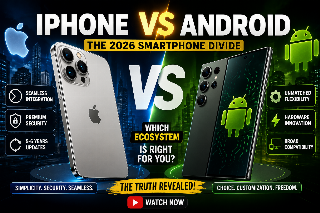
The 2026 Smartphone Divide: iPhone vs. Android Technology
Article Technology

The 2026 Smartphone Divide: iPhone vs. Android

As we move through 2026, the long-standing rivalry between iOS and Android has evolved. While both platforms are more capable and secure than ever, they serve fundamentally different philosophies: Apple’s curated ecosystem versus Android’s open-source flexibility.

Orwell, George 9 min 293

Mixed Content

Technology
Article Technology

The Post-Automation Economy: Architecting Human Skill Premiums in the Age of Autonomy

The rapid proliferation of agentic workflows and large action models is structurally inverting the traditional corporate skill pyramid. While routine analytical processes and information retrieval tasks are being automated into low-cost utility, uncommoditizable human traits—emotional intelligence, strategic ambiguity management, and ethical governance—are commanding an unprecedented value premium. Succeeding in the post-automation enterprise requires re-engineering workforce development to focu

Mutwassim 3 min 72
The Decline of Friction: Inside the FinTech Revolution in Cross-Border Settlement and Digital Identity Technology
Article Technology

The Decline of Friction: Inside the FinTech Revolution in Cross-Border Settlement and Digital Identity

The traditional plumbing of global finance—characterized by multi-day delays, hidden fees, and fragmented identity silo—is undergoing a profound transformation. A new generation of FinTech architectures, combining distributed ledger technology (DLT), synchronized liquidity pools, and decentralized digital passports, is enabling cross-border instant payments with near-zero friction.

Mutwassim 1 min 44
The City as a Switch: Architecting IoT Logistics for the Post-Congestion Urban Era Technology
Article Technology

The City as a Switch: Architecting IoT Logistics for the Post-Congestion Urban Era

The traditional model of urban delivery—reliant on high-emission diesel vans navigating static street grids—is creating unsustainable levels of congestion and pollution in global metros. To reclaim urban space, cities are transitioning to IoT-orchestrated logistics. This data-driven framework utilizes autonomous delivery swarms, automated micro-fulfillment centers, and dynamic digital kerb-side management to route goods with the efficiency of internet packets, transforming static streets into fl

Mutwassim 4 min 71
Beyond the Coffee Shop: How Cross-Border Employment and Sovereign Visas Are Institutionalizing Remote Work Technology
Article Technology

Beyond the Coffee Shop: How Cross-Border Employment and Sovereign Visas Are Institutionalizing Remote Work

Remote work is transitioning from an informal perk into an institutionalized pillar of international commerce. Over 60 nations have launched dedicated digital nomad visa regimes, while multi-jurisdictional compliance platforms and Employer of Record (EOR) frameworks dismantle traditional geographic barriers. As knowledge workers disperse globally, enterprises and municipal governments are formalizing policies around tax residency, permanent establishment risk, and asynchronous operational workfl

Mutwassim 3 min 71
The Death of Syntax: Inside the Shift to Intent-Driven Software Engineering Technology
Article Technology

The Death of Syntax: Inside the Shift to Intent-Driven Software Engineering

The day-to-day discipline of software engineering is undergoing its most radical abstraction leap since the transition from assembly language to high-level compilers. Generative code synthesis and deterministic reasoning engines are automating boilerplate syntax, turning software developers into systems architects. Survival in this new paradigm demands mastering intent formalization, specification design, and continuous verification.

Mutwassim 3 min 71
The Post-Visual Threat: Architecting Zero-Trust Defense Against Weaponized Deepfakes Technology
Article Technology

The Post-Visual Threat: Architecting Zero-Trust Defense Against Weaponized Deepfakes

The rapid weaponization of real-time voice cloning and synthetic video generation has transformed social engineering from opportunistic phishing into targeted executive identity emulation. High-profile incidents involving multi-million-dollar wire transfers authorized via synthetic video calls prove that sight and sound can no longer authenticate authorization. Securing modern enterprises requires an uncompromising zero-trust identity layer capable of neutralizing synthetic deception.

Mutwassim 3 min 137
Beyond the Battery: How Electric Mobility Is Forcing a Overhaul of the Global Power Grid Technology
Article Technology

Beyond the Battery: How Electric Mobility Is Forcing a Overhaul of the Global Power Grid

The global transition toward electric vehicles is no longer constrained primarily by battery chemistry or vehicle range. Instead, the real bottleneck has shifted directly to the electrical grid. As commercial fleets and passenger cars electrify at scale, utilities and city planners are racing to deploy vehicle-to-grid (V2G) bidirectional systems, AI-driven dynamic load balancers, and decentralized microgrid storage to avoid grid failure.

Mutwassim 3 min 58
Cloud 3.0: The Shift Toward Sovereign Data Architectures and Edge Computing Technology
Article Technology

Cloud 3.0: The Shift Toward Sovereign Data Architectures and Edge Computing

The architectural assumption that enterprise compute and storage should reside in a handful of centralized hyperscaler data centers is fracturing. Driven by strict cross-border data sovereignty regulations and the demand for millisecond-latency AI inference, global IT leaders are pivoting to Cloud 3.0—a model centered on distributed, locally governed, and hybrid sovereign architectures.

Mutwassim 3 min 61