




France vs Morocco Highlights: Mbappé and Dembélé Send France Into World Cup Semi-Finals

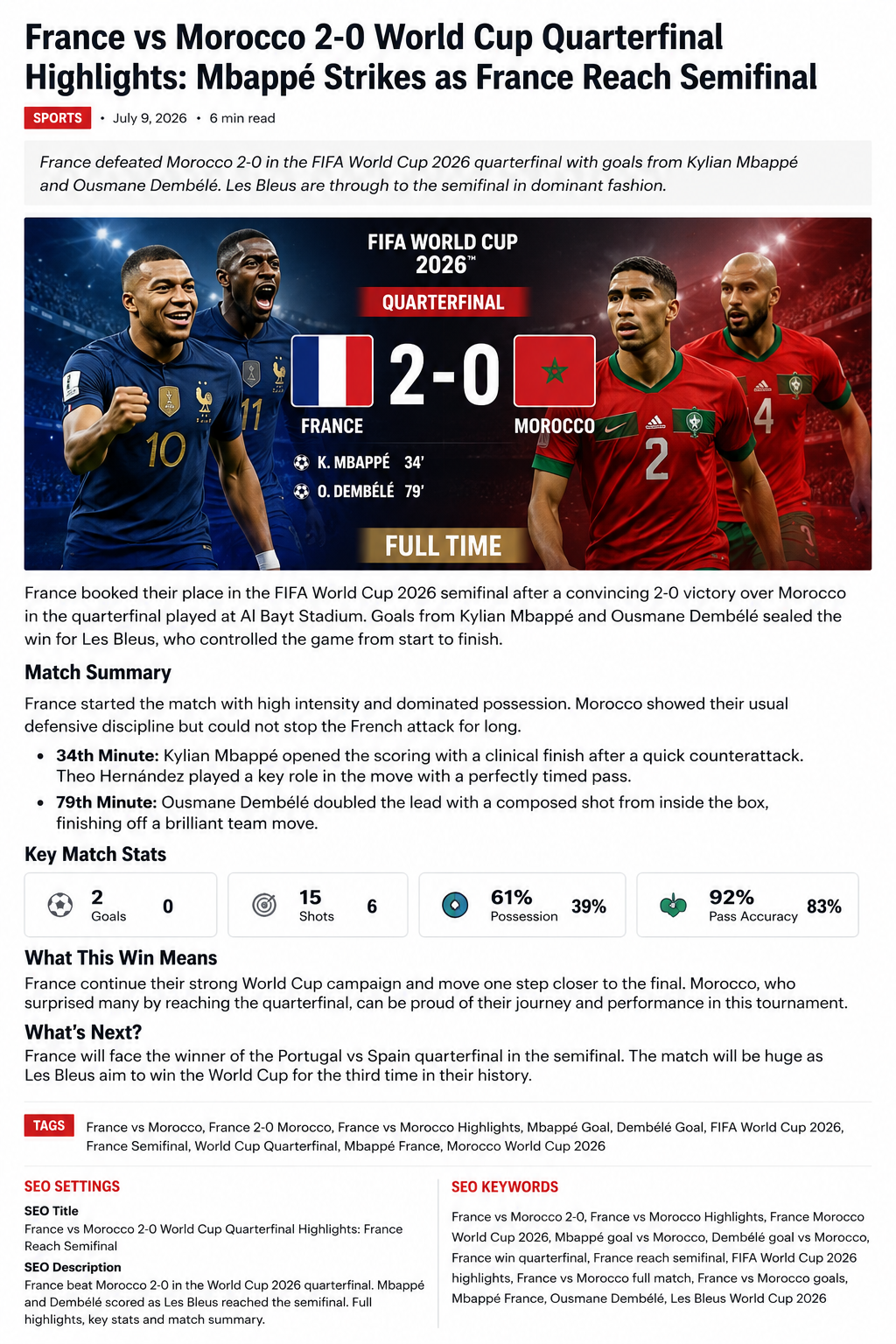
France beat Morocco 2-0 in the FIFA World Cup 2026 quarter-final, with Kylian Mbappé and Ousmane Dembélé scoring in the second half to end Morocco’s strong tournament run.

France vs Morocco Highlights: Mbappé and Dembélé Send France Into World Cup Semi-Finals

France vs Morocco Highlights: Mbappé and Dembélé Send France Into World Cup Semi-Finals

France booked their place in the FIFA World Cup 2026 semi-finals with a controlled 2-0 win over Morocco in the quarter-final at Boston Stadium. The match was tight in the first half, but France took control after the break through goals from Kylian Mbappé and Ousmane Dembélé. FIFA’s match centre listed the fixture as France vs Morocco at Boston Stadium on July 9, 2026, with Facundo Tello as referee.

For Morocco, this was the end of another emotional World Cup journey. The Atlas Lions had carried African and Arab football hopes deep into the tournament, but France’s quality in the final third proved too strong.

Match Summary

The first half was tense and cautious. France had the better attacking threat, but Morocco stayed compact and tried to keep the game alive for as long as possible. The biggest moment before half-time came when France were awarded a penalty, but Kylian Mbappé missed the chance to put his team ahead. The Guardian’s live report recorded the key first-half events as a France penalty, an Mbappé miss, and a 0-0 half-time score.

Morocco survived the first half, but they could not turn that survival into attacking momentum. France looked more dangerous after the restart, and once the first goal came, the game changed completely.

Key Moment: Mbappé Breaks the Deadlock

The breakthrough arrived in the 60th minute when Kylian Mbappé scored to make it 1-0. After missing the earlier penalty, Mbappé responded like a big-match player. His goal gave France control and forced Morocco to open up.

The Guardian listed Mbappé’s goal at the 60th minute as the moment France went 1-0 ahead. That goal also increased the pressure on Morocco, who had spent much of the match defending rather than attacking with confidence.

Dembélé Makes It 2-0

Only six minutes later, Ousmane Dembélé doubled France’s lead. He advanced through the middle and finished with a low strike from the edge of the area. Morocco goalkeeper Yassine Bounou got a hand to it, but he could not keep it out. The Guardian described the 66th-minute goal as a quick second blow that effectively decided the quarter-final.

That second goal killed Morocco’s momentum. France no longer needed to chase the game. They could manage possession, control space, and protect the lead.

Morocco’s Struggles in Attack

Morocco had shown courage and quality earlier in the tournament, but this quarter-final was different. They struggled to create clear chances and never fully tested France’s defensive structure.

The Guardian’s live coverage noted that Morocco had produced very little attacking threat by the hour mark, while France were able to take advantage once Mbappé scored. Morocco improved slightly in the final stages, including a dangerous free-kick situation and late pressure, but it was not enough to seriously threaten France’s lead.

France’s Big Strength: Tournament Control

France did not need to play their most beautiful football to win this match. That is what makes them dangerous. They were patient, disciplined, and clinical when the chances came.

Reuters reported that France coach Didier Deschamps praised his team’s belief after the win and highlighted their discipline, composure, and ability to deal with expectations. The victory also sent France into another major semi-final under Deschamps.

France’s squad depth also stood out. Even when the match was tense, they had players who could change the rhythm and punish Morocco quickly.

Mbappé Injury Concern

There was a small concern for France when Mbappé appeared to suffer an ankle knock later in the match. The Guardian reported that he left the field after going down and was later seen with an icepack, though he was able to celebrate with the squad afterward.

For France, Mbappé’s fitness will be one of the biggest talking points before the semi-final. He remains their most dangerous player and one of the biggest stars of the tournament.

What This Result Means

France are now through to the semi-finals and will face either Spain or Belgium. Al Jazeera reported that France’s 2-0 win over Morocco sent them into the World Cup semi-final, with their next opponent coming from Spain vs Belgium.

For Morocco, the defeat is painful, but their tournament should still be respected. Reaching the quarter-final of a World Cup is a major achievement, and they remain one of the strongest football stories outside Europe and South America.

Final Verdict

France vs Morocco was not a goal-fest, but it was a strong knockout performance from France. Morocco defended well for long periods, but France had the match-winners.

Mbappé recovered from a missed penalty to score the opener, Dembélé added the second, and France managed the rest of the match professionally. The 2-0 result shows why France remain one of the strongest contenders to win the World Cup.


Quick Summary

France beat Morocco 2-0 in the FIFA World Cup 2026 quarter-final, with Kylian Mbappé and Ousmane Dembélé scoring in the second half to end Morocco’s strong tournament run.

Quick Facts

Category: Sports
Published: July 10, 2026
Updated: September 26, 2026
Reading time: 5 min
31 views
Updated Sep 26, 2026 5 min read

Related Articles

View all

Popular

View all

Mixed Content

Sports
Article Sports

The Post-Automation Economy: Architecting Human Skill Premiums in the Age of Autonomy

The rapid proliferation of agentic workflows and large action models is structurally inverting the traditional corporate skill pyramid. While routine analytical processes and information retrieval tasks are being automated into low-cost utility, uncommoditizable human traits—emotional intelligence, strategic ambiguity management, and ethical governance—are commanding an unprecedented value premium. Succeeding in the post-automation enterprise requires re-engineering workforce development to focu

Mutwassim 3 min 72
The Decline of Friction: Inside the FinTech Revolution in Cross-Border Settlement and Digital Identity Sports
Article Sports

The Decline of Friction: Inside the FinTech Revolution in Cross-Border Settlement and Digital Identity

The traditional plumbing of global finance—characterized by multi-day delays, hidden fees, and fragmented identity silo—is undergoing a profound transformation. A new generation of FinTech architectures, combining distributed ledger technology (DLT), synchronized liquidity pools, and decentralized digital passports, is enabling cross-border instant payments with near-zero friction.

Mutwassim 1 min 44
The City as a Switch: Architecting IoT Logistics for the Post-Congestion Urban Era Sports
Article Sports

The City as a Switch: Architecting IoT Logistics for the Post-Congestion Urban Era

The traditional model of urban delivery—reliant on high-emission diesel vans navigating static street grids—is creating unsustainable levels of congestion and pollution in global metros. To reclaim urban space, cities are transitioning to IoT-orchestrated logistics. This data-driven framework utilizes autonomous delivery swarms, automated micro-fulfillment centers, and dynamic digital kerb-side management to route goods with the efficiency of internet packets, transforming static streets into fl

Mutwassim 4 min 71
Beyond the Coffee Shop: How Cross-Border Employment and Sovereign Visas Are Institutionalizing Remote Work Sports
Article Sports

Beyond the Coffee Shop: How Cross-Border Employment and Sovereign Visas Are Institutionalizing Remote Work

Remote work is transitioning from an informal perk into an institutionalized pillar of international commerce. Over 60 nations have launched dedicated digital nomad visa regimes, while multi-jurisdictional compliance platforms and Employer of Record (EOR) frameworks dismantle traditional geographic barriers. As knowledge workers disperse globally, enterprises and municipal governments are formalizing policies around tax residency, permanent establishment risk, and asynchronous operational workfl

Mutwassim 3 min 71
The Death of Syntax: Inside the Shift to Intent-Driven Software Engineering Sports
Article Sports

The Death of Syntax: Inside the Shift to Intent-Driven Software Engineering

The day-to-day discipline of software engineering is undergoing its most radical abstraction leap since the transition from assembly language to high-level compilers. Generative code synthesis and deterministic reasoning engines are automating boilerplate syntax, turning software developers into systems architects. Survival in this new paradigm demands mastering intent formalization, specification design, and continuous verification.

Mutwassim 3 min 71
The Post-Visual Threat: Architecting Zero-Trust Defense Against Weaponized Deepfakes Sports
Article Sports

The Post-Visual Threat: Architecting Zero-Trust Defense Against Weaponized Deepfakes

The rapid weaponization of real-time voice cloning and synthetic video generation has transformed social engineering from opportunistic phishing into targeted executive identity emulation. High-profile incidents involving multi-million-dollar wire transfers authorized via synthetic video calls prove that sight and sound can no longer authenticate authorization. Securing modern enterprises requires an uncompromising zero-trust identity layer capable of neutralizing synthetic deception.

Mutwassim 3 min 137
Beyond the Battery: How Electric Mobility Is Forcing a Overhaul of the Global Power Grid Sports
Article Sports

Beyond the Battery: How Electric Mobility Is Forcing a Overhaul of the Global Power Grid

The global transition toward electric vehicles is no longer constrained primarily by battery chemistry or vehicle range. Instead, the real bottleneck has shifted directly to the electrical grid. As commercial fleets and passenger cars electrify at scale, utilities and city planners are racing to deploy vehicle-to-grid (V2G) bidirectional systems, AI-driven dynamic load balancers, and decentralized microgrid storage to avoid grid failure.

Mutwassim 3 min 58
Cloud 3.0: The Shift Toward Sovereign Data Architectures and Edge Computing Sports
Article Sports

Cloud 3.0: The Shift Toward Sovereign Data Architectures and Edge Computing

The architectural assumption that enterprise compute and storage should reside in a handful of centralized hyperscaler data centers is fracturing. Driven by strict cross-border data sovereignty regulations and the demand for millisecond-latency AI inference, global IT leaders are pivoting to Cloud 3.0—a model centered on distributed, locally governed, and hybrid sovereign architectures.

Mutwassim 3 min 61