





Saudi Arabia Package Visa for Pakistanis: New Travel Option Explained

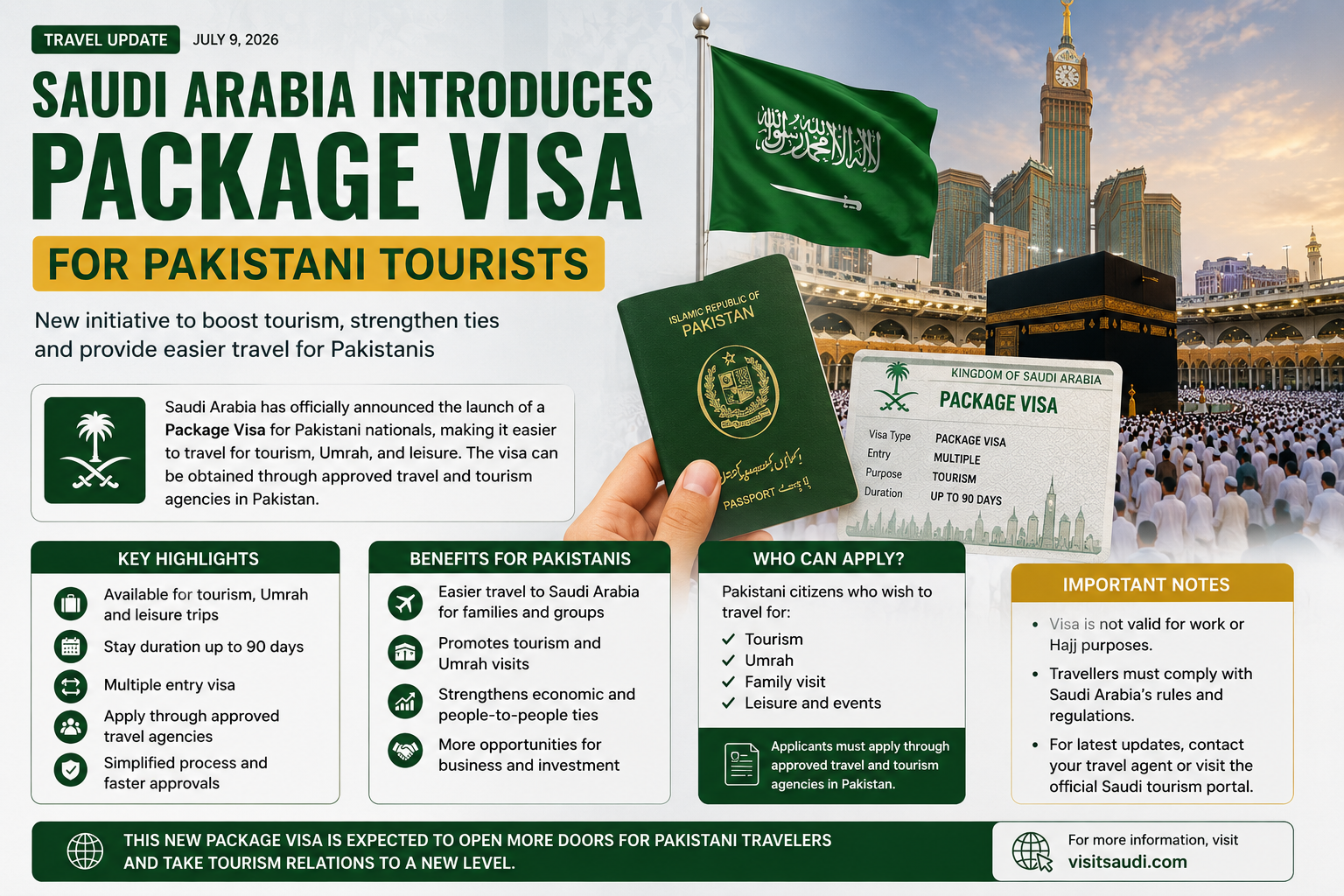
Saudi Arabia has launched a new Package Visa initiative that allows eligible Pakistani travelers to combine visa processing, flights, hotels, and tourism experiences through one travel booking.

Saudi Arabia Package Visa for Pakistanis: New Travel Option Explained

Saudi Arabia Package Visa for Pakistanis: New Travel Option Explained

Saudi Arabia has introduced a new “Package Visa” initiative to make travel easier for international visitors, including Pakistani tourists. The new system is designed to bring visa processing, flight booking, hotel accommodation, and tourism activities into one connected travel package.

For Pakistanis, this is an important update because Saudi Arabia is already one of the most visited countries for Pakistani travelers. People travel there for Umrah, Hajj, family visits, work, business, and tourism. The Package Visa now gives eligible travelers a simpler way to plan tourist trips to the Kingdom.

What Is the Saudi Package Visa?

The Saudi Package Visa is a new digital travel initiative that connects tourist visa applications directly with approved travel packages. Instead of booking a flight, hotel, activities, and visa separately, travelers can use qualified travel and tourism service providers to arrange everything in one process.

Arab News reported that the new scheme allows eligible travelers to book flights, hotels, and visas through a single process, with the option to include events, activities, and tourism experiences.

This means the visa is not being treated as a separate step at the end of the travel process. It becomes part of the full travel package from the beginning.

Why This Matters for Pakistani Travelers

Saudi Arabia is one of the most important overseas destinations for Pakistanis. Arab News reported that Pakistani travel to Saudi Arabia increased from 2.7 million in 2024 to an estimated 2.87 million in 2025.

This makes Pakistan a major market for Saudi tourism and travel services. Many Pakistanis already have strong religious, family, business, and employment links with Saudi Arabia. The Package Visa can make tourist travel easier for people who want to visit Saudi cities, cultural sites, events, and new tourism destinations.

How the Package Visa Works

The Package Visa works through qualified travel and tourism providers. These providers must meet Saudi service standards and offer proper customer support. Business Recorder reported that the initiative is being rolled out through qualified providers in selected international markets before a wider global launch.

A traveler may be able to book:

Flights

Hotel accommodation

Tourist visa processing

Events and activities

Tourism experiences

Trip planning services

The main idea is convenience. Travelers do not need to handle every part of the trip separately.

Available Through Approved Providers

The Package Visa is not available through every random travel agent. It is being made available through qualified travel and tourism service providers that meet defined service standards.

Business Recorder reported that Package Visa is available only through qualified travel and tourism service providers that meet service standards and offer 24/7 customer support.

This is important for Pakistani travelers because visa-related scams and fake travel offers are common. People should only use trusted, registered, and authorized providers when applying for any Saudi travel service.

What Can Be Included in the Package?

According to Khaleej Times, the tourist package visa can combine airfare, licensed tourist accommodation, and electronic visa processing, with the option to add experiences, events, and activities.

This means the Package Visa is not only about entering Saudi Arabia. It is about building a complete travel experience. A visitor can plan the trip, book the stay, include activities, and complete visa processing in one place.

For Pakistani tourists, this could be useful for trips to Riyadh, Jeddah, AlUla, the Red Sea region, Diriyah, Abha, and other Saudi destinations.

Is This an Umrah Visa?

The Package Visa should not be confused with an Umrah visa or Hajj visa. Current reports describe it as a tourist-focused travel package initiative. Pakistanis who are traveling specifically for Hajj or Umrah should still follow the official religious travel rules and use the proper Hajj or Umrah channels.

However, because Saudi Arabia is a major religious and tourism destination, many Pakistani travelers may be interested in understanding how this new tourist option works.

Why Saudi Arabia Is Launching This Visa

Saudi Arabia is trying to grow its tourism sector under Vision 2030. The country wants to attract more international visitors and make travel easier by using digital services and stronger private-sector partnerships.

Khaleej Times reported that the new service is part of Saudi Arabia’s wider tourism transformation and follows other travel access options such as e-tourist visas, visa on arrival, and transit visas.

The Package Visa fits into that strategy because it makes the visitor journey simpler from booking to arrival.

Benefits for Pakistanis

The biggest benefit is simplicity. Pakistani travelers may not need to manage multiple separate steps for visa, flights, hotel, and activities.

The second benefit is better planning. Since the package can include hotels and tourism activities, travelers may find it easier to estimate the total cost of the trip.

The third benefit is support. Approved providers are expected to offer customer support, which can help travelers if they face booking or visa-related issues.

The fourth benefit is tourism access. Pakistanis who want to explore Saudi Arabia beyond religious travel may find this option useful.

What Travelers Should Check Before Applying

Pakistani travelers should carefully check whether the provider is authorized, what the package includes, what is refundable, what visa conditions apply, and whether the trip is for tourism, Umrah, business, or another purpose.

They should also confirm passport validity, travel dates, hotel details, total cost, cancellation policy, and visa approval conditions before making payment.

The Package Visa is a new initiative, so details may continue to evolve as the rollout expands.

Final Verdict

Saudi Arabia’s Package Visa is a major travel update for Pakistani tourists. It simplifies the journey by combining visa processing, flights, hotels, and tourism experiences into one package through approved providers.

For Pakistanis, this can make Saudi travel easier, safer, and more organized, especially for those planning tourism-focused visits. But travelers should use only qualified providers and confirm the latest official requirements before booking.


Quick Summary

Saudi Arabia has launched a new Package Visa initiative that allows eligible Pakistani travelers to combine visa processing, flights, hotels, and tourism experiences through one travel booking.

Quick Facts

Category: Travel
Published: July 10, 2026
Updated: September 26, 2026
Reading time: 5 min
45 views
Updated Sep 26, 2026 5 min read

Related Articles

View all
17 Hidden Travel Gems Most Tourists Miss in 2026 Travel
Article Travel

17 Hidden Travel Gems Most Tourists Miss in 2026

Are you tired of fighting crowds at the world's most famous landmarks? As global tourism hits new heights in 2026, the savviest travelers are veering off the beaten path to find authenticity, serenity, and incredible value. From the rugged peaks of Central Asia to the coastal villages of the Balkans, these 17 hidden gems offer the adventure of a lifetime before the rest of the world catches on.

Joyce, James 8 min 52

Popular

View all

Mixed Content

Travel
Article Travel

The Post-Automation Economy: Architecting Human Skill Premiums in the Age of Autonomy

The rapid proliferation of agentic workflows and large action models is structurally inverting the traditional corporate skill pyramid. While routine analytical processes and information retrieval tasks are being automated into low-cost utility, uncommoditizable human traits—emotional intelligence, strategic ambiguity management, and ethical governance—are commanding an unprecedented value premium. Succeeding in the post-automation enterprise requires re-engineering workforce development to focu

Mutwassim 3 min 72
The Decline of Friction: Inside the FinTech Revolution in Cross-Border Settlement and Digital Identity Travel
Article Travel

The Decline of Friction: Inside the FinTech Revolution in Cross-Border Settlement and Digital Identity

The traditional plumbing of global finance—characterized by multi-day delays, hidden fees, and fragmented identity silo—is undergoing a profound transformation. A new generation of FinTech architectures, combining distributed ledger technology (DLT), synchronized liquidity pools, and decentralized digital passports, is enabling cross-border instant payments with near-zero friction.

Mutwassim 1 min 44
The City as a Switch: Architecting IoT Logistics for the Post-Congestion Urban Era Travel
Article Travel

The City as a Switch: Architecting IoT Logistics for the Post-Congestion Urban Era

The traditional model of urban delivery—reliant on high-emission diesel vans navigating static street grids—is creating unsustainable levels of congestion and pollution in global metros. To reclaim urban space, cities are transitioning to IoT-orchestrated logistics. This data-driven framework utilizes autonomous delivery swarms, automated micro-fulfillment centers, and dynamic digital kerb-side management to route goods with the efficiency of internet packets, transforming static streets into fl

Mutwassim 4 min 71
Beyond the Coffee Shop: How Cross-Border Employment and Sovereign Visas Are Institutionalizing Remote Work Travel
Article Travel

Beyond the Coffee Shop: How Cross-Border Employment and Sovereign Visas Are Institutionalizing Remote Work

Remote work is transitioning from an informal perk into an institutionalized pillar of international commerce. Over 60 nations have launched dedicated digital nomad visa regimes, while multi-jurisdictional compliance platforms and Employer of Record (EOR) frameworks dismantle traditional geographic barriers. As knowledge workers disperse globally, enterprises and municipal governments are formalizing policies around tax residency, permanent establishment risk, and asynchronous operational workfl

Mutwassim 3 min 71
The Death of Syntax: Inside the Shift to Intent-Driven Software Engineering Travel
Article Travel

The Death of Syntax: Inside the Shift to Intent-Driven Software Engineering

The day-to-day discipline of software engineering is undergoing its most radical abstraction leap since the transition from assembly language to high-level compilers. Generative code synthesis and deterministic reasoning engines are automating boilerplate syntax, turning software developers into systems architects. Survival in this new paradigm demands mastering intent formalization, specification design, and continuous verification.

Mutwassim 3 min 71
The Post-Visual Threat: Architecting Zero-Trust Defense Against Weaponized Deepfakes Travel
Article Travel

The Post-Visual Threat: Architecting Zero-Trust Defense Against Weaponized Deepfakes

The rapid weaponization of real-time voice cloning and synthetic video generation has transformed social engineering from opportunistic phishing into targeted executive identity emulation. High-profile incidents involving multi-million-dollar wire transfers authorized via synthetic video calls prove that sight and sound can no longer authenticate authorization. Securing modern enterprises requires an uncompromising zero-trust identity layer capable of neutralizing synthetic deception.

Mutwassim 3 min 137
Beyond the Battery: How Electric Mobility Is Forcing a Overhaul of the Global Power Grid Travel
Article Travel

Beyond the Battery: How Electric Mobility Is Forcing a Overhaul of the Global Power Grid

The global transition toward electric vehicles is no longer constrained primarily by battery chemistry or vehicle range. Instead, the real bottleneck has shifted directly to the electrical grid. As commercial fleets and passenger cars electrify at scale, utilities and city planners are racing to deploy vehicle-to-grid (V2G) bidirectional systems, AI-driven dynamic load balancers, and decentralized microgrid storage to avoid grid failure.

Mutwassim 3 min 58
Cloud 3.0: The Shift Toward Sovereign Data Architectures and Edge Computing Travel
Article Travel

Cloud 3.0: The Shift Toward Sovereign Data Architectures and Edge Computing

The architectural assumption that enterprise compute and storage should reside in a handful of centralized hyperscaler data centers is fracturing. Driven by strict cross-border data sovereignty regulations and the demand for millisecond-latency AI inference, global IT leaders are pivoting to Cloud 3.0—a model centered on distributed, locally governed, and hybrid sovereign architectures.

Mutwassim 3 min 61