




Walk into any modern household, check your monthly bank statement, or open your smartphone's app store, and you will quickly notice a profound shift in how we pay for goods and services. Gone are the days when commerce was strictly transactional—where you walked into a store, exchanged a one-time lump sum of cash for an item, and walked away owning it outright. Today, everything from your entertainment and transportation to your razor blades, pet food, and software is delivered via a continuous stream of monthly payments.
We live firmly inside the "Subscription Economy." Once restricted primarily to newspaper deliveries, magazine subscriptions, and gym memberships, the recurring revenue model has completely infiltrated virtually every consumer industry on Earth. But why has this business model experienced such explosive, unstoppable growth? Why do modern consumers happily trade ownership for access, and why are corporations rushing to convert every product into a monthly fee? Let us examine the economic, psychological, and strategic forces driving why subscription businesses keep growing.
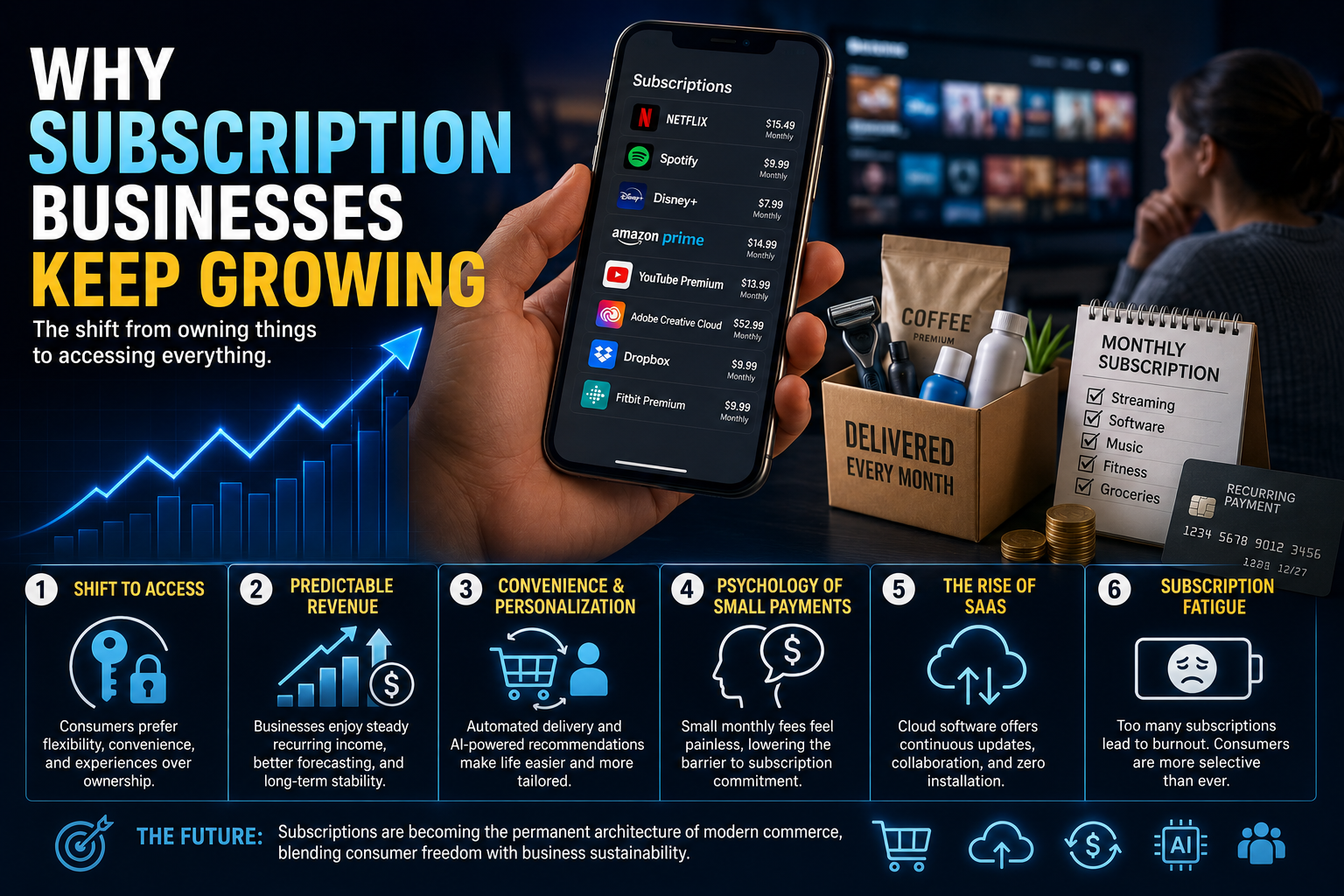
1. The Shift From Ownership to Access
For decades, consumer culture was built on accumulation. Owning physical things—CDs, DVDs, hardcover books, luxury cars, and large homes—served as status symbols and markers of adulthood. However, consumer values have undergone a massive philosophical transformation, particularly among younger generations.
Millennials and Gen Z increasingly prioritize experiences, convenience, and flexibility over physical clutter. Why spend $20 buying a single movie on Blu-ray when you can pay $15 a month to access an infinite library of thousands of movies on-demand? Why buy a $30,000 automobile when car-sharing and ride-subscription services cover maintenance, insurance, and parking? Subscriptions grant consumers the freedom of immediate access without the heavy financial burdens, depreciation, and storage nightmares of permanent ownership.
2. Predictable Recurring Revenue: The Holy Grail for Businesses
From a corporate financial standpoint, traditional retail is a stressful, volatile gamble. Every single month, a traditional business must restart its marketing efforts from scratch to convince customers to walk through the door or click "buy." If an economic downturn hits, consumer spending dries up instantly, leaving companies scrambling for survival.
Subscription models completely flip this dynamic on its head by generating predictable recurring revenue (PRR). When a business locks customers into annual or monthly contracts, revenue flows in automatically on a schedule. This financial predictability allows companies to:
- Accurately forecast cash flow months and years in advance.
- Make confident investments in long-term research, development, and expansion.
- Secure favorable financing and venture capital funding due to reliable business metrics.
- Withstand temporary market fluctuations and supply chain disruptions.
3. Frictionless Convenience and Personalization
Modern consumers are busier, more overstimulated, and more decision-fatigued than any generation in human history. We make thousands of micro-decisions every single day, leading to mental exhaustion when it comes to routine chores like grocery shopping, restocking household cleaning supplies, or picking out new clothes.
Subscription services eliminate routine friction through automated convenience. Once you set up a subscription for coffee beans, contact lenses, or razor blades, you never have to think about running out again. The items simply show up on your doorstep right when you need them. Furthermore, subscription platforms leverage advanced artificial intelligence and machine learning algorithms to personalize offerings. By tracking your viewing history, reading habits, or past purchases, services curate custom recommendations that make the user experience feel uniquely tailored to your personal tastes.
4. The Psychology of Micro-Transactions
Human psychology struggles to process cumulative financial impact when costs are broken down into small, digestible chunks. If a company tells a consumer that a specialized piece of software, cloud storage, or media library costs $600 upfront for an annual license, many customers will balk at the high sticker price and close the browser tab.
However, if that same company frames the price as "$9.99 a month," the human brain perceives it as an insignificant, painless micro-transaction—less than the cost of a single lunch. Ironically, consumers often end up paying significantly more over a multi-year period through monthly fees than they would have through a single lifetime purchase, but the psychological barrier to entry is dramatically lower.
5. The Expansion of SaaS (Software as a Service)
Perhaps the most explosive engine behind the subscription economy's rise has been the tech sector's pivot to Software as a Service (SaaS). In the past, companies bought expensive software packages on floppy disks or CDs—such as Microsoft Office or Adobe Photoshop—for hundreds of dollars. These programs became obsolete within a few years, forcing users to buy entirely new software editions.
By moving software into cloud-hosted subscription models, companies like Adobe, Microsoft, Salesforce, and Zoom transformed software into a living, breathing service. Users receive continuous cloud updates, real-time security patches, and instant collaborative features. For businesses, this means zero installation friction and seamless remote work capabilities across global teams.
6. The Looming Challenge: Subscription Fatigue
Despite its massive success, the subscription boom is encountering a growing wave of consumer pushback known as "subscription fatigue." Because virtually every industry has pivoted to recurring billing—from streaming video and music to fitness apps, gaming networks, meal kits, and smart refrigerators—monthly fees are rapidly accumulating.
When consumers audit their bank statements, they often discover they are paying for half a dozen streaming services they rarely watch, a gym membership they haven't used in months, and software apps they forgot they signed up for. As a result, consumers are becoming much more selective, frequently rotating subscriptions on and off based on current needs. This forces subscription businesses to constantly innovate, provide exceptional value, and reduce churn rates to keep customers from hitting the cancel button.
Conclusion: The Permanent Architecture of Modern Commerce
The subscription model is not a passing fad or a temporary marketing gimmick. It represents a fundamental restructuring of modern commerce built around the powerful intersection of consumer desire for flexibility and corporate need for financial stability.
As artificial intelligence, cloud infrastructure, and predictive analytics continue to evolve, subscription businesses will only become more sophisticated and deeply integrated into our daily routines. Whether subscription fatigue trims the excess or companies discover brand-new sectors to automate, recurring revenue has permanently reshaped how humanity buys, consumes, and experiences the world.