






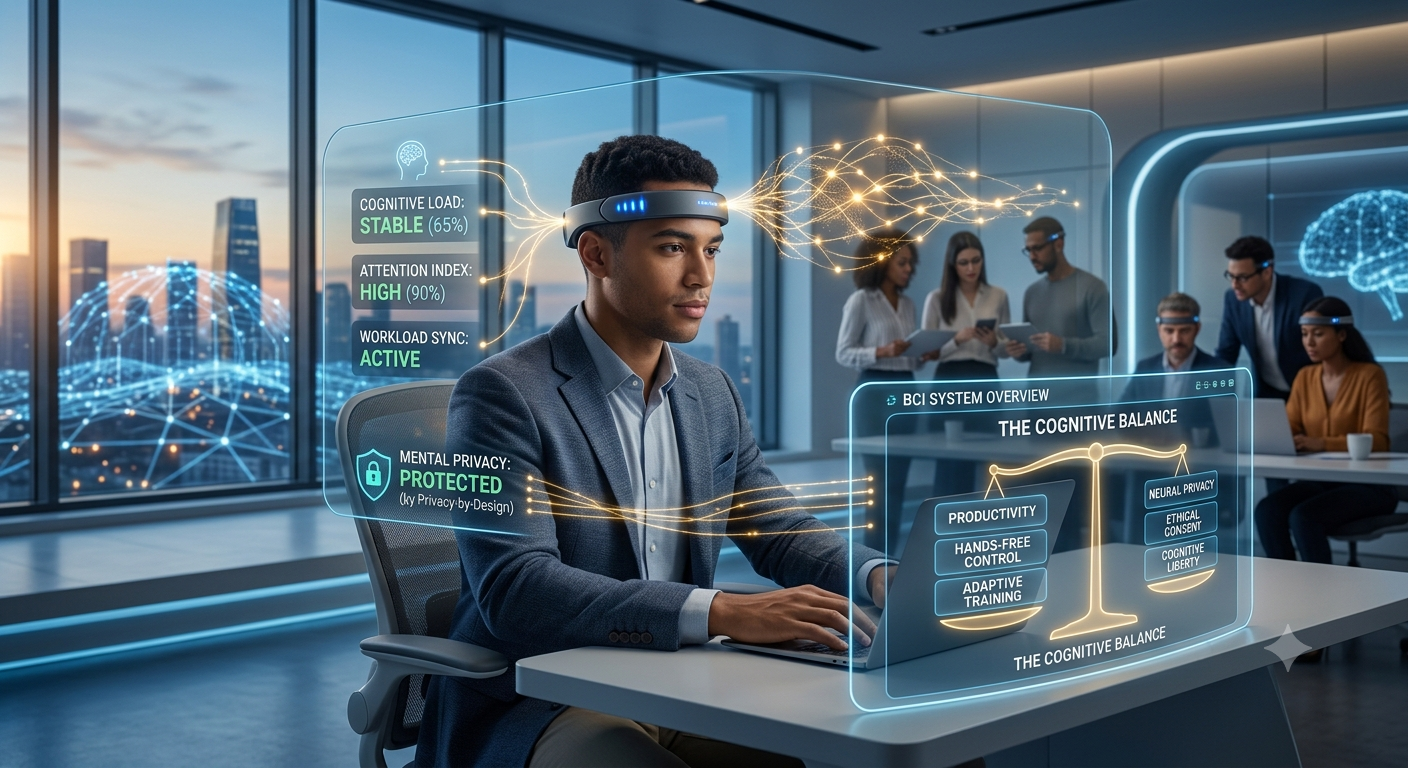
The Mind-Machine Link Moves to Work
For decades, Brain-Computer Interfaces (BCIs) were considered one of the most fascinating ideas in science fiction. The concept of controlling computers using only human thoughts seemed futuristic, with practical applications limited primarily to scientific research and advanced medical treatments. Early BCI technologies focused on helping people who had lost the ability to move or communicate due to paralysis, spinal cord injuries, or neurological disorders. By translating neural signals into digital commands, these systems enabled patients to control robotic limbs, operate computers, and even generate speech through brain activity alone.
Today, Brain-Computer Interface technology is entering an entirely new phase of development. Rapid advancements in artificial intelligence, neuroscience, wearable electronics, and signal-processing algorithms have made BCIs smaller, more accurate, and significantly more accessible. Instead of remaining confined to hospitals and research laboratories, neurotechnology is gradually moving into commercial environments where businesses are exploring new ways to improve productivity, workplace safety, employee training, and human-computer interaction.
This transition has the potential to redefine how people interact with digital systems. Rather than relying exclusively on keyboards, mice, touchscreens, or voice assistants, future professionals may interact with software directly through neural signals. However, as this technology moves closer to everyday business environments, it also introduces one of the most complex ethical challenges of the digital era: protecting the privacy of the human mind.
Understanding Brain-Computer Interfaces
A Brain-Computer Interface is a technology that creates a direct communication pathway between the human brain and an external digital device. Instead of using physical movements or spoken commands, BCIs interpret electrical signals generated by brain activity and convert them into machine-readable instructions.
Modern BCIs rely on sophisticated machine learning algorithms capable of recognizing specific patterns within neural activity. These systems continuously analyze electrical impulses produced by the brain, allowing computers to respond to a user's intentions with increasing accuracy.
While invasive BCIs require surgically implanted electrodes, recent innovation has shifted heavily toward non-invasive wearable devices. These solutions use lightweight sensors placed on the scalp or integrated into comfortable wearable products, eliminating the need for surgery while making the technology suitable for broader commercial adoption.
As sensor technology improves, wearable BCIs are becoming faster, more comfortable, and capable of supporting increasingly sophisticated workplace applications.
The Rise of Cognitive Workplaces
Businesses are beginning to explore how neurotechnology can improve efficiency without replacing human workers. Instead of automating jobs, Brain-Computer Interfaces are being designed to augment human capabilities by creating faster and more intuitive interactions with digital systems.
Modern enterprise BCIs commonly appear as smart headbands, wearable caps, specialized helmets, or even earbuds equipped with electroencephalography (EEG) sensors that measure brain activity through the scalp.
These devices continuously analyze cognitive signals and provide valuable insights into how individuals interact with complex work environments.
Dynamic Cognitive Load Management
One of the most promising commercial applications of BCIs involves monitoring cognitive workload in real time.
Many professions require sustained concentration under high levels of stress. Air traffic controllers, surgeons, emergency responders, industrial operators, pilots, and financial traders often make critical decisions where even minor lapses in attention can have serious consequences.
Brain-Computer Interfaces can detect indicators of mental fatigue, declining focus, excessive stress, or cognitive overload before human performance noticeably deteriorates.
Rather than waiting for mistakes to occur, intelligent workplace systems could automatically recommend rest breaks, temporarily redistribute workloads, or adjust task complexity based on an employee's current cognitive condition.
This proactive approach could significantly improve workplace safety while reducing human error in high-risk industries.
Hands-Free Human-Computer Interaction
Traditional computing relies on physical devices such as keyboards, mice, touchscreens, and voice assistants.
Brain-Computer Interfaces introduce an entirely new interaction model by allowing users to perform digital actions using intentional thought patterns.
Although today's commercial BCIs cannot read complex thoughts, they are becoming increasingly capable of recognizing simple neural commands.
Future professionals may be able to:
- Scroll through technical documentation without touching a keyboard.
- Navigate presentation slides mentally.
- Switch between software applications.
- Approve system notifications.
- Control robotic equipment remotely.
- Operate augmented reality interfaces.
- Interact with industrial control systems.
For workers operating in sterile environments, hazardous locations, or situations where hands-free interaction is essential, this technology could dramatically improve efficiency and accessibility.
Smarter Employee Training
Corporate learning platforms are also beginning to integrate neurotechnology into workforce development.
Traditional online training assumes that every employee learns at the same pace. Brain-Computer Interfaces offer the possibility of creating highly personalized learning experiences based on real-time cognitive feedback.
If the system detects declining attention, increasing confusion, or mental fatigue, educational software could automatically:
- Slow lesson delivery.
- Repeat difficult concepts.
- Present alternative explanations.
- Introduce interactive exercises.
- Recommend short recovery breaks.
- Measure engagement more accurately.
Rather than evaluating employees solely through final examinations, organizations could better understand how individuals learn throughout the training process, ultimately improving knowledge retention and professional development.
Improving Workplace Accessibility
Brain-Computer Interfaces also offer enormous potential for workplace inclusion.
Employees living with physical disabilities or limited mobility may benefit from alternative methods of interacting with computers and digital systems.
Instead of depending entirely on conventional input devices, BCIs could enable users to operate software, communicate with colleagues, control assistive technologies, and complete professional tasks more independently.
As accessibility becomes an increasingly important business priority, neurotechnology may help organizations create more inclusive workplaces where physical limitations present fewer barriers to employment.
The Challenge of Mental Privacy
Despite its tremendous promise, Brain-Computer Interface technology introduces a unique ethical concern rarely encountered in previous digital innovations: mental privacy.
Unlike activity logs, keyboard monitoring, or screen recordings, neural information originates directly from the human brain.
Although current BCIs cannot interpret complex thoughts or memories, they may detect patterns associated with:
- Stress levels
- Mental fatigue
- Emotional responses
- Attention levels
- Cognitive workload
- Concentration
- Possible neurological conditions
This raises difficult questions regarding who owns neural information and how it should be protected.
If employers gain access to detailed brain activity, there is a risk that cognitive metrics could eventually influence hiring decisions, promotions, performance evaluations, or workplace surveillance.
Protecting employees from inappropriate use of neural data will become increasingly important as commercial neurotechnology evolves.
Building Ethical Governance
To ensure responsible adoption, organizations must establish comprehensive governance frameworks before deploying Brain-Computer Interfaces in the workplace.
Responsible implementation should include several key principles:
Employee Consent
Participation should always remain voluntary. Employees must clearly understand what data is collected, why it is collected, and how it will be used before providing informed consent.
Privacy by Design
Wherever possible, brain signal processing should occur locally on wearable devices rather than transmitting raw neural information to centralized cloud servers.
Only anonymized performance indicators should leave the device, minimizing privacy risks.
Strict Data Protection
Neural information should receive stronger legal protection than conventional workplace analytics due to its highly personal nature.
Organizations should establish strict retention policies, encryption standards, and access controls to prevent unauthorized use.
Ethical Boundaries
Brain activity should never become a tool for routine employee surveillance or automated disciplinary decisions.
Instead, neurotechnology should be used exclusively to improve safety, accessibility, employee well-being, and productivity.
Transparent governance policies will be essential for maintaining employee trust as these systems become more common.
The Future of Brain-Computer Interfaces
Advancements in artificial intelligence, neuroscience, wearable sensors, and edge computing are expected to make Brain-Computer Interfaces significantly more capable over the coming decade.
Future systems may seamlessly integrate with virtual reality, augmented reality, robotics, autonomous vehicles, and intelligent workplace software.
Professionals could collaborate with AI systems through increasingly natural interactions, reducing dependence on traditional input devices while improving productivity across industries.
Researchers also anticipate major breakthroughs in healthcare, rehabilitation, education, and assistive technologies, where BCIs could dramatically improve quality of life for millions of people.
However, widespread adoption will ultimately depend on balancing innovation with ethical responsibility. Public trust will only grow if organizations demonstrate that neural information is treated with the highest standards of privacy, transparency, and security.
Conclusion
Brain-Computer Interfaces represent one of the most exciting frontiers in modern technology. By enabling direct communication between the human brain and digital systems, BCIs have the potential to transform workplace productivity, improve accessibility, enhance professional training, and create entirely new forms of human-computer interaction.
Yet this remarkable innovation also challenges traditional ideas of privacy, personal autonomy, and workplace governance. Unlike other forms of digital information, neural data reflects aspects of human cognition that deserve exceptional protection.
The organizations that lead the future of cognitive workplaces will not simply adopt the latest neurotechnology—they will build environments founded on transparency, voluntary participation, robust security, and ethical responsibility. As Brain-Computer Interfaces continue to evolve, their greatest success will depend not only on technological capability but also on ensuring that innovation empowers people without compromising the privacy of the human mind.