





The global economy is often perceived as a massive, heavy ship that changes course at a glacial pace. We tend to assume that the companies and sectors dominating our daily lives—automotive giants, global logistics networks, pharmaceutical conglomerates, and financial institutions—have held their unshakeable thrones for generations. We look at the Fortune 500 and assume permanence.
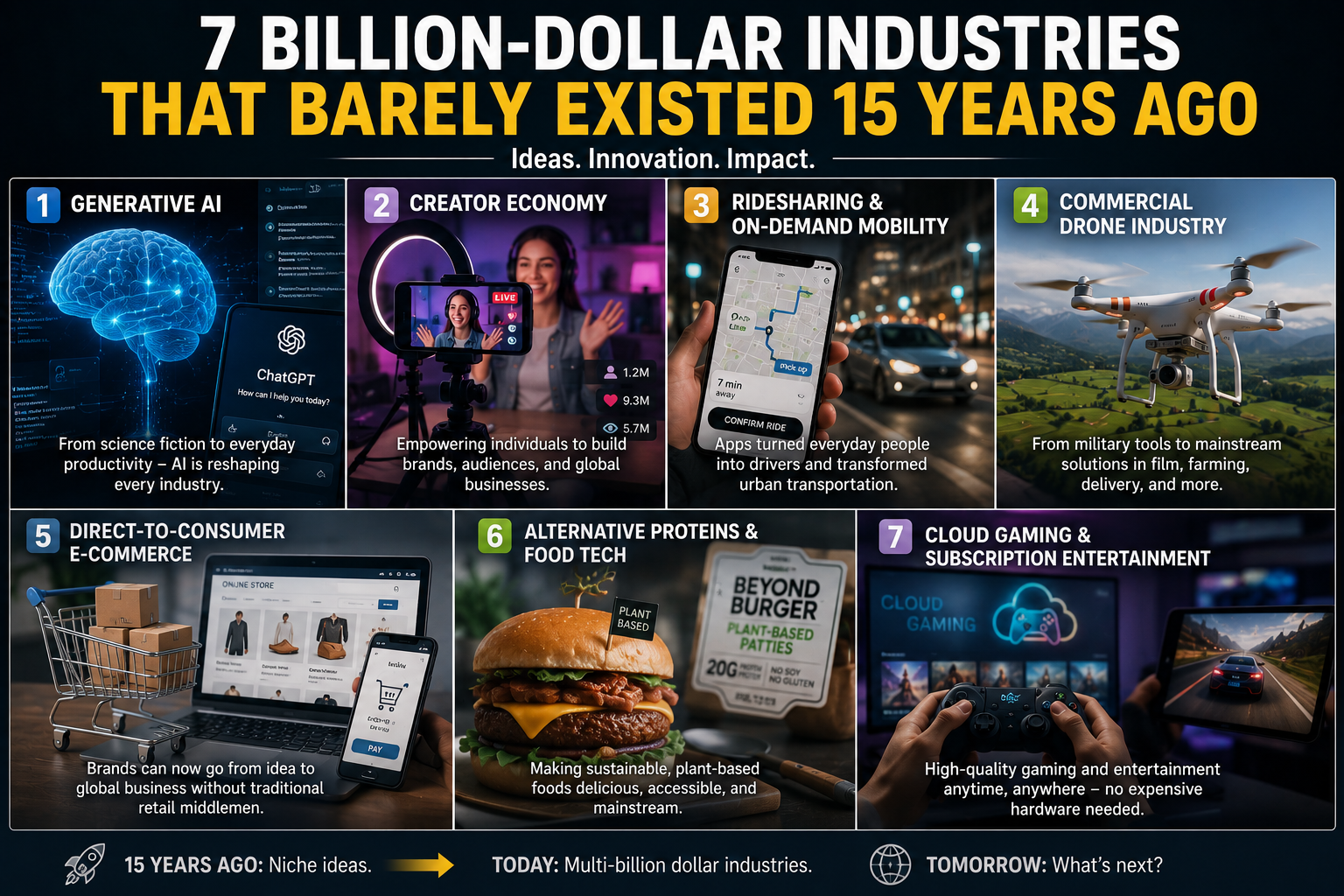
Yet, if you wind the clock back just fifteen short years, several of the most powerful, lucrative, and influential business sectors on planet Earth either did not exist at all, or were nothing more than obscure garage experiments, niche hobbies, or experimental college tech projects. The speed of modern technological innovation, coupled with shifting human behavior, has unlocked an era where entire billion-dollar empires can be built in the blink of an eye. Here are the major billion-dollar industries that barely existed 15 years ago.
1. The Generative Artificial Intelligence Sector
Fifteen years ago, artificial intelligence was primarily a subject for academic research labs, chess-playing computers, and science fiction cinema. While algorithms existed to handle basic search sorting and spam filtering, the concept of computers generating original art, writing sophisticated computer code, composing symphonies, and holding hyper-realistic conversational dialogues was decades away in the collective public imagination.
Today, generative AI is a juggernaut racing toward a multi-trillion-dollar valuation. Powered by massive leaps in neural network architecture, deep learning models, and cloud computing infrastructure, companies like OpenAI, Anthropic, Midjourney, and an army of enterprise software providers have transformed how humanity works. From automated customer support and medical drug discovery to graphic design and software development, generative AI has created an entirely new macroeconomic ecosystem almost overnight.
2. The Professional Creator Economy
Fifteen years ago, if you wanted to build a career as a video producer, broadcaster, writer, or entertainer, your path was strictly gated by traditional gatekeepers. You needed a network executive, a Hollywood studio, a publishing house, or a record label to finance your production, distribute your work, and grant you permission to reach an audience.
Today, the "Creator Economy" is a thriving global marketplace valued well over $250 billion, empowering tens of millions of independent content creators, streamers, podcasters, newsletter writers, and online educators. Platforms like YouTube, TikTok, Twitch, Substack, and Patreon built the digital infrastructure that allowed individuals to bypass traditional media conglomerates entirely. Anyone with a smartphone, an internet connection, and a unique perspective can now build a direct-to-consumer media empire, monetize through sponsorships and memberships, and employ full-scale production teams.
3. The Ridesharing and On-Demand Mobility Market
Imagine walking out of an airport fifteen years ago, standing on the curb in the rain, and trying to hail a yellow taxi by waving your arms wildly or calling a local dispatch number while praying someone picked up. The concept of pulling out a pocket glass screen, tapping a button, watching a live GPS map of a stranger driving toward you in their personal vehicle, and stepping inside without ever pulling out physical cash or a credit card was pure science fiction.
Companies like Uber and Lyft completely upended the century-old global transportation and taxi industries. By leveraging smartphone GPS integration, peer-to-peer digital matchmaking, and frictionless in-app payment processing, they spawned a multi-billion-dollar on-demand mobility market that permanently altered urban transit, delivery logistics, and part-time labor economics worldwide.
4. The Commercial Drone Industry
Fifteen years ago, unmanned aerial vehicles (UAVs) were almost exclusively high-tech military hardware utilized for classified reconnaissance and defense operations. They were multi-million-dollar machines operated by specialized military personnel on remote desert bases.
Today, commercial drones are everywhere. Driven by rapid advancements in lightweight lithium-ion battery technology, high-resolution miniature camera optics, and stable gyroscope stabilization, consumer and industrial drones have birthed a massive global market. Real estate agents use them for aerial property listings, Hollywood filmmakers capture sweeping cinematic panoramas, agricultural enterprises monitor crop health across vast farmlands, and logistics companies are experimenting with autonomous package delivery.
5. The Direct-to-Consumer (DTC) E-Commerce Revolution
Historically, launching a physical retail brand meant navigating a brutal gauntlet: convincing major big-box department store buyers to stock your products, manufacturing massive wholesale inventories, paying huge slotting fees, and watching traditional retail middlemen swallow your profit margins.
The rise of turnkey e-commerce platforms like Shopify, combined with targeted social media advertising on Facebook, Instagram, and TikTok, birthed the Direct-to-Consumer (DTC) revolution. Suddenly, boutique brands making mattresses, cosmetics, apparel, and kitchenware could bypass retail middlemen entirely. They could launch a brand from a laptop, market directly to niche consumer demographics via targeted digital ads, fulfill orders through third-party logistics networks, and scale from zero to nine figures in revenue in just a few years.
6. Alternative Proteins and Plant-Based Food Tech
Fifteen years ago, if you walked into a supermarket looking for a vegetarian burger, your options were limited to dry, crumbly hockey pucks made of compressed soy and frozen vegetables hidden away in a dusty corner of the health food aisle. They were targeted strictly at dedicated ethical vegans who were willing to compromise heavily on taste and texture.
Today, alternative protein technology is a multi-billion-dollar food science sector. Companies like Beyond Meat and Impossible Foods utilized molecular gastronomy and food engineering to analyze what makes meat taste, smell, and bleed like real beef. By breaking down plant proteins, amino acids, and coconut fats, they created plant-based burgers that sizzle on grills and line the shelves of major fast-food chains worldwide, catering to mainstream flexitarians and environmental consumers.
7. Cloud Gaming and Subscription Entertainment Services
For decades, playing high-end video games required buying an expensive physical console (like a PlayStation or Xbox) or building a high-end desktop gaming PC packed with an expensive graphics card. If your hardware couldn't handle the computing requirements of a new release, you were left out.
The proliferation of high-speed fiber-optic broadband and hyper-fast cloud server data centers gave birth to cloud gaming services like Xbox Cloud Gaming, GeForce NOW, and Amazon Luna. Instead of processing complex 3D graphics locally on your device, the heavy lifting is handled by massive remote server farms that stream the game to your screen instantly like a movie. This technology expanded the multi-billion-dollar gaming market to tablets, smartphones, and low-end laptops, democratizing high-end entertainment for billions of people.
Conclusion: The Only Constant Is Acceleration
These seven industries prove that the global business landscape is more malleable and fast-moving than ever before. What starts as a niche technological breakthrough, a clever software script, or a shift in consumer preference can rapidly scale into a multi-billion-dollar powerhouse that reshapes human culture.
As artificial intelligence, quantum computing, biotechnology, and renewable energy grids continue to mature over the next fifteen years, entirely new markets that we cannot currently fathom will emerge from the shadows. The future belongs to those who recognize the speed of innovation before the rest of the world catches up.