




Introduction
In today’s fast-moving world, productivity has become one of the most valuable skills anyone can develop. Yet despite having countless apps, digital planners, AI assistants, and automation tools, many people still end each day feeling overwhelmed and exhausted. The problem isn’t always a lack of time—it’s often a lack of energy management, poor planning, and constant distractions.
Modern workplaces expect people to multitask, respond instantly to messages, attend endless meetings, and keep up with a nonstop stream of notifications. Unfortunately, this constant switching between tasks reduces focus, increases stress, and makes even simple work feel mentally draining.
True productivity in 2026 is no longer about working longer hours or staying busy every minute of the day. Instead, it’s about working intentionally, protecting your energy, prioritizing meaningful tasks, and creating systems that help you perform at your best. Successful professionals understand that sustainable productivity comes from consistency, not burnout.
Whether you’re a student, entrepreneur, freelancer, remote worker, or office professional, adopting a few proven productivity strategies can dramatically improve your focus, reduce stress, and help you accomplish more in less time. The following methods are practical, research-backed, and easy to implement into your daily routine.
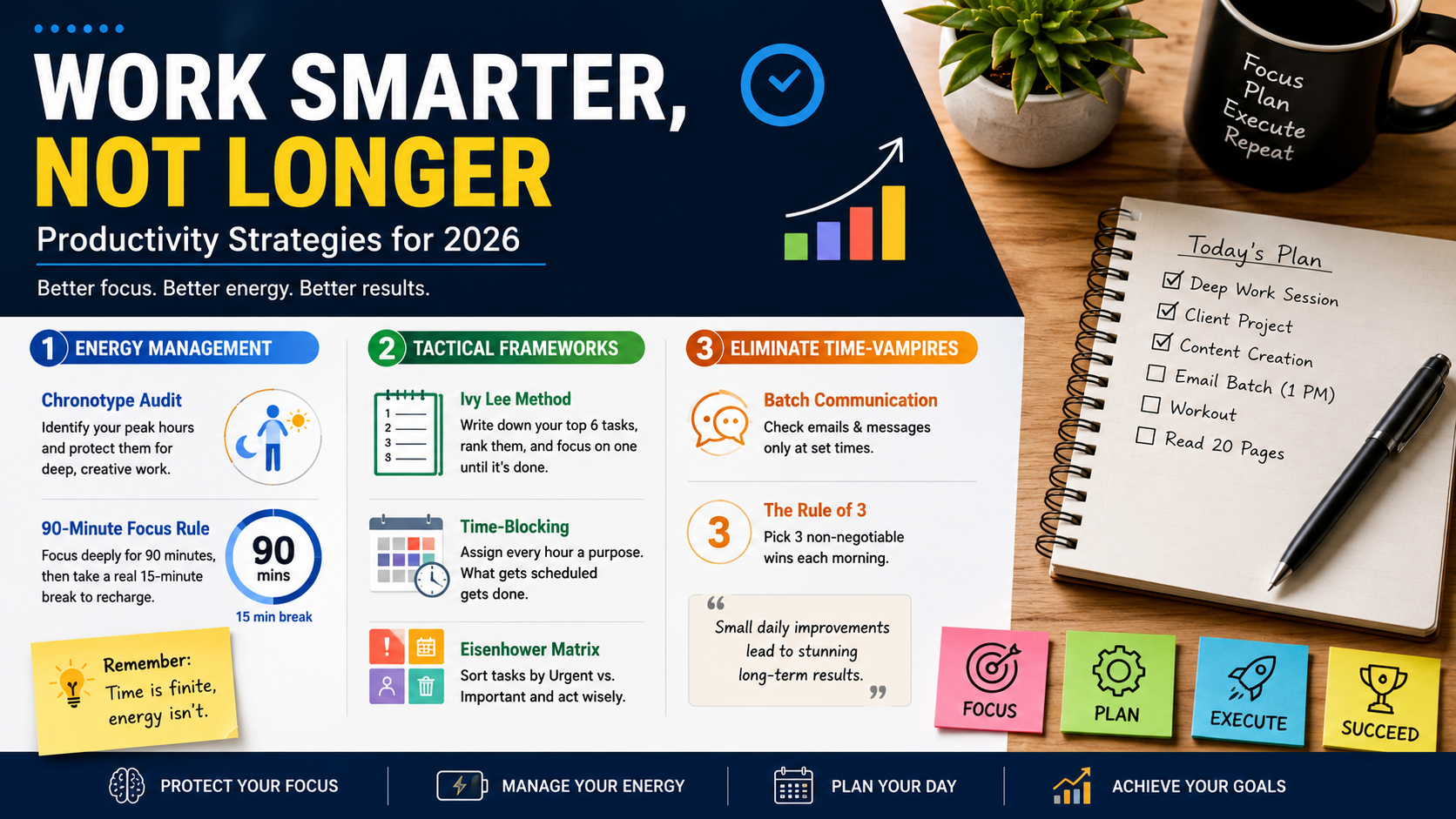
1. Energy Management Over Time Management
Most people spend their lives trying to manage time, but time is fixed. Everyone receives the same 24 hours each day. What truly changes is your energy level.
Your ability to concentrate, solve problems, and make decisions fluctuates throughout the day. Instead of forcing yourself to complete demanding work when you’re mentally exhausted, align your tasks with your natural energy patterns.
The Chronotype Audit
Every person has a unique biological rhythm known as a chronotype. Some people naturally feel most alert early in the morning, while others perform their best later in the afternoon or evening.
Spend one week observing your energy levels. Notice when you feel:
- Most creative
- Highly focused
- Physically energetic
- Easily distracted
- Mentally tired
Once you’ve identified your peak performance window, protect it from interruptions.
Use your highest-energy hours for:
- Strategic planning
- Creative writing
- Studying
- Problem-solving
- Designing projects
- Learning new skills
Reserve low-energy periods for tasks such as:
- Answering emails
- Scheduling meetings
- Organizing files
- Administrative work
- Routine paperwork
Working with your body’s natural rhythm rather than against it leads to better performance with significantly less stress.
The 90-Minute Focus Rule
Neuroscience suggests that our brains naturally work in cycles known as ultradian rhythms. Most people can maintain deep concentration for approximately 90 minutes before attention begins to decline.
Instead of forcing yourself to work continuously for several hours, divide your day into focused work sessions.
A productive cycle looks like this:
- 90 minutes of uninterrupted deep work
- 15–20 minutes of genuine rest
- Repeat throughout the day
During breaks, avoid checking social media or emails. Instead:
- Walk outside
- Stretch your body
- Drink water
- Practice deep breathing
- Rest your eyes from screens
These breaks restore mental energy and improve concentration for the next work session.
2. Tactical Frameworks for Better Execution
Working hard isn’t enough. You also need a reliable system that helps you decide what deserves your attention.
Without structure, even the busiest day can produce very little meaningful progress.
Several proven productivity frameworks help simplify decision-making and improve execution.
The Ivy Lee Method
One of the simplest yet most effective productivity systems was developed over a century ago and remains highly relevant today.
At the end of each workday:
- Write down the six most important tasks for tomorrow.
- Rank them in order of importance.
- Begin the next morning by working only on Task One.
- Don’t move to the next task until the current one is complete.
This method eliminates decision fatigue because your priorities have already been established before the day begins.
Instead of constantly wondering what to do next, your attention stays focused on meaningful work.
Time Blocking
Traditional to-do lists often become overwhelming because they don’t assign specific times for completing tasks.
Time blocking solves this problem by giving every hour of your day a purpose.
For example:
8:00–9:30 AM – Deep work
9:30–10:00 AM – Email responses
10:00–11:30 AM – Project development
11:30–12:00 PM – Meetings
1:00–2:30 PM – Research
3:00–4:00 PM – Administrative tasks
Scheduling your work creates accountability and reduces procrastination because every activity already has a designated place.
The Eisenhower Matrix
Not every urgent task is important.
The Eisenhower Matrix helps you separate meaningful work from unnecessary busyness.
Divide every task into four categories.
Do First
Tasks that are both urgent and important.
Examples include:
- Project deadlines
- Medical appointments
- Client emergencies
Schedule
Important tasks that aren’t immediately urgent.
Examples include:
- Exercise
- Learning new skills
- Strategic planning
- Long-term projects
These activities often create the greatest long-term success.
Delegate
Tasks that require attention but don’t necessarily require your personal involvement.
Whenever possible, delegate or automate them.
Eliminate
Some activities provide almost no value.
These may include:
- Endless social media scrolling
- Unnecessary meetings
- Constant notification checking
- Busy work without meaningful outcomes
Removing low-value activities creates more space for work that truly matters.
3. Eliminating Invisible Time Vampires
Many people lose hours every day without realizing where the time went.
These hidden distractions quietly reduce productivity while increasing mental fatigue.
Learning to recognize and eliminate them can dramatically improve your efficiency.
Batch Your Communication
Checking emails every few minutes feels productive, but it actually interrupts concentration.
Every interruption forces your brain to switch contexts, making it difficult to return to deep work.
Instead, designate specific communication windows.
For example:
- 9:30 AM
- 1:00 PM
- 4:30 PM
Outside these periods, close email tabs and silence unnecessary notifications.
This simple habit protects your focus while ensuring important messages still receive timely responses.
The Rule of Three
Long task lists often create anxiety because everything feels equally important.
Instead, identify only three essential accomplishments for each day.
Ask yourself:
“If I complete only three things today, what would make the biggest difference?”
These become your non-negotiable priorities.
Anything else becomes a bonus.
This strategy keeps your attention on meaningful progress rather than endless activity.
4. Reduce Decision Fatigue
Every decision consumes mental energy.
From choosing clothes to deciding what to eat, hundreds of small decisions accumulate throughout the day.
Successful people often simplify routine choices so their mental energy remains available for important work.
You can reduce decision fatigue by:
- Preparing tomorrow’s outfit the night before
- Meal prepping for the week
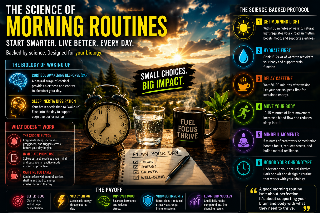
- Using a consistent morning routine
- Organizing your workspace
- Creating reusable templates
The fewer unnecessary decisions you make, the more mental capacity remains for creative thinking and problem-solving.
5. Protect Your Deep Work
Deep work refers to periods of uninterrupted concentration where you produce your highest-quality work.
Unfortunately, notifications, meetings, and multitasking constantly interrupt these valuable sessions.
Create an environment that supports focus.
During deep work:
- Turn your phone on silent.
- Close unnecessary browser tabs.
- Disable notifications.
- Wear noise-canceling headphones if needed.
- Inform coworkers that you’re unavailable for interruptions.
Even one uninterrupted hour of focused work often produces better results than three distracted hours.
6. Build Healthy Productivity Habits
Productivity isn’t only about work.
Your physical health directly affects your mental performance.
Simple habits such as:
- Drinking enough water
- Sleeping seven to nine hours
- Exercising regularly
- Eating balanced meals
- Taking walking breaks
all contribute to higher energy and improved concentration.
Ignoring your health eventually reduces productivity regardless of how well your schedule is organized.
7. Review Your Progress Weekly
Many people plan every day but rarely evaluate their progress.
Set aside 20 to 30 minutes every week to reflect.
Ask yourself:
- What went well?
- What distracted me?
- Which tasks created the biggest results?
- What should I improve next week?
Regular reflection helps you refine your productivity system instead of repeating ineffective habits.
Conclusion
Mastering productivity in 2026 isn’t about squeezing more work into every hour. It’s about using your energy wisely, protecting your attention, prioritizing meaningful tasks, and building systems that make success sustainable.
By understanding your natural energy cycles, using frameworks like the Ivy Lee Method, Time Blocking, and the Eisenhower Matrix, eliminating invisible distractions, batching communication, focusing on your top three priorities, reducing decision fatigue, protecting deep work, maintaining healthy habits, and reviewing your progress consistently, you can accomplish more while experiencing less stress.
Remember, productivity isn’t measured by how busy you appear. It’s measured by the value you create, the goals you achieve, and the balance you maintain. Small improvements practiced consistently will always outperform occasional bursts of extreme effort.
The most productive people aren’t those who work the longest—they’re the ones who work with intention, protect their energy, and focus on what truly matters every single day.