





Artificial intelligence is moving beyond systems that only answer questions. A new generation of AI systems can now plan tasks, choose tools, take actions, evaluate results, and continue working until a goal is completed.
These systems are called AI agents.
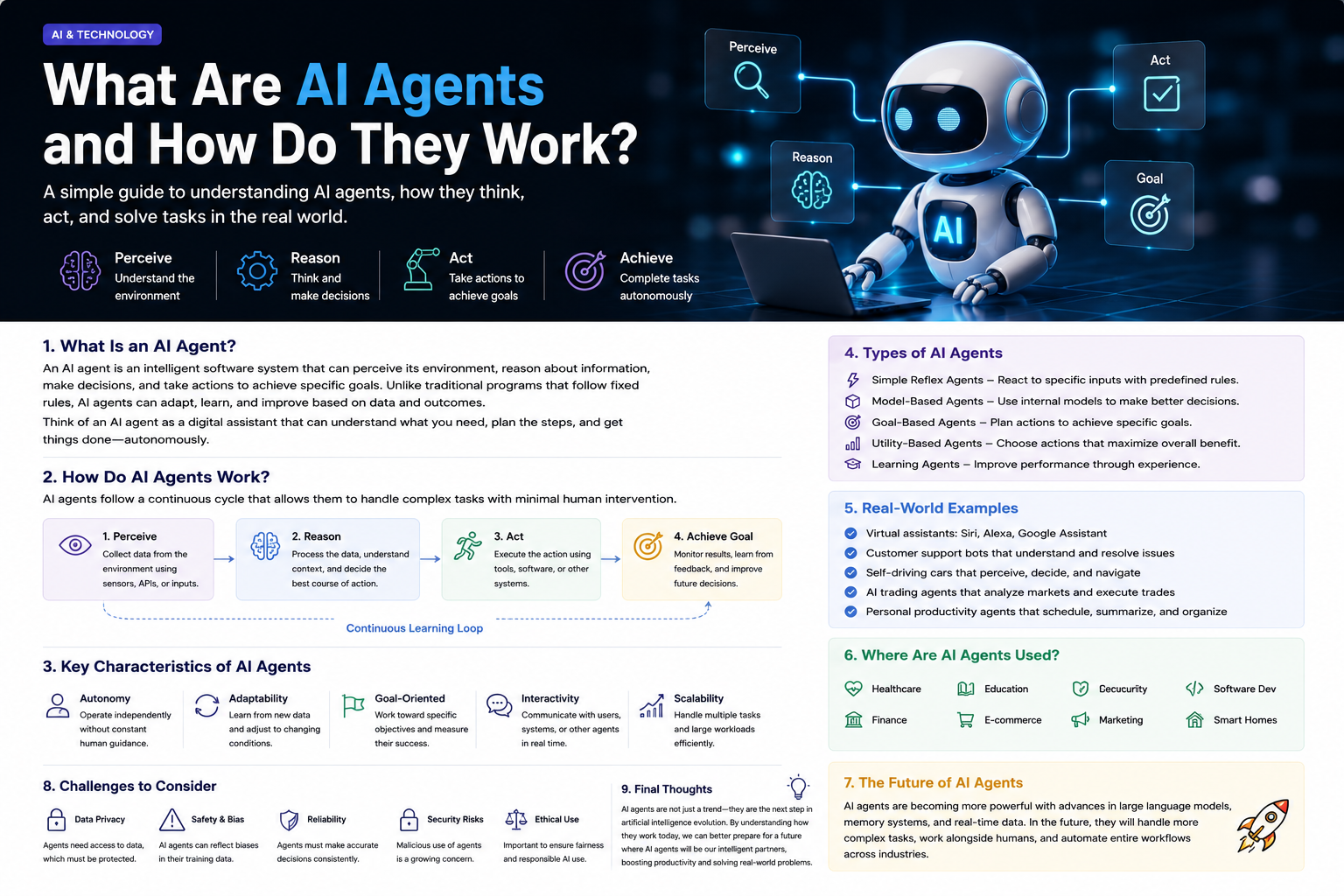
An AI agent can be understood as software that uses artificial intelligence to pursue a goal and complete tasks on behalf of a user. Unlike a traditional chatbot that mainly responds to prompts, an agent can decide what steps are needed, use available tools, and perform actions with a degree of independence. Google describes AI agents as software systems that pursue goals using reasoning, planning, memory, and autonomous decision-making, while OpenAI describes agents as applications that plan, call tools, collaborate, and maintain enough state to complete multi-step work.
A Simple Example of an AI Agent
Imagine asking an ordinary chatbot:
“Find me a suitable hotel in Paris.”
The chatbot may give you a list of hotels based on the information it already has or finds through search.
Now imagine asking an AI agent:
“Find a highly rated hotel in Paris near the Eiffel Tower, compare the prices for my dates, check my calendar, and prepare the best option for approval.”
The agent may:
- Check the travel dates.
- Search hotel websites.
- Compare prices and ratings.
- Filter hotels according to your requirements.
- check your calendar.
- Prepare a recommendation.
- Ask for approval before booking.
The important difference is that the agent does not only produce an answer. It works through a sequence of actions to achieve a goal.
How Does an AI Agent Work?
Most AI agents operate through a repeating cycle. The exact architecture differs between systems, but the general process includes receiving a goal, understanding the environment, planning, using tools, taking action, checking the result, and continuing until the task is finished.
Step 1: The Agent Receives a Goal
The process begins when a user or another system gives the agent an objective.
Examples include:
“Research five competitors and prepare a report.”
“Reply to simple customer support requests.”
“Find available meeting times and schedule a call.”
“Review this software project and identify bugs.”
“Monitor security alerts and prepare an incident summary.”
The goal may be simple or may require many connected tasks.
Step 2: The Agent Understands the Task
The AI model analyzes the request and identifies what needs to be done.
It may determine:
What information is required
Which tools are available
Which actions need approval
What order the steps should follow
What rules or restrictions must be respected
This reasoning stage helps the agent turn a broad request into smaller tasks.
Step 3: The Agent Creates a Plan
The agent creates a plan for reaching the goal.
For example, a research agent may decide to:
Search for reliable sources
Collect relevant information
Compare conflicting claims
Organize the findings
Write a summary
Check whether the report answers the original question
OpenAI’s practical guide explains that agents combine models, tools, and instructions, allowing the system to manage a workflow and decide how to complete the task.
Step 4: The Agent Uses Tools
Tools are what allow an AI agent to move beyond conversation.
An agent may be given access to:
Web search
Calendar
Databases
Spreadsheets
Business software
Code execution
File storage
Customer relationship management systems
Payment platforms
APIs
A model alone can suggest what should happen. An agent with tools may be able to perform the action.
Anthropic notes that an agent’s effectiveness depends heavily on the tools it is given and how clearly those tools are designed.
Step 5: The Agent Takes Action
After selecting a tool, the agent performs an action.
It may:
Search a database
Read a file
Send an email
Update a spreadsheet
Create a support ticket
Run code
Schedule a meeting
Generate a report
Request approval
The amount of autonomy depends on how the system is designed. Some agents may act independently, while others must request human approval before sensitive actions.
Step 6: The Agent Evaluates the Result
A useful agent does not simply take one action and stop. It checks whether the result moved it closer to the goal.
For example, if a search returns weak results, the agent may change the search query. If code fails, it may inspect the error and try a different solution. If information is incomplete, it may ask the user for clarification.
This repeated process is sometimes called an agent loop.
The loop may look like this:
Goal → Plan → Use Tool → Take Action → Check Result → Continue or Finish
Step 7: The Agent Completes the Task
The agent stops when it believes the goal has been achieved, a defined limit has been reached, or human input is required.
It may then provide:
A final answer
A completed report
A list of actions taken
A recommendation
A request for approval
A record of any unresolved issues
Main Components of an AI Agent
An effective AI agent usually contains several connected components.
The AI Model
The model acts as the reasoning engine or “brain” of the agent. It interprets instructions, decides what to do, and generates responses.
Large language models are commonly used because they can understand natural language, reason across information, and interact with tools.
Instructions
Instructions define the agent’s role, goals, rules, and boundaries.
For example, a customer service agent may be instructed to resolve basic issues but transfer refund disputes to a human employee.
Clear instructions help prevent the agent from taking actions outside its intended purpose.
Tools
Tools allow the agent to interact with external systems.
Without tools, the agent may only be able to explain what should be done. With tools, it may be able to complete the task.
Memory and State
Memory helps the agent retain relevant information across a task or multiple interactions.
This may include:
Previous user preferences
Completed steps
Search results
Tool outputs
Conversation history
Unresolved tasks
State is especially important for long-running workflows. Google has demonstrated agents that can pause for days, resume when an external event occurs, and continue without losing workflow context.
Guardrails
Guardrails limit what an agent can do.
They may require approval before:
Sending money
Deleting files
Publishing content
Changing business records
Sending external messages
Accessing sensitive information
Guardrails are necessary because AI models can make mistakes, misunderstand instructions, or produce incorrect information.
AI Agents vs Chatbots
Chatbots and AI agents are related, but they are not the same.
A chatbot is usually reactive. It responds when a user asks a question.
An AI agent is goal-oriented. It can decide what actions are required and continue working through several steps.
A chatbot might explain how to schedule a meeting.
An AI agent might check calendars, find a suitable time, create the event, invite participants, and send reminders.
IBM describes AI assistants as primarily reactive, while AI agents are more proactive and autonomous in pursuing a specific goal.
AI Agents vs Traditional Automation
Traditional automation follows fixed rules.
For example:
If a customer submits a form, send a confirmation email.
This works well when the process is predictable.
An AI agent can handle situations where the next action is not always known in advance. It can interpret context, choose from multiple tools, and adapt its plan based on new information.
Traditional automation follows a predefined path.
An AI agent can choose the path.
However, traditional automation is often more reliable for simple, repetitive tasks. Anthropic recommends using the simplest solution that works and avoiding complex agents when a fixed workflow is sufficient.
Types of AI Agents
AI agents can be organized in several ways depending on their complexity and purpose.
Simple Reflex Agents
A simple reflex agent responds to the current situation using predefined rules.
For example, a thermostat may turn on cooling when the temperature becomes too high.
These agents do not usually plan far ahead or maintain detailed memory.
Model-Based Agents
Model-based agents maintain an internal understanding of their environment.
They use this internal model to make decisions even when they cannot directly observe every detail.
Goal-Based Agents
Goal-based agents evaluate actions according to whether they help achieve a specific goal.
For example, a navigation agent may compare different routes and choose the one most likely to reach the destination efficiently.
Utility-Based Agents
Utility-based agents compare possible results and select the option with the highest expected value.
They may balance factors such as cost, speed, risk, quality, and user preference.
Learning Agents
Learning agents improve based on experience, feedback, or new information.
IBM identifies simple reflex, model-based reflex, goal-based, utility-based, and learning agents as five commonly discussed AI-agent categories.
What Is a Multi-Agent System?
A multi-agent system uses several specialized agents that work together.
For example, a content production system may include:
A research agent
A fact-checking agent
A writing agent
An SEO agent
An editing agent
Each agent handles a specific part of the task, while an orchestrator coordinates the overall workflow.
Google’s Agent2Agent protocol was introduced to help agents communicate, share information, and coordinate work across different systems.
Multi-agent systems can handle complex tasks, but they are also harder to design, monitor, and control.
Real-World Uses of AI Agents
AI agents are already being developed for many industries.
Customer Service
Customer service agents can understand customer questions, search company information, respond to routine requests, update tickets, and escalate difficult cases to human staff.
IBM notes that customer service agents can resolve tickets, communicate with customers, analyze information, and escalate complex issues.
Software Development
Coding agents can:
Read code
Identify bugs
Write tests
Suggest fixes
Run commands
Review pull requests
Update documentation
Some advanced coding agents can continue working across multiple files and tools.
Research
Research agents can search multiple sources, organize findings, compare information, and prepare reports.
They can reduce the time required for repetitive research, but their findings must still be reviewed for accuracy.
Business Operations
Agents can support:
Invoice processing
Employee onboarding
Supply-chain planning
Sales research
Meeting scheduling
Document preparation
Internal reporting
Google has highlighted workplace uses ranging from ordering employee laptops to supporting customer service and supply-chain planning.
Cybersecurity
Security agents can monitor alerts, collect evidence, enrich threat information, summarize incidents, and recommend actions.
Because security decisions can have serious consequences, human approval and strict guardrails are especially important.
Personal Productivity
Personal agents may help users:
Manage schedules
Organize email
Plan travel
Track tasks
Research purchases
Prepare documents
Coordinate reminders
These systems may become more useful as they gain secure access to more personal tools.
Benefits of AI Agents
AI agents can provide several important benefits.
They can automate multi-step work.
They can operate across different tools.
They can reduce repetitive manual tasks.
They can adapt when conditions change.
They can work continuously.
They can help people focus on higher-value decisions.
They can support personalized services at scale.
The biggest advantage is not simply faster text generation. It is the ability to connect reasoning with action.
Risks and Limitations of AI Agents
AI agents are powerful, but they also introduce serious risks.
Incorrect Decisions
An AI agent may misunderstand the goal, use unreliable information, or choose the wrong action.
If the agent has access to important systems, one mistake can affect real data, customers, or business operations.
Hallucinations
AI models can generate confident but incorrect information. If an agent treats that information as fact, it may take the wrong action.
Security Risks
Agents may be exposed to malicious instructions, unsafe websites, compromised tools, or prompt-injection attacks.
They may also have access to sensitive information that must be protected.
Excessive Autonomy
Giving an agent too much authority can be dangerous.
Important actions should require human approval, especially when they involve money, legal decisions, sensitive data, system access, or public communication.
Lack of Transparency
Complex agents may take many steps across several tools. Organizations need logs and monitoring so humans can understand what the agent did and why.
Cost and Reliability
Agents may repeatedly call models and tools, which can increase cost and processing time.
They may also fail when an external service becomes unavailable or a tool returns unexpected information.
Are AI Agents Fully Autonomous?
Most current AI agents are not completely autonomous in the science-fiction sense.
They usually operate within:
A defined goal
A limited set of tools
Specific instructions
Security permissions
Usage limits
Human approval rules
A well-designed agent should know when to continue independently and when to ask a human for help.
Will AI Agents Replace Human Workers?
AI agents are more likely to change tasks than instantly replace every profession.
They can take over repetitive activities, prepare first drafts, search information, and coordinate workflows. But humans are still needed for judgment, responsibility, creativity, empathy, strategy, and decisions involving uncertainty or consequences.
The most realistic future is human-agent collaboration. People will set goals, review important decisions, and handle complex situations, while agents perform repetitive or time-consuming work.
The Future of AI Agents
AI agents are becoming more capable, connected, and specialized.
Future systems are likely to include:
Better long-term memory
Safer tool access
Stronger reasoning
More reliable planning
Better cooperation between agents
Clearer human approval controls
Deeper integration with workplace software
OpenAI, Google, Anthropic, IBM, and other technology organizations are actively developing tools and frameworks for building, coordinating, and monitoring agentic systems.
Final Verdict
AI agents are software systems that can understand goals, create plans, use tools, take actions, and evaluate results with limited supervision.
The easiest way to understand the difference is this:
A chatbot gives you an answer.
An AI agent works toward an outcome.
AI agents can improve productivity in research, customer service, software development, business operations, cybersecurity, and personal organization. But they also require careful design, secure permissions, reliable tools, human oversight, and clear guardrails.
AI agents are not perfect digital employees. They are goal-driven software systems that can handle increasingly complex work when humans give them the right tools, boundaries, and supervision.