






The Death of Syntax: Inside the Shift to Intent-Driven Software Engineering

As AI-native toolchains handle manual implementation, software engineering is shifting from writing lines of code to formalizing architectural intent.

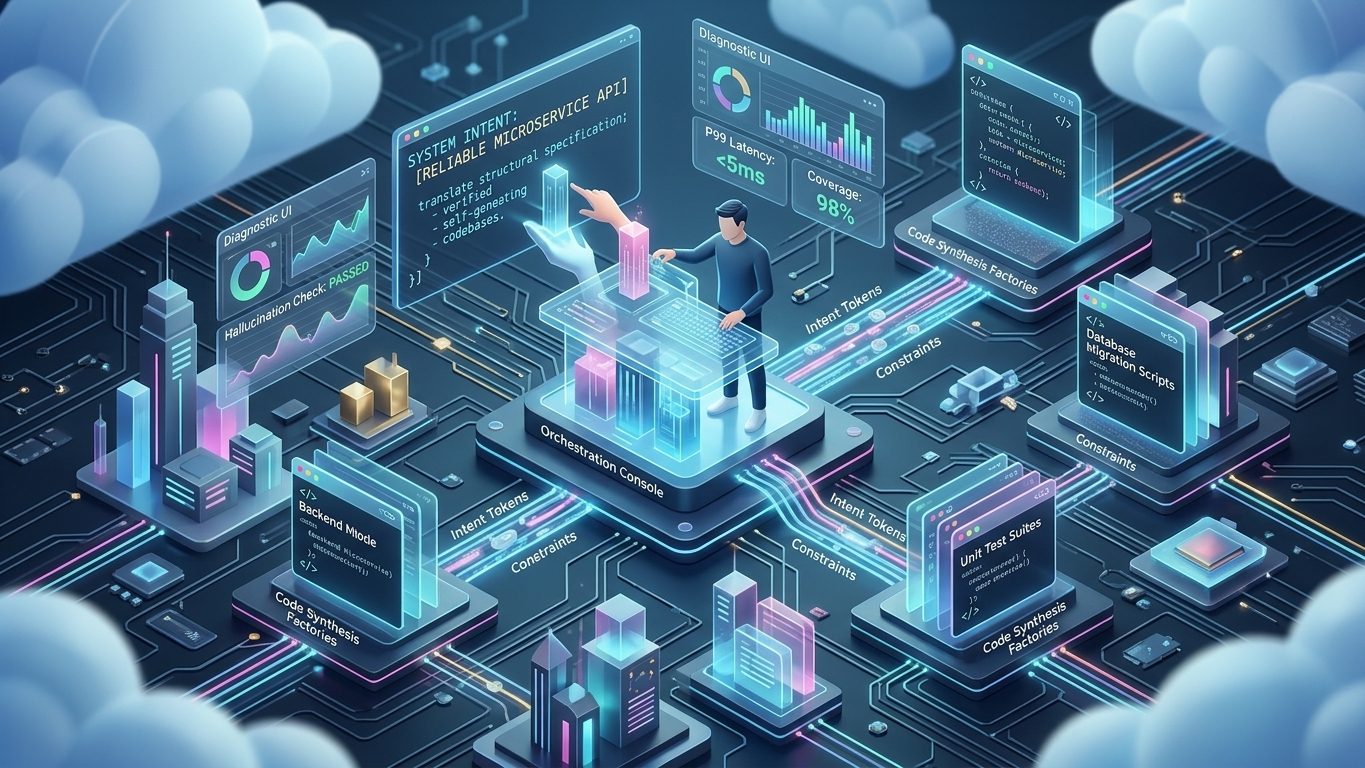
Isometric 3D rendering of an engineer orchestrating an intent-driven software canvas where high-level system diagrams compile into live backend code.
A developer orchestrating natural-language architectural specifications into verified, self-generating microservice codebases. Enterprise Software Engineering / DevTech Insights

Throughout the history of computer science, software engineering productivity has advanced through successive layers of abstraction. In the earliest days of computing, programmers manually mapped hardware registers and punched cards. The introduction of assembly language abstracted binary machine code; high-level languages like C, Java, and Python abstracted memory management and instruction pipelines; and modern cloud-native frameworks abstracted physical server infrastructure.

Today, the software industry is crossing a far more consequential threshold: the abstraction of syntax itself.

The emerging paradigm—intent-driven development (IDD)—marks the transition from manually typing boilerplate algorithms, database schemas, and API handlers to formalizing system behavior, boundaries, and business logic at a strategic level. The engineer's primary output is no longer raw source code; it is deterministic intent, verifiable specifications, and comprehensive architectural constraints.

From Auto-Complete to Autonomous Implementation

The first phase of AI-assisted engineering centered on probabilistic autocomplete—tools embedded in modern IDEs that predict the next line or block of code. While helpful, these systems operated locally, lacking broad awareness of repository architecture, cross-service dependencies, and company-wide security standards.

Intent-driven development changes this relationship entirely:

  • Declarative System Specifications: Engineers declare what the system must achieve rather than how to implement every step. An engineer specifies data schemas, performance targets (such as p99 latency thresholds), authentication models, and edge-case behaviors using structured Markdown, domain-specific languages (DSLs), or architectural diagrams.

  • Context-Aware Code Synthesis: Autonomous coding engines ingest the specification alongside existing codebase dependencies, design tokens, and CI/CD configurations, generating the underlying microservices, database migrations, and unit tests end-to-end.

  • Continuous Feedback Loops: When compilation errors, runtime exceptions, or failing integration tests emerge in sandboxed environments, the engine iteratively diagnoses the stack trace and refactors its own code without requiring manual debugging from the developer.

The Premium on Systems Architecture and Verification

As the cost of writing code approaches zero, the volume of generated code escalates exponentially. This inversion introduces a significant industry risk: software bloat, architectural drift, and subtle hallucinated vulnerabilities buried within massive, multi-repo applications.

Because syntax generation is commoditized, the software engineering skillset is aggressively shifting toward architecture, systems design, and formal verification:

  • Rigorous Specification Engineering: Ambiguous requirements produce broken software. The most critical developer skill is now the ability to write unambiguous, mathematically sound, and comprehensive specifications that leave no room for model misinterpretation.

  • Automated Guardrails and Policy-as-Code: Engineering organizations are deploying automated linters, security scanners, and formal verification engines that validate every generated pull request against zero-trust standards before execution.

  • System Observability and Traceability: With AI handling low-level plumbing, human engineers concentrate on high-level observability—monitoring distributed transaction tracing, memory profiles, database query costs, and cross-service latency degradation.

The New Role of the Software Engineer

Intent-driven engineering does not make software developers obsolete; it elevates them.

Freed from the mechanical friction of remembering framework-specific syntax, wrestling with build configurations, and wiring repetitive CRUD endpoints, developers function as technical product conductors. They translate business problems into scalable architectures, enforce system integrity, and evaluate the trade-offs between performance, reliability, and cost.

The organizations and engineers that thrive in this era will not be those who pride themselves on how quickly they can type syntax, but those who excel at critical thinking, systems thinking, and architectural rigor.


Quick Summary

The day-to-day discipline of software engineering is undergoing its most radical abstraction leap since the transition from assembly language to high-level compilers. Generative code synthesis and deterministic reasoning engines are automating boilerplate syntax, turning software developers into systems architects. Survival in this new paradigm demands mastering intent formalization, specification design, and continu...

Key Takeaways

  • Declarative System Specifications: Engineers declare what the system must achieve rather than how to implement every step. An engineer specifies data schemas, performance targets (such as p99 latency thresholds), authentication models, and edge-case behaviors using structured Markdown, domain-specific languages (DSLs), or architectural diagrams.
  • Context-Aware Code Synthesis: Autonomous coding engines ingest the specification alongside existing codebase dependencies, design tokens, and CI/CD configurations, generating the underlying microservices, database migrations, and unit tests end-to-end.
  • Continuous Feedback Loops: When compilation errors, runtime exceptions, or failing integration tests emerge in sandboxed environments, the engine iteratively diagnoses the stack trace and refactors its own code without requiring manual debugging from the developer.
  • Rigorous Specification Engineering: Ambiguous requirements produce broken software. The most critical developer skill is now the ability to write unambiguous, mathematically sound, and comprehensive specifications that leave no room for model misinterpretation.
  • Automated Guardrails and Policy-as-Code: Engineering organizations are deploying automated linters, security scanners, and formal verification engines that validate every generated pull request against zero-trust standards before execution.

Quick Facts

Category: Technology
Published: September 12, 2026
Updated: September 12, 2026
Reading time: 3 min
1 views
Updated Sep 12, 2026 3 min read

Related Articles

View all
The 2026 Smartphone Divide: iPhone vs. Android Technology
Article Technology

The 2026 Smartphone Divide: iPhone vs. Android

As we move through 2026, the long-standing rivalry between iOS and Android has evolved. While both platforms are more capable and secure than ever, they serve fundamentally different philosophies: Apple’s curated ecosystem versus Android’s open-source flexibility.

Orwell, George 9 min 266

Mixed Content

Technology
Article Technology

The Post-Automation Economy: Architecting Human Skill Premiums in the Age of Autonomy

The rapid proliferation of agentic workflows and large action models is structurally inverting the traditional corporate skill pyramid. While routine analytical processes and information retrieval tasks are being automated into low-cost utility, uncommoditizable human traits—emotional intelligence, strategic ambiguity management, and ethical governance—are commanding an unprecedented value premium. Succeeding in the post-automation enterprise requires re-engineering workforce development to focu

Mutwassim 3 min 1
The Decline of Friction: Inside the FinTech Revolution in Cross-Border Settlement and Digital Identity Technology
Article Technology

The Decline of Friction: Inside the FinTech Revolution in Cross-Border Settlement and Digital Identity

The traditional plumbing of global finance—characterized by multi-day delays, hidden fees, and fragmented identity silo—is undergoing a profound transformation. A new generation of FinTech architectures, combining distributed ledger technology (DLT), synchronized liquidity pools, and decentralized digital passports, is enabling cross-border instant payments with near-zero friction.

Mutwassim 1 min 1
The City as a Switch: Architecting IoT Logistics for the Post-Congestion Urban Era Technology
Article Technology

The City as a Switch: Architecting IoT Logistics for the Post-Congestion Urban Era

The traditional model of urban delivery—reliant on high-emission diesel vans navigating static street grids—is creating unsustainable levels of congestion and pollution in global metros. To reclaim urban space, cities are transitioning to IoT-orchestrated logistics. This data-driven framework utilizes autonomous delivery swarms, automated micro-fulfillment centers, and dynamic digital kerb-side management to route goods with the efficiency of internet packets, transforming static streets into fl

Mutwassim 4 min 1
Beyond the Coffee Shop: How Cross-Border Employment and Sovereign Visas Are Institutionalizing Remote Work Technology
Article Technology

Beyond the Coffee Shop: How Cross-Border Employment and Sovereign Visas Are Institutionalizing Remote Work

Remote work is transitioning from an informal perk into an institutionalized pillar of international commerce. Over 60 nations have launched dedicated digital nomad visa regimes, while multi-jurisdictional compliance platforms and Employer of Record (EOR) frameworks dismantle traditional geographic barriers. As knowledge workers disperse globally, enterprises and municipal governments are formalizing policies around tax residency, permanent establishment risk, and asynchronous operational workfl

Mutwassim 3 min 1
The Post-Visual Threat: Architecting Zero-Trust Defense Against Weaponized Deepfakes Technology
Article Technology

The Post-Visual Threat: Architecting Zero-Trust Defense Against Weaponized Deepfakes

The rapid weaponization of real-time voice cloning and synthetic video generation has transformed social engineering from opportunistic phishing into targeted executive identity emulation. High-profile incidents involving multi-million-dollar wire transfers authorized via synthetic video calls prove that sight and sound can no longer authenticate authorization. Securing modern enterprises requires an uncompromising zero-trust identity layer capable of neutralizing synthetic deception.

Mutwassim 3 min 13
Beyond the Battery: How Electric Mobility Is Forcing a Overhaul of the Global Power Grid Technology
Article Technology

Beyond the Battery: How Electric Mobility Is Forcing a Overhaul of the Global Power Grid

The global transition toward electric vehicles is no longer constrained primarily by battery chemistry or vehicle range. Instead, the real bottleneck has shifted directly to the electrical grid. As commercial fleets and passenger cars electrify at scale, utilities and city planners are racing to deploy vehicle-to-grid (V2G) bidirectional systems, AI-driven dynamic load balancers, and decentralized microgrid storage to avoid grid failure.

Mutwassim 3 min 20
Cloud 3.0: The Shift Toward Sovereign Data Architectures and Edge Computing Technology
Article Technology

Cloud 3.0: The Shift Toward Sovereign Data Architectures and Edge Computing

The architectural assumption that enterprise compute and storage should reside in a handful of centralized hyperscaler data centers is fracturing. Driven by strict cross-border data sovereignty regulations and the demand for millisecond-latency AI inference, global IT leaders are pivoting to Cloud 3.0—a model centered on distributed, locally governed, and hybrid sovereign architectures.

Mutwassim 3 min 23
Beyond Offshoring: The Strategic Pivot to Multi-Hub Sourcing and Nearshore Resilience Technology
Article Technology

Beyond Offshoring: The Strategic Pivot to Multi-Hub Sourcing and Nearshore Resilience

The era of hyper-optimized, single-country manufacturing has come to an end. Faced with regulatory friction, geopolitical realignment, and maritime chokepoint vulnerabilities, global corporations are trading the narrow margins of ultra-lean offshoring for redundant, regionalized production networks. This strategic decoupling is fundamentally rewriting global trade routes and capital expenditure priorities.

Mutwassim 3 min 18