






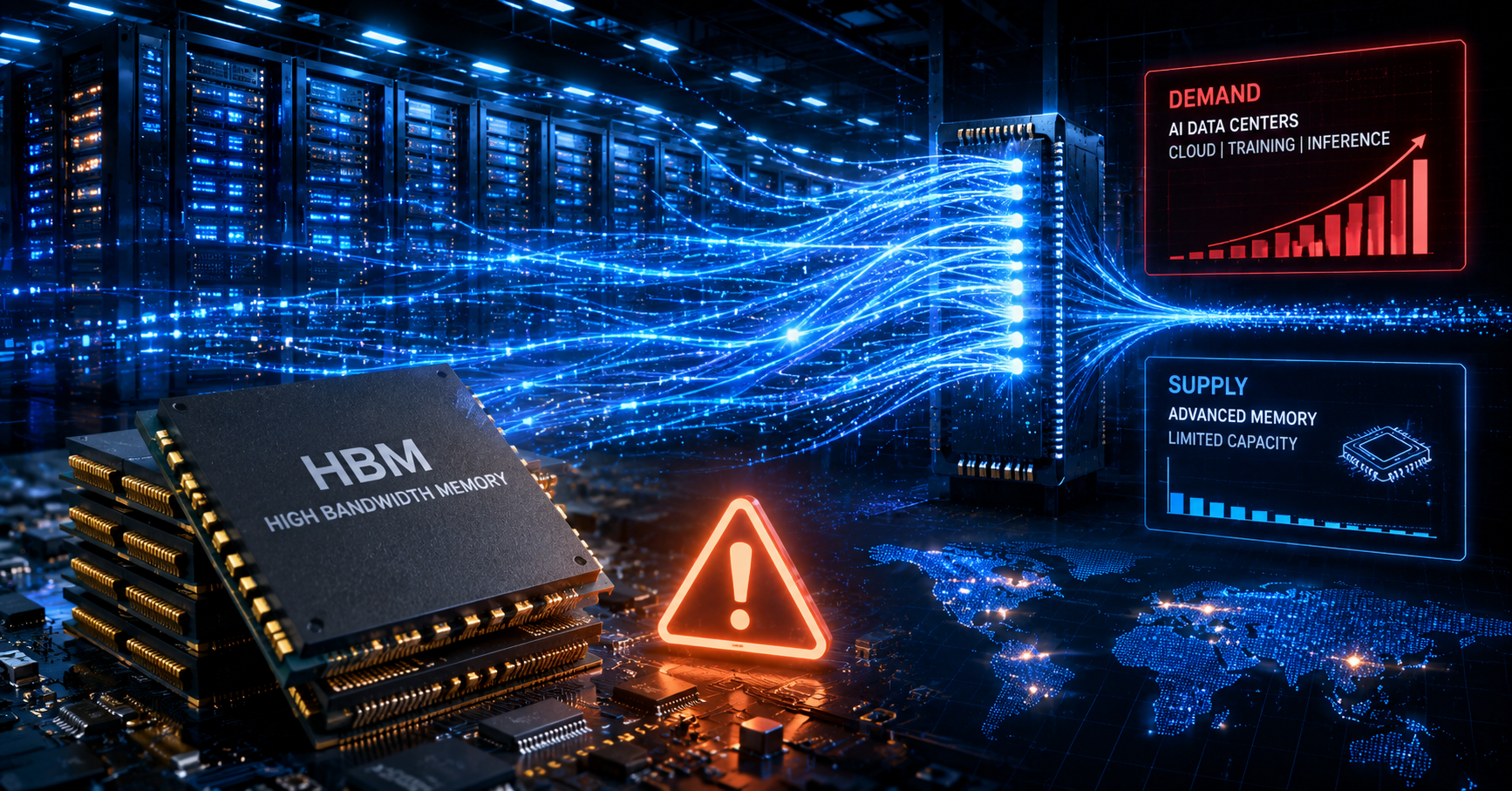
Artificial intelligence has a memory problem.
The world's technology companies are building increasingly powerful AI systems, expanding data centres and deploying enormous numbers of advanced processors.
But those processors need memory.
A lot of it.
Now, one of the world's most important memory chip manufacturers is warning that demand could become far greater than the industry can comfortably supply.
SK hynix CEO Kwak Noh-jung has warned that 2027 could become the worst year for memory supply shortages in the industry's history.
Even more concerning, demand may continue to exceed supply beyond 2030.
The AI revolution is no longer only a race for smarter models.
It is becoming a race for the physical hardware required to keep those models running.
Why Artificial Intelligence Needs So Much Memory
Modern AI systems process enormous amounts of data.
Advanced processors can perform calculations at extraordinary speeds, but they need rapid access to information while completing those calculations.
Memory plays a critical role in this process.
Large AI models repeatedly move huge volumes of data between processors and memory.
If the memory system cannot supply data quickly enough, expensive AI processors may spend valuable time waiting.
This is why high-bandwidth memory, commonly known as HBM, has become one of the most important components in the AI industry.
HBM is designed to move data at extremely high speeds.
As AI models become larger and more demanding, technology companies need increasing amounts of this specialised memory.
The result is enormous pressure on global production.
The Warning for 2027 Is Serious
Kwak Noh-jung's warning is significant because SK hynix has become a crucial supplier in the AI hardware market.
The South Korean chipmaker is a major producer of high-bandwidth memory used in advanced AI systems.
According to Reuters, Kwak expects 2027 to bring the industry's worst-ever memory supply shortage.
He also believes demand could continue exceeding supply beyond 2030.
That suggests the problem may not be a temporary disruption.
The industry could be entering a longer period where memory production struggles to keep pace with the rapid expansion of artificial intelligence infrastructure.
Factories cannot instantly increase semiconductor output.
Building new production facilities requires enormous investment, specialised equipment and significant time.
AI demand can grow much faster than new factories can be completed.
AI Data Centres Are Changing the Chip Market
The rapid construction of AI data centres is reshaping the semiconductor industry.
Technology companies are investing heavily in infrastructure capable of training and operating advanced artificial intelligence models.
These facilities can contain thousands of AI accelerators.
Each accelerator requires access to advanced memory.
Multiply that requirement across enormous data centres and the scale of demand becomes easier to understand.
The pressure does not stop with one facility.
Companies around the world are racing to expand AI capacity at the same time.
Cloud providers, AI laboratories, governments and major enterprises are all competing for advanced computing infrastructure.
The global demand for memory is therefore being pushed by multiple industries simultaneously.
High-Bandwidth Memory Has Become Critical AI Infrastructure
For years, conversations about AI hardware focused heavily on graphics processors and specialised accelerators.
Memory received far less public attention.
That is changing.
An advanced AI processor is only one part of a larger computing system.
HBM allows processors to access data at the speeds required for demanding AI workloads.
As models become more complex, memory bandwidth can become a major performance limitation.
This has transformed memory manufacturers into strategically important players in the AI supply chain.
The companies capable of producing advanced HBM technology are no longer simply supplying another computer component.
They are helping determine how quickly the world's AI infrastructure can expand.
Could Ordinary Computers and Phones Be Affected?
The immediate shortage warning is closely connected to advanced AI memory.
However, pressure across semiconductor manufacturing can have wider consequences.
Chip manufacturers have limited production capacity.
When demand for highly profitable AI components increases, companies must make decisions about where to invest and how production resources are allocated.
That can create pressure in other areas of the memory market.
Personal computers, smartphones, gaming devices, servers and many other electronics rely on memory technology.
Consumers should not assume that every laptop or phone will suddenly become unavailable.
However, prolonged supply pressure can affect component pricing and production planning across the technology industry.
If manufacturers face higher costs, those pressures may eventually influence the prices of finished devices.
Building More Factories Is Not a Quick Solution
The obvious answer to a shortage is to manufacture more chips.
Semiconductor production is not that simple.
Modern chip factories are among the most complex manufacturing facilities ever created.
They require highly specialised machinery, controlled environments, experienced engineers and enormous financial investment.
A company cannot respond to a sudden increase in demand by opening a new production line within a few weeks.
Capacity expansion can take years.
SK hynix and other semiconductor manufacturers are investing in new production capabilities, but the AI market is also growing rapidly.
This creates a difficult race.
Manufacturers are expanding supply while AI companies continue increasing demand.
If demand grows faster, the shortage remains.
The AI Industry Is Discovering Physical Limits
Artificial intelligence often feels like a purely digital technology.
Users type a prompt and receive an answer.
Behind that simple experience is a massive physical infrastructure.
AI requires data centres.
Data centres require processors.
Processors require advanced memory.
The systems require electricity, cooling equipment, networking technology and physical buildings.
Every layer has limitations.
The memory shortage warning is another reminder that AI growth cannot continue based on software improvements alone.
The physical supply chain must grow with it.
A breakthrough AI model can be developed relatively quickly compared with the time required to construct a new semiconductor manufacturing facility.
That difference in speed is becoming increasingly important.
The Biggest AI Companies May Have an Advantage
A severe memory shortage could create another problem.
The largest technology companies often have greater purchasing power and stronger relationships with hardware suppliers.
They may be able to secure long-term supply agreements or invest directly in infrastructure.
Smaller AI companies may find it more difficult to access advanced hardware at competitive prices.
This could widen the gap between the biggest AI companies and emerging competitors.
An AI startup may have talented researchers and an innovative model.
But without access to sufficient computing infrastructure, turning that technology into a large-scale product becomes much harder.
The future AI competition may therefore depend on hardware access almost as much as software intelligence.
Memory Could Become the New AI Battleground
The first phase of the generative AI boom focused on models.
Which chatbot was smarter?
Which system could write better code?
Which model could process more information?
The next phase may increasingly focus on infrastructure.
Companies need reliable access to processors, memory and energy.
Memory manufacturers are becoming central to this competition.
If advanced memory remains scarce, the companies controlling supply could gain even greater strategic importance.
Technology companies may also invest more heavily in memory efficiency.
AI developers could design systems that use hardware more effectively rather than simply demanding more computing resources.
Shortages often create pressure for innovation.
What Happens If the Warning Is Correct?
If 2027 becomes the worst memory shortage in industry history, the impact could spread across multiple parts of the technology sector.
AI infrastructure projects may become more expensive.
Hardware companies could face difficult supply decisions.
Smaller technology businesses may struggle to compete for advanced components.
Consumer electronics manufacturers could experience additional cost pressure.
Investors may also pay much closer attention to memory companies that were previously less visible in mainstream AI discussions.
The situation will depend on how quickly manufacturers expand production and how rapidly AI demand continues to grow.
There is also the possibility that improvements in AI efficiency could reduce some pressure.
But current industry signals suggest demand remains extremely strong.
AI's Next Crisis May Be About Supply, Not Intelligence
For years, the biggest question surrounding artificial intelligence was how smart the technology could become.
The industry may now have to confront a more practical question.
Can the world manufacture enough hardware to support its AI ambitions?
The warning from one of the world's leading memory manufacturers suggests the answer is becoming increasingly uncertain.
2027 is still ahead.
Factories are expanding.
Technology is improving.
AI systems may become more efficient.
But if demand continues growing at its current pace, the next major AI bottleneck may not be an algorithm.
It may be memory.