





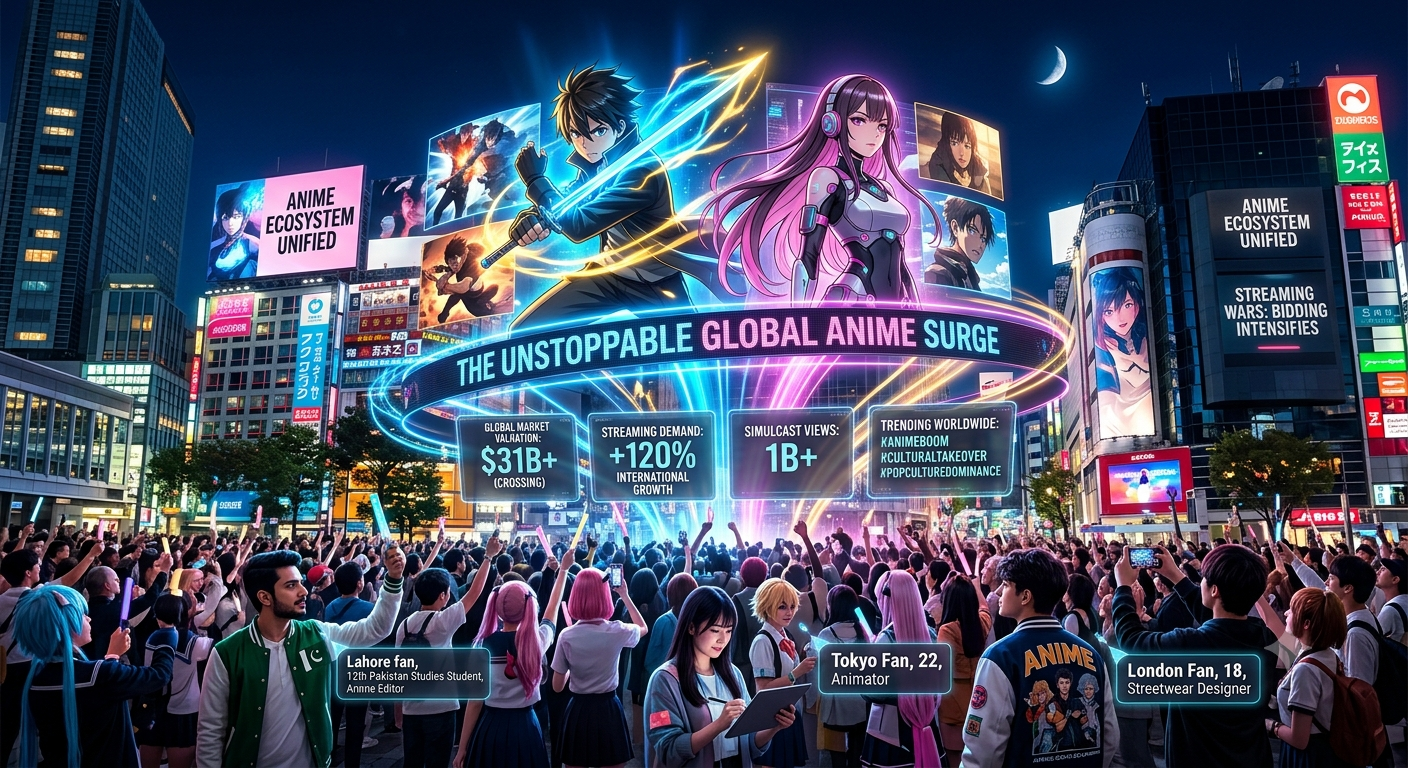
What was once considered a niche form of entertainment enjoyed by a dedicated fan community has now become one of the fastest-growing industries in global media. Japanese animation, better known as anime, has transformed from a regional cultural export into a worldwide entertainment powerhouse. Today, anime dominates streaming platforms, social media, cinemas, gaming communities, and merchandise markets, attracting audiences from every age group and nearly every corner of the world. The rise of digital streaming, globalization, and online fan communities has allowed anime to break language and cultural barriers, making it one of the most influential forms of storytelling of the modern era. Recent industry reports estimate that the global anime market has surpassed $30 billion in value, with international demand growing faster than domestic consumption in Japan. Streaming giants and entertainment companies are investing billions of dollars to secure exclusive broadcasting rights, finance original productions, and expand anime into new global markets. What was once viewed as a niche hobby has officially become a mainstream cultural phenomenon.
The Streaming Revolution Behind Anime’s Growth
One of the biggest reasons behind anime’s explosive global success is the evolution of digital streaming services. In the past, international fans often waited months or even years before new episodes became available in their countries. Today, simulcast technology has completely changed the viewing experience. Major streaming platforms now release new episodes worldwide within minutes or hours of their original broadcast in Japan, complete with professionally translated subtitles and multiple language dubs.
This instant global accessibility has created a truly connected international fanbase. Whether someone lives in New York, London, Dubai, Karachi, or Tokyo, millions of viewers can experience the same episode at nearly the same time. Social media platforms such as YouTube, TikTok, Instagram, Reddit, and X (formerly Twitter) further amplify this excitement through reviews, theories, reaction videos, memes, and fan discussions. As a result, anime trends regularly dominate worldwide social media conversations, generating billions of online interactions every year.
A Style of Storytelling Unlike Any Other
Anime has also gained worldwide popularity because it offers storytelling that appeals to audiences far beyond children. Unlike traditional Western animation, which has historically focused on family-friendly entertainment, anime explores a much broader range of genres and emotional themes. From action, fantasy, science fiction, and romance to psychological thrillers, historical dramas, horror, sports, and slice-of-life stories, anime offers something for virtually every viewer.
Its narratives often feature complex characters, emotional character development, moral dilemmas, and long-term story arcs that span multiple seasons. Rather than presenting simple heroes and villains, many anime series explore themes such as sacrifice, identity, friendship, mental health, perseverance, loss, and personal growth. Combined with cinematic animation, detailed artwork, memorable soundtracks, and emotionally powerful storytelling, anime creates experiences that resonate deeply with audiences of all ages.
A Multi-Billion Dollar Entertainment Industry
Anime’s influence now extends far beyond television and movies. It has become a massive global business that drives multiple industries simultaneously. Successful franchises generate enormous revenue through merchandise, video games, collectible figures, clothing, books, music albums, mobile games, and theatrical releases. Major international brands regularly collaborate with anime franchises to launch limited-edition fashion collections, footwear, accessories, and lifestyle products that often sell out within hours.
The music industry has also benefited enormously from anime’s popularity. Opening and ending theme songs frequently climb global streaming charts, introducing Japanese artists to international audiences. Meanwhile, anime-based video games continue to rank among the world’s best-selling titles, creating even stronger connections between gaming and animation fans.
The Cultural Influence Beyond Entertainment
Anime has evolved into a powerful form of cultural influence that reaches well beyond entertainment. Interest in Japanese language learning has grown significantly as many fans wish to watch their favorite series in their original form. Universities, language schools, and online learning platforms have reported increasing enrollment in Japanese language courses, while tourism to Japan has received a major boost from fans visiting famous anime locations, museums, theme parks, and cultural landmarks featured in popular series.
International anime conventions have also expanded dramatically. Events that once attracted a few thousand visitors now welcome hundreds of thousands of fans annually, bringing together voice actors, artists, creators, game developers, musicians, and cosplayers from around the world. These conventions have become major celebrations of creativity, community, and global pop culture.
Technology Is Transforming Anime Production
Behind the scenes, anime studios are embracing new technologies to improve production efficiency while maintaining artistic quality. Artificial intelligence is increasingly being used to assist with animation cleanup, color correction, background generation, frame interpolation, and production planning. Rather than replacing artists, these tools help reduce repetitive workloads and allow creative teams to focus on storytelling, character design, and visual direction.
Studios are also experimenting with advanced CGI integration, real-time rendering technologies, virtual production techniques, and cloud-based collaboration systems. These innovations are helping productions become faster, more efficient, and capable of delivering increasingly detailed visual experiences without compromising artistic integrity.
The Future of Global Anime
The future of anime appears stronger than ever. Streaming platforms continue to expand their investments, international co-productions are becoming more common, and audiences continue to grow across every continent. Highly anticipated movie releases, new television adaptations, original productions, and live-action collaborations are ensuring that anime remains one of the fastest-growing sectors of global entertainment.
What began as a uniquely Japanese art form has successfully evolved into a universal language of storytelling that connects millions of people regardless of culture or nationality. As technology advances and global demand continues to rise, anime is no longer simply a popular entertainment genre—it has become a permanent pillar of modern global media, shaping the future of storytelling for generations to come.